http://www.cloudave.com

hpdisplay It all started like a routine WinUpdate: downlod 6 updates, install them, then surrender the persistent nuisance and reboot to let Vista do its thing.. then wait .. wait.. coffee .. back.

However, after the successful reboot the system wanted to install a device driver to my monitor.  I thought it was a bit weird (has it not just done it?), but clicked OK, let it search for the driver.  Searching in Windows Update, that is… WTF?

After  a few minutes I decided to check Vista update history: it turns out that the driver update for my HP w2207 display failed to install.  Clicking on all the “help” links led to generic useless nonsense – business as usual…

Continue reading

Tags: , , , ,

My Vista-based laptop gave me the Windows has recovered from an unexpected shutdown screen: this is where you have the options to start Windows normally or select one of several “safe” driver- and service-less modes to boot.  I picked normal, the system booted .. end of story.

Except… I walked away for a little while, and 15 or so minutes later when I came back, the computer was in the same stage.  So I repeated the process… and guess what:

Coming back a little later again, I saw the computer at the ugly reboot screen again.  What was going on?  This is a few weeks old laptop with hardly anything installed on it, is it already dying?

I got lucky: for the first time in my life, Vista’s Problem Reports and Solutions actually found the answer:

After you apply update 973879 on a computer that is running an x64-based version of Windows Vista or of Windows Server 2008, you may receive a "Stop 0×0000007e" or "Stop 0×00000050" error message within 10 minutes after system startup.

Well, not exactly, I dug into what these errors were, and my computer behaved rather differently, basically playing a game of perpetual reboot.  Still, I figured I would go ahead and uninstall this update – I even got lucky, I could simply remove it without having to resort to the more torturous Method 3, that involves a Windows Preinstallation Environment.  (Yuck… I don’t like the sound of it.).

Voila!  My PC is in working condition again… and I just hope in won’t become total crap in the two months left before it gets rescued by Windows 7.


(Cross-posted @ CloudAve)

Tags: , , , , , ,

I don’t normally quote such a huge chunk of a post, but this is a gem:

A couple years ago, after trying nearly everything to get my new Dell to work, I did the unthinkable. I called Dell’s tech support. After giving the service tag and all that other jazz, I explained the problem to the technician.

"According to the BIOS," I said, "my computer has 4GB of RAM installed. But Vista Ultimate only shows 2GB."

"Hmm," the tech responded, "what is this Vissa software you are using?"

"Microsoft Vista Ultimate," I explained, "you know, the new Microsoft OS?"

The rep paused. "I’m sorry, we don’t support third party software. But if you would like, I can help you restore your computer to its original state. Do you have your Dell Resource CD?"

"No, no," I countered, "this isn’t third party software. It is the operating system that came with the computer when I purchased it from you."

"What is the software called again?"

"Microsoft Vista," I said slowly, "Ultimate Edition."

The rep put me on hold for a few minutes and returned several minutes later. "Where did you get this Vissa program? I will see if anyone here has heard of it."

"Well," I wasn’t sure how to respond, "it’s Microsoft’s newest Operating System, and it is called Vista."

"Ooooh," the rep responded, "Vissa! Yes, I understand now."

I just waited for a moment.

"Well Mr. Mike," he said, "this is a problem with the Vissa software. We have notified Microsoft and they have informed us that you can not use more than 3GB of memory with this software. I suggest you uninstall it and install the XP Pro that came with your computer."

"But, my computer came with Vista Ultimate installed on it. It is less than two weeks old."

The technician seemed a little confused, "okay, but I can send you a copy of XP Pro?"

"No thank you," I said, "my friend bought the exact same PC, and his shows the 4GB in Vista, so I don’t think it is a bug."

"I see. So is there anything else I can help you with, Mr. Mike?"

"I would really like to find out how to resolve this," I pleaded, "I read up a little on it on a website, but I cannot make changes to the BIOS with everything grayed out. I was hoping you could help me?"

"Unfortunately we don’t offer support for other software like Bios and Vissa, but we can help you restore your system back to its original configuration if you would like?"

"No," I was started to get agitated, "I really would like see the 4GB in Vista."

Without even acknowledging my request, the rep said "so is there anything else I can help you with Mr. Mike?"

"But can’t you tell me who else I could check with to try and find answer to this problem?"

In the same exact tone, the rep repeated "so is there anything else I can help you with Mr. Mike?"

I said no, and disconnected the call shortly thereafter.

Hilarious.  And yes, I’m pretty sure the story is somewhat exaggerated, perhaps entirely fictional, yet something in the dialogue will no doubt sound familiar to all of us.  The Brainless Stonewalling Machine runs Customer Service in far too many places.

Btw, you should bookmark / subscribe to The Daily WTF.

image

Tags: , , , , , ,

Lenovo, home of the (formerly IBM) Thinkpad’s is not exactly known as a price leader: those Thinkpads have a great reputation and a matching price-tag.  But times are changing, and Lenovo is becoming budget-friendly: the recently announced Ideapad U series, the G550, and the all-in-one Ideacentre are all “cool” computers with an attractive price.  For all my love of Netbooks I admit I got tempted to get my hands on a new Ideapad U350 – basically somewhere in between a superslim notebook and a netbook, for $599 – not a bad price.

And of course getting the free Windows 7 upgrade put me at ease that I won’t be stuck in Vista prison for long…  but wait!  How will I install the upgrade?  Lenovo says:

Each upgrade kit will be mailed separately and contain:

  • Windows 7 Certificate of Authenticity
  • Windows 7 OS Upgrade DVD
  • Lenovo Drivers / Apps DVD1
  • Instructions on how to upgrade the operating system

But there’s a small problem: this unit does not have an optical drive at all – which is all fine with me, in fact I’ve removed it from another, heavier laptop: all I need is a lightweight, portable productivity tool, won’t be watching DVD’s.   Still, the prospect of installing DVD-based software without a DVD-drive is not that heart-warming, so I fired up this email inquiry to Lenovo (after some struggle to find an address):

To: websales@lenovo.com
Date: 07/18/09 10:04
Subject: Windows 7 upgrade for Ideapad U350
I’m considering a U350, but wonder how the upgrade to Win7 will take place since these units don’t have an optical drive. If the upgrade is done via download, does that mean Vista has to remain operational and I can’t get a a ‘clean’ Win7 install?
Thanks a lot,
Zoli

Today I received the following non-response:

Dear Zoli,
Thank you for contacting Lenovo, the makers of ThinkPad and ThinkCentre products.
I understand that you want to know if you can place an order for a U350 and want to know about the Windows 7 upgrade. You also want to know how to upgrade since these computers does not have an optical drive. I request you to please contact our Sales Department to get accurate information about the upgrade and to get help in placing an order,
If you have further questions or concerns, please feel free to contact us at 866-42-THINK (84465) option number 2. We will be happy to assist at that time.
Once again, thank you for contacting Lenovo.

What load of crap!  Why should I call Sales Department?  Doesn’t his email address read Websales?  Customer Service 101: respond at the channel you were contacted at.   And it’s not like I am asking for a very difficult, individualized answer: in fact my question is so obvious it should have been answered as part of the Win& FAQ @  Lenovo’s website.

Serious loss of credibility… what kind of support can I expect when I have real problems?

(Cross-posted from CloudAve)

Tags: , , , , , , , ,

Fellow Windows Vista victims, there’s light at the end of the tunnel: we may soon set ourselves free and only have to pay a $50 ransom.  I just did. 

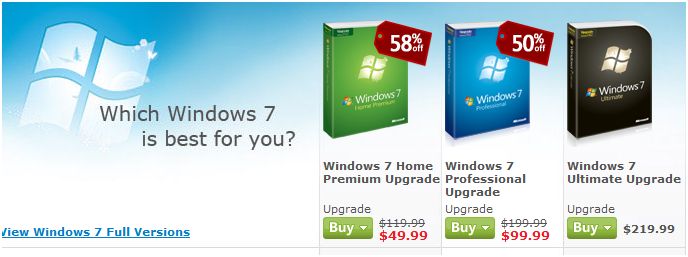
The $50 ransom is not a bad deal. Forget the myriad of Win7 SKU’s and whopping prices all the way to $319.99.  I’m calling BS: the real standalone Win7 price is $50 or $100.  Period.

Continue reading…

Tags: , , , , , , , , , , , ,

*chirp (won’t that asterisk in the front backfire with some search engines?) is supposedly the best, cutest, Twhirl-killer mother-of-all Twitter Client.  Except it’s Dead On Arrival. Read the full story here…

..and in the meantime a little consolation prize:

Tags: , , , , , , , ,

Put the last nail in the Vista coffin.  Windows 7 is on the fast track.

- good summary of the Windows situation by Signal to Noise.  Yes, Win 7 Beta will be available for download starting tomorrow, and it promises to be less of a resource hog than Vista.  Microsoft also talks about providing free upgrades to Windows 7 for Vista users – at least those who buy Vista after July 1st.

Good start, but not enough. The upgrade assurance is vital for both Microsoft and more importantly its OEM partners, the computer manufacturers to avoid a slump in computer purchases while waiting for the next OS.

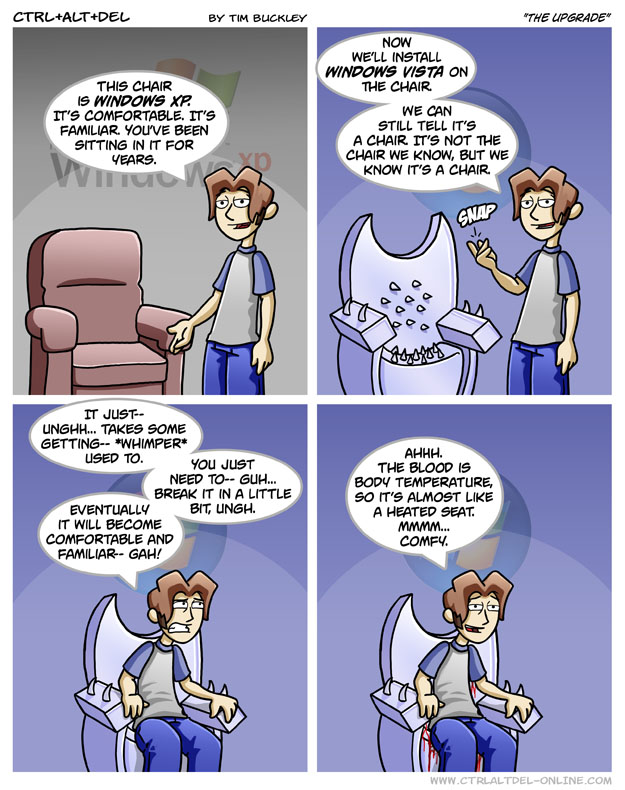
But let’s not forget what Win 7 really is: it’s Vista Final.  As it has been widely discussed, Win 7 does not have a new kernel, it’s all about lots of incremental improvements to Vista.  In other words, it’s a Vista that works – using the Microsoft lingo perhaps it should be called Vista SP3.

Make no mistake, the accelerated move to Windows 7 is a marketing decision, not a technical one. Vista became such a disaster that Microsoft finally realized no amount of marketing can save it: it was better the abandon the shipwreck and start with a clean slate, a “new” Windows product.

But that leaves millions of Vista victims behind, who did not want to by this junk, but had no other choice when they bought their computers.  I’ve repeatedly said that Windows 7 should:

  • Be released as  Vista Final (meaning it works)
  • Be provided as a free upgrade to Vista
  • Come with a  letter of apology to all Vista victims

OK, I know … fat chances for the letter of apology.  But I am serious about the upgrade: customers who paid for Vista deserve a working (SP3-level) OS.  Abandoning those millions would be akin to a hit-and-run on a mass scale.

Update:  Finally, I don’t feel alone anymore: Jason Perlow @ ZDNet agrees: Windows 7 Should be a Fixta Free For All:

…since Windows 7 is essentially a performance and usability fix for a defective product, I’m of the increasing opinion that a Windows 7 upgrade should be free to anyone who was conned into buying Windows Vista.
Related articles by Zemanta

(This post originally appeared on CloudAve. – to stay on top of Cloud Computing news, analysis and just our opinion, grab the CloudAve Feed here.)

Tags: , , , , , ,

If you love Windows XP, you’ll hate Windows 7 – says Ed Bott on ZDnet.  Windows 7: Mojave My Ass –complains Jason Perlow. Dwight Silverman confirms: Sorry, but Windows 7 isn’t a return to Windows XP, while others don’t refrain from some name-calling.

Sorry guys, you’re all wrong

You’re debating the merits of an operating system based on it’s UI.  Sure, if you migrate from XP to Win7, some of the changes can be confusing – but it’s an initial change, the learning curve is not that steep.  I actually side with Ed Bott here, the search box to launch programs is a more user-friendly approach than having to remember the names of all *.exe files a’la XP. 

But it does not really matter.  Mojave my ass?  Mojave was a bogus experiment (in fact a PR blitz dressed up as an experiment) showing happy “users” who liked the Vista UI – but hey had no chance to assess what fails in a short demo, and that’s what doomed Vista, not appearances.

Windows in all flavors, be it XP, Vista or 7 is not an application.  It’s a friggin’ operating system whose job is to get us into applications and get out of the way.  In today’s flurry of blog posts Adrian Kingsley-Hughes has the right approach, presenting performance tests – yes, performance is key to judging how good an operating system is.

The other key criteria is how invisible it stays. Think about it: any time you have to get down to OS level typically means something does not work right.  It’s the stupid unexplainable little things like:

  • Vista and XP computers not finding each other on a home network until you apply an undocumented patch to the XP machines
  • Simple copy or delete operations taking forever
  • Not being authorized to move / delete files on my own computer even after elevating to Admin mode, killing UAC and a number of weird cryptic options that take an IT deapartment to deal with, not a home user
  • Windows upgrade failing if more than 3GB memory is installed
  • The latest Windows upgrade causing printer and camera drivers from several vendors reinstall themselves (some take 30 minutes or more, kinda big deal)
  • …

The list could go on, but I think you get my drift:  Windows 7 (and any other OS) will be judged on how well computers will run, let users interact with real application without having to touch the OS itself.

Finally, to address the speculation about Windows 7 upgrade paths, let me just reiterate this:

  • Win7  should be released as  Vista Final (meaning it works)
  • It should be provided it as a free upgrade to Vista
  • It should come with a letter of apology to all Vista victims

OK, I know we have fat chances for the apology – but I really mean the free upgrade part.

(Cross-posted from CloudAve – to stay on top of Cloud Computing news, analysis and just our opinion, grab the CloudAve Feed here.)

Tags: , , , , , , , , , ,

Hardly a day goes by without another new Netbook announcement, at lower and lower prices.  The first baby eee PC by ASUS was toy-like ( I returned it after a day), but the current crop are quite usable mobile computing devices. 

These new Netbooks are flying off the shelf, so much so that sometimes you wonder if manufacturers rush to re-label their notebooks to netbooks, just to ride the wave.  Whereas the first model had a puny 7” screen, the current standard is a minimum of 8.9, but 10” is becoming widely available, and when Dell recently announced their Inspiron Mini 12, ZDNet’s Larry Dignan rightfully noted that the netbook-notebook-laptop lines have just become blurry.

Dell’s divider line may very well be at the 12” screen size, considering anything beyond that a notebook.  ASUS CEO Jerry Shen clearly draws the line at 10” – a definition that fits his own eee PC line.  I think all these size-based definitions are meaningless. Size truly matters, but for another reason: when you pick a travel n*tbook,  you clearly need something small and lightweight, yet with a decent keyboard and screen.  But that’s not what differentiates Netbooks from any other computer.

The real divider is how you use it.  A Netbook is a light mobile computing device that allows you to process information, access the Internet, and that does not store a bundle of bloated programs or data

When computers first became personal, most of us only got one at the workplace, then years later the family PC appeared– one expensive computer shared by the entire family.  Now we often have individual PC’s for just about anyone at home, including the kids, and are moving to a new pattern, where individuals will have a number of purpose-oriented computing devices, be it a desktop, workhorse laptop, netbook or smartphone.  The fundamental change is that we’re not really working on the computer itself, but on the Net: the computer (keyboard, screen) is just our way to access the net. As Coding Horror’s Jeff Atwood says in The Web Browser is the New Laptop :

After spending some time with a netbook, I realized that calling them "small laptops" is a mistake. Netbooks are an entirely different breed of animal. They are cheap, portable web browsers.

We’re getting to the point where for most productivity task the computer’s performance or even the operating system won’t matter anymore: all we need is a decent screen and keyboard to get online. 

But computer manufacturers while jumping on this hot new trend, seem to be confused.  Minor flavors aside they typically offer two major configurations:

  • The uber-geek netbook:
    • Linux
    • Solid-state drive (SSD)
  • For the rest of the world:
    • Windows XP
    • Traditional hard drive

That’s not a very smart combination, if you ask me.  Statistics show the return rate of Linux vs. Windows based netbooks is 4 to 1. Buyers of the cute little netbooks are happy first, then they become frustrated that they can’t instantly do things they are used to – and a learning curve with a $400  $200 device is unacceptable.  Let’s face it, Linux is not friendly enough for most non-geeks – including yours truly.  But why can I not have a netbook with XP and SSD?

Typical netbook SSD’s are still in the 8-16GB range, while harddisks are up to 160GB.  That’s a trap that vendor themselves fall into: my sexy little netbook (an Acer Aspire One) came loaded with crapware, including trial versions of MS Office, MS Works, Intervideo WinDVD (on a DVD-less computer!) and who knows what else.  Once the pattern is established, and you have large storage, you will start installing your own programs and data, too, the temptation is just too hard to resist.  You no longer have a netbook, it just became a noteboook.

The New York Times ran an article this week: In Age of Impatience, Cutting Computer Start Time, discussing the problem of slow boot times.  Anyone who ever had a Windows computer knows this tends to get worse over time.  My own Vista desktop had a sub-minute startup time a year ago when new, not it takes 3-4 minute to boot it.  The two older XP-based laptops take 6-7 minutes to reboot.  This well-known Windows disease can only be cured by refreshing your system from time to time. It’s an ugly process, requires wiping out your harddisk’s content, re-installing Windows, then your programs and data.  PC manufacturers don’t exactly help by providing “restore disks” instead of proper OS CD’s: why would you start with a pre- SP1 copy of WinXP and reinstall a bunch of years-old obsolete crapware   when the objective was to cleanup your system in the first place?

If you want to avoid the pain, keep your netbook free of applications and data: use it as a NETbook, and it will stay nimble and fast (sort of).

Talk about fast, there’s a neat solution to reduce boot-up time: Splashtop, a quick-load platform by startup company DeviceVM can put you online within seconds, without loading the main operating system. Chances are you’d be using it 80% of the time, relegating full Windows to an as-needed basis.  DeviceVM charges manufacturers about $1 per system, so why is it that it’s often found in high-end notebooks, but not in the netbooks by the same manufacturer?   Splashtop should be a must on any netbook.

 Finally, a word on connectivity and prices:  Wifi gets you online almost, but not all the time, so obviously a 3G connection is a useful addition to your netbook.  But you will pay for 3G data usage, so why don’t carriers subsidize your netbook purchase, like they do with cell phones?   The day will come, as the WSJ reports, HP may be one of the first to introduce such a model:  H-P Mulls Service Bundles for Netbooks. When that happens, your notebook will not be too different from a smartphone, just with a larger keyboard and display.


(Cross-posted from CloudAve.)


Related articles by Zemanta

Tags: , , , , , , , , , , , , , , , , ,

For two days in a row TechMeme was overflowing with Microsoft news coming out of PDC: Azure, Windows 7, Web Office (whatever the MS name will be).   But on the very day that supposedly all belonged to Microsoft there was a stream of seemingly unrelated items on TechMeme all pointing in the same direction, none too good for Microsoft.

Joe Wilcox @ Microsoft Watch declared that Windows Vista No Longer Matters :

Contrary to ridiculous assertions recently made by Microsoft CEO Steve Ballmer, Windows Vista is a flop. If businesses aren’t buying Vista, after waiting six (now seven) years, it’s no success. Yet, during the last day of the Gartner 2008 expo 10 days ago, Steve asserted that Vista “has been extremely successful.”

Success in terms of revenue does not mean actual product acceptance.  The fact is, most of the Vista revenue comes from consumers, not the corporate Market.  Consumers don’t intentionally buy Vista, they buy computers: good luck trying to buy a system without Vista on it – unless it’s a Mac or the refreshingly new category of Netbooks.  And if you cough up the extra $50-$99 most OEM’s charge you to “downgrade” to XP, it is still booked as a Vista sale!  Like I’ve said before, don’t be blinded by Vista sales numbers.  No wonder MS omitted the Vista licence count during last week’s earnings announcement.

PDC has shown that Microsoft is now eager to forget about Vista, a bad dream, fully focusing on Windows 7.   They must have realized that no multi-million-dollar marketing campaign can fix Vista’s badly tarnished reputation.

Where public opinion is more divided is whether this was just a perception issue, or actual product problems.  Count me in the latter camp – no Mojave Experiment can convince me otherwise.  The problem with Vista has never been appearance, or features as originally designed: it’s the zillions of inconsistencies, little things that fail every day turning us Vista-users into Vista-sufferers.

The stream of messages coming out of PDC appear to confirm this: it’s clear that Windows 7 does not mean major architectural, infrastructural changes – that’s what Vista did.  Win7 is all about the user experience – in other words, putting the finishing touches on Vista.  I said over a year ago: we don’t need another desktop OS.  But I guess I am OK with Windows 7, provided Microsoft:

  • Releases it as  Vista Final (meaning it works)
  • Provides it as a free update to Vista
  • Attaches  a letter of apology to all Vista victims (yeah, fat chances…)

Whether it’s Vista or Windows 7, almost doesn’t matter – it will likely be the last major desktop OS MS releases, and as such it represents the end of an era.  Obviously Microsoft themselves recognizes it (finally!), this years PDC is all about moving to the Cloud, be it the Azure initiative, or the announcement of moving Office to the Web.  (To be precise it’s the announcement of a future product announcement).

This trend will only be accelerated by the shift in what devices we use for our (cloud-based) computing needs.  Time to Leave the Laptop Behind – says The Wall Street Journal, joined by Coding Horror’s Jeff Atwood who declares: The Web Browser is the New Laptop.  Every day another Netbook is announced, at lower and lower prices, and they change how we access information forever.  I’ll be devoting the next post to this subject, in the meantime leaving you with another post from Henry Blodget:  Microsoft Windows: The Beginning of the End.

(Originally posted @ CloudAve)

Tags: , , , , , , , , , , , ,

Theme Tweaker by Unreal