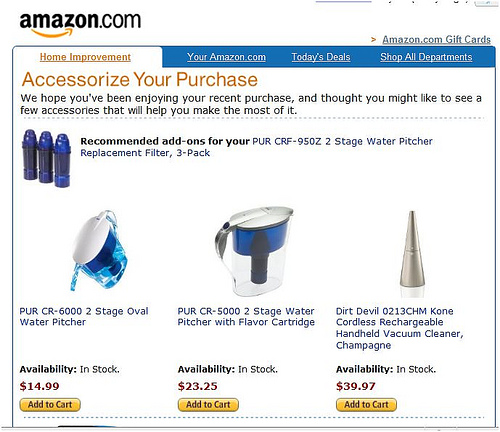
I think this email promo I’ve just received from Amazon after purchasing the replacement filters (first item shown) speaks for itself.  I guess if I had bought a kitchen sink or some furniture, they would offer a house as accessory.smile_regular

Tags: , ,

If you think this is yet-another post on Platform as a Service, you’re wrong.Ā Ā  I’ll be talking about much simpler things here:

  • PaaS – Pasta as a Service
  • TaaS – Tea as a Service
  • GaaS – Groceries as a Service

No kidding.Ā  Well, maybe a bit, but this is about real business – also the focus of a recent article by Fortune: Amazon’s next revolution, discussing the early days as Earth’s Biggest Bookstore, then moving on to other businesses, and now Kindle-izing our reading habits while revolutionizing the publishing industry.

So let’s talk about retail, from the consumers’ point of view, examining how Amazon changed our shopping habits and is on the way to becoming the default vendor for just about everything we buy.

Read on …

Tags: , , , , , , , , , ,

Amazon will soon start selling wine, reports the Financial Times.   Too bad it’s based on an obsolete model: physically shipping bulky goods.  It’s like shipping boxed software, when it’s available on the Net.  Or bulky books when it’s available on Amazon’s very own Kindle.

It’s time Amazon entered the 21st Century, the age of Waas: Wine as a Service.

(Watch the video here in case the embedded player does not work in your feed.)


Related posts: TechCrunch


Tags: , , , , , , ,

It’s rare that I get into a public debate with a fellow Enterprise Irregular, but today is the day:

Michael Krigsman at ZDNet’s Project Failures cites the stellar response by Technorati as exemplary customer communication at a time of system failure that Amazon should learn from.

True, Amazon did not shine (that’s an understatement) when S3 went down earlier today. I’m sure Amazon will work on not only improving infrastructure, but communication – like Salesforce.com did after their major outage, establishing an Health Monitor, reminds us Lassy Dignan at ZDNet.

True, Technorati was exceptionally forthcoming in that particular incident – but the emphasis is on exceptionally, which is why I would not set them as role model for quite a while. Infrastructure problems have been the constant state of affairs for Technorati for years, the Technorati Monster is still at large, and most of these problems have been swiped under the carpet. In fact when they recently removed old posts from their online index without any notification, they explicitly stated they hoped most users wouldn’t notice.

I salute Technorati on their new approach to transparency, if it holds – but they are very, very far from being a role model.smile_sad

Tags: , , , , , ,

TechMeme is great in threading together relevant posts, but is largely based (so I think…) on direct linking, so of course it could not auto-detect the ironic relationship between:

Phil quotes Greg Olsen, CTO of Coghead, a web-based development platform which moved its servers to the Amazon infrastructure recently:

ā€œAs ironic as it may be, we continue to see software applications deployed as a service but which fail to use any service-based infrastructure themselves”

“The move to SaaS applications built on SaaS is a much more profound shift than the move from on-premise applications to SaaS applications …”

“Ironically, some of the first victims of this new economy may be some pioneers of the software-as-a-service movement. Today, many established SaaS application providers are applying much more of their precious focus and capital to infrastructure issues than newer competitors that are aggressively utilizing service-based infrastructure … the build-it-all-ourselves SaaS application vendor … will ultimately end up as [an] anachronism.ā€

Today’s Amazon outage appears to rebuff Phil and Greg’s point. Reality check: this is the first time Amazon S3 went down, and it’s already back up. Salesforce.com had its fair share of outages, so did other SaaS providers, and so did just about any in-house systems companies run their own installed software on. I’m a big believer in focus, specialization and I trust the few mega-cloud companies that will emerge can maintain a more robust infrastructure than we could all do individually. (So yes, if it’s not obvious, I do buy into Nick Carr’s Big Switch concept.)

Another approach is to look at where value can be added: the consensus view from a quick Enterprise Irregulars chat is that infrastructure will be commoditized faster (or it already is) than software, where there is a lot more room for innovation by new and – thanks to outsourced infrastructure – smaller players.

And if acronyms were not ugly enough already, here’s to entering the age of SaaS-on-SaaS. smile_shades

Update: What better confirmation of my point than today’s rumors about EMC hosting  SAP’s system  – I assume it’s Business ByDesign, the new On-Demand offering for the SMB market. (Side-note: I’ll be traveling and be time and Internet-challenged for the next three weeks, but SAP’s BDD is one of the subjects I will come back, as it seems to be largely misunderstood. Oh, and I just love the fact how Mozy, my favorite online backup service is often referred to in the EMC story).


Related posts (on the Amazon outage): Rough Type, mathewingram.com/work, LinkFog, Data Center Knowledge, Web Worker Daily, TechCrunch, Moonwatcher, Project Failures, SmoothSpan Blog, Enterprise Anti-Matter.

Tags: , , , , , , , , , , , , , , , ,

Amazon vs. Google?

SaaS, Technology January 31st, 2008

A few years ago this would have been a crazy question. A bookstore against a search engine? Apples and oranges… not anymore. Still, we’re more used to pitting Google against Yahoo, Amazon against eBay. But think about it:

Adoption of Amazon Elastic Compute Cloud (EC2) and Amazon Simple Storage Service (S3) continues to grow. As an indicator of adoption, bandwidth utilized by these services in fourth quarter 2007 was even greater than bandwidth utilized in the same period by all of Amazon.com’s global websites combined.

The above quote is from Amazon’s earnings release. There are more then 330,000 developers registered to use Amazon Web Services. Some of these new Web 2.0 offerings will actually take off, in fact some will get mass adoption. That translates to tens of millions of users whose online activity flows through Amazon, and this is where Google comes in the picture.

Forget Search, Google is the world’s primary Advertising engine. They need to have (I did not say own!) all our data. Nick Carr is right:

For Google, literally everything that happens on the Internet is a complement to its main business. The more things that people and companies do online, the more ads they see and the more money Google makes. In addition, as Internet activity increases, Google collects more data on consumers’ needs and behavior and can tailor its ads more precisely, strengthening its competitive advantage and further increasing its income.

The business models are different: for Google everything you do is secondary (and largely free to you), since they make their money on the ads, while Amazon directly charges for their individual services (albeit not much). Amazon will have tens of millions of users, and Google wants them, too.

If we buy into Nick Carr’s “Big Switch” vision of utility computing (and I do), are these two giants competing to become “The Cloud computer”? Or perhaps one of the 5?smile_wink

Related posts: ReadWriteWeb, TechCrunch, Between the Lines, Data Center Knowledge, ProgrammableWeb.

Tags: , , , , ,

Tax-time is soon upon us, and for millions of Americans that means buying TurboTax again.  Fastest way to get it? Download from Intuit. Cheapest way to get it?  Buy at Costco. 

Not anymore. This year the fastest AND cheapest way is to download it from Amazon. Yes, Amazon entered the software download business, although initially the only available products are the different TurboTax flavors.


The traditional, box-sale page points to the download version, claiming you will “save time and money by downloading” software.  Well, not quite. The downloadable version of each product is priced to match the boxed product+shipping charges. This is a missed opportunity, there are obvious savings from not having to manufacture, ship and store a tangible product, so they could afford to create financial incentives to move more customers to the download option.  (Note: “they” means both Amazon and TurboTax maker Intuit, which also offers the box and download at identical prices.)

There’s one thing I really, really don’t like about this new Amazon service:  before you can purchase anything, you need to download and install the “Amazon Downloader”, which in turn will download and install the actual product. Now,  I don’t know about you, but I certainly am not buying software frequently enough to justify the need for a client, whatever benefits(?) this approach may offer. And of course once you install software, you know you’re in for a lifetime of endless updates…smile_baringteeth

If you ever need to download your purchased software again, it’s available under a new section called ā€œYour Media Library.ā€  As Mashable’s Adam Hirsch discovered, this is a lot more than just a listing of your digital purchases: you can list all purchases from Amazon and other sources, adding your items by simply scanning their barcode through your webcam, Amazon will convert and import the information automatically . There are a number of ways to share all this with friends, start discussions, tag items, subscribe to your friends’ collections via RSS, and follow what’s hot at any time.

If you think this is all similar to FaceBook’s Beacon, that’s because it is. With a significant difference: Amazon’s version is entirely opt-in. 


Related posts: Download Squad, Mashable, Windows Connected, Web Worker Daily.

Tags: , , , , , , , ,

Ugly

Technology November 18th, 2007

OK, OK, I get it… it’s the Future of Reading. It will change the world. Yet it’s undeniably ugly.smile_sad

“This isn’t a device, it’s a service.” True, this is a much more compelling package than the Sony Reader was, but at least that other, “dumber” device had style.

I can’t help but compare to the Seiko-Epson electronic paper display (see below) announced days ago: sheer elegance. Yes, I know, it’s not a complete product, just a display… but somehow I can’t see them turn this display into something that looks like a kitchen appliance. smile_tongue

Dan Farber says:

It’s enough to make Gutenberg stir in his grave and to make Steve Jobs envious

Well, certainly not for the design…

Aesthetics aside, Anne Zelenka makes a really good point:

Wouldn’t it have been cool if Amazon built an e-book reader so inexpensive they could almost give it away for free, then make money by selling e-books for people to read on it (or selling upscale versions of the reader later)? Instead, they stuffed it so full of technological wizardry that it costs $399.

Most people have no idea if they’d really like to use an e-book reader or not. It may be something you just have to experience to grasp. But who’s going to experiment with electronic book reading when the price of entry is so high?

Amazon’s Jeff Bezos says:

ā€œThis is the most important thing we’ve ever done..It’s so ambitious to take something as highly evolved as the book and improve on it. And maybe even change the way people read.ā€

Something tells me it will take a price-cut to pursue that ambition…

Update (11/4): Mea Culpa for missing the point. It’s ugly with a purpose :-)

Tags: , , , , , , , ,