MinTuit: What’s Next After the Intuit / Mint Deal
Business, SaaS September 14th, 2009
TechCrunch50 could not have asked for a better start: they get to announce that personal finance startup Mint winner of the $50K grand prize @ TC50 two years ago just got acquired for $170M.
Great exit for a startup – not so sure about concerned users. But the big question today is why it made sense for Intuit and what the future holds for Mint and its users. The consensus is that first of all this has been a defensive move. Mint started to bite into the Intuit / Quicken pie, and Intuit just had to stop it.
There is some irony in this deal: the playbook had been written by Microsoft, against Intuit.
Continue reading …
Tags: acquisitions, aggregation, benchmarking, data mining, intuit, intumint, mergers, microsoft, Microsoft Money, mint, mintuit, money management., MS Money, Online Banking, personal finance, PFM, quickbooks, quicken, SaaS, Wesabe, xref
The Cat is Out of the Bag (Again): The Not-So-Hidden Business Model in SaaS
Business, SaaS June 1st, 2009
Forget software: it’s all about (your) data.
Hyper-growing Financial Management system provider and Quicken / MS Money challenger Mint recently raised eyebrows announcing their plan to sell anonymized aggregate customer data. Some reviewers were screaming, we saw bombastic titles like Personal Finance Startup Mint Wants To Sell Your Money Trail – but in reality the news wasn’t earth shattering. You don’t really believe your spending patterns are not dissected – aggregated – analyzed in every possible way and sold by your bank and credit card company, do you?
So nothing new – but a good opportunity to discuss the role of user data in SaaS business models – and there is more than outright sale of data.
Read more …
Tags: aggregate data, benchmarking, business model, data ownership, data privacy, freshbooks, mint, saan, SaaS, xref
Benchmarking the Benchmarkers
SaaS, Startups August 22nd, 2008

I’ve repeatedly praised Web-based Invoicing service FreshBooks for being innovators, unveiling the hidden business model enabled by SaaS: benchmarking. But who’s benchmarking the benchmarkers?
Competitor Xero has just issued a call looking for benchmarking partners comparing metrics like:
- Customer acquisition rates
- Teaming model and allocation of spend
- Sales and marketing spend
- Sales quotas
- Google spend
- Pipeline conversion
CEO Rod Drury is looking for 5-10 partners, communicating either directly, or through a trusted third party. Either way, its quite a challenge, as unlike the aggregate anonymous data Freshbooks provides to their customers, this level of sharing requires quite a level of trust.
Interestingly I contemplated similar ideas just a few days ago when Zoho CEO Sridhar Vembu published his margin analysis of Google, SAP, Oracle, Microsoft and a few others. He drew a conclusion that since Google’s current revenue and profit per employee metrics were much higher than even the best players in the application space, Google has little incentive to move into this space forcefully. (He then followed up with a What’s in it for Zoho? post)
Specific conclusions aside, I thought it would really be interesting to expand this spreadsheet buy including Zoho and comparable companies as well as additional metrics. Needless to say I ran into a similar dilemma that Xero is facing now: these are private companies that don’t typically publish their financial results, to get them participate we would need a relatively larger sample and it would still require a leap of faith.
Rest assured I’ll be watching Xero’s experiment with great interest.
Related posts:
- Benchmarking: No Longer the Hidden Business Model in SaaS
- SaaS Will Never Be the Same – Again
- Freshbooks Launches Benchmarking Service: SaaS Will Never Be the Same
- The “Hidden” Business Model in SaaS: Benchmarking
- SaaS: The Cat is Out of the Bag
Tags: accounting, benchmarking, billing, freshbooks, Google, invoicing, SaaS, xero, zoho
Benchmarking: No Longer the Hidden Business Model in SaaS
Business, SMB / SME, SaaS April 9th, 2008
The cat is out of the bag – was my first reaction when FreshBooks announced the launch of their new benchmarking service in October 2006. Then, and later I called it the hidden business model in SaaS:
He basically announced the hidden value proposition enabled by SaaS: competitive benchmarking. All previous benchmarking efforts were hampered by the quality of source data, which, with all systems behind firewalls was at least questionable. SaaS providers will have access to the most authentic data ever, aggregation if which leads to the most reliable industry metrics and benchmarking.
With Google’s entry today, benchmarking is no longer the hidden business model: it has just gone mainstream. Potentially great value added service, a new revenue source for the provider, which may even allow them to give the core service away for free.
Give away? Do you think I’m smoking something? Read Jeremiah Owyang who predicted that storage companies will (?) eventually pay for your data. ![]()
Related post: Dennis @ AccMan Pro,
Tags: benchmarking, freshbooks, Google, SaaS
SaaS Will Never Be the Same – Again
Business, Enterprise Software, SaaS December 4th, 2007
The first time I said SaaS would never be the same was referring to Freshbook’s launch of their benchmarking service:
It’s *the* hidden business model enabled by SaaS. An opportunity not talked about, but so obvious it has to be on the back of all SaaS CEO’s mind. Benchmarking is a huge business, practiced by research firms like Forrester, Hoovers, Dunn and Bradstreet, as well as by specialized shops like the Hackett group – none of which are affordable to small businesses. More importantly, all previous benchmarking efforts were hampered by the quality of source data, which, with systems behind firewalls was at least questionable. SaaS providers will have access to the most authentic data ever, aggregation if which leads to the most reliable industry metrics and benchmarking.
Hosting customer data offers a lot more opportunities, beyond benchmarking. Tomorrow CRM provider Salesforce.com will launch a new service called Salesforce to Salesforce (S2S) that facilitates the sharing of data between customers -reports TechCrunch. I believe, just like Freshbook’s move, the ramifications of this new Salesforce service will go way beyond the immediate opportunities it brings to customers ( not that those are negligible: see first reaction by Echosign CEO Jason Lemkin, another business innovator in my book.)
This is a first step in a paradigm-shift: while current concerns about SaaS mostly focus on the security, privacy, and consequently isolation of business data, eventually a culture of controlled sharing for business benefits will develop. Forget CRM; think of more complete business suites, like NetSuite, or when it really kicks in, SAP’s Business ByDesign, the most comprehensive SaaS business suite ever. Procurement, manufacturing, inventory, resources…etc data – can you envision the improvements in Supply Chain visibility? SaaS will never be the same – again.
Update (12/5): Larry Dignan at Between the Lines sees the same opportunity:
Today, the service is predictably focused on sharing sales lead and CRM-type information. But as Salesforce.com grabs more large customers its possible that the latest service could be used to exchange supply chain information and link other business processes.
Tags: A1S, benchmarking, business bydesign, crm, data security, data sharing, freshbooks, netsuite, On-Demand, privacy, SaaS, salesforce.com, sap, sap bbd
Freshbooks Launches Benchmarking Service: SaaS Will Never Be the Same
Business, Collaboration, Personal Productivity, SMB / SME, SaaS, Software, Startups, Technology April 16th, 2007
Way back at the Office 2.0 conference FreshBooks CEO Mike McDerment dropped a bomb in the last 20 seconds in his presentation: being software as as service, they can aggregate customers’ data, categorize it by industry, size ..etc, and once they do that, why not turn it into a service, providing customers with their own performance metrics as well as benchmarking them against their peers.
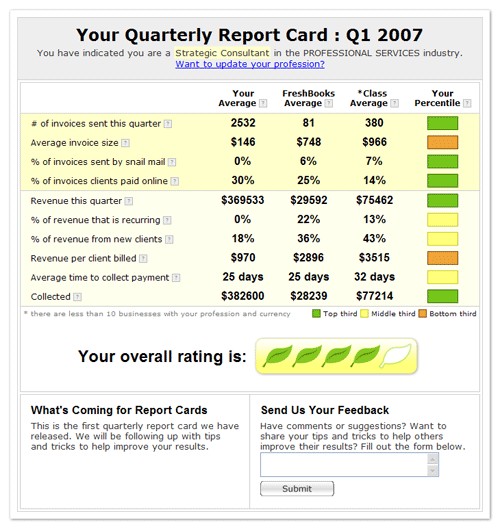
A few months later, the Small Business Report Card service will launch tomorrow at the Web 2.0 Expo as well as online. The service will be free to all Freshbooks customers, who will:
- all receive their own performance metrics, and
- if they select their peer group based on (currently) 80 types of business / professions, geography and several other business criteria, they will also receive their relative position, “score-card” within that group.
The sample below is a mock-up of the actual Report Card, but is shows the initial metrics reported. Clearly, as they further enhance the program, there will be more and more criteria, and FreshBooks customers will have a say in what performance metrics they find valuable.

Remember, FreshBooks’ customers are mostly small businesses who don’t have an army of MBA-types crunch the numbers and look for business (in)efficiencies. In fact it’s probably fair to say some would not even know how to interpret the numbers, until they are put in prospective – hence the value of relative benchmarking.
But why will SaaS never be the same? This isn’t just about FreshBooks and its customers.
It’s *the* hidden business model enabled by SaaS. An opportunity not talked about, but so obvious it has to be on the back of all SaaS CEO’s mind. Benchmarking is a huge business, practiced by research firms like Forrester, Hoovers, Dunn and Bradstreet, as well as by specialized shops like the Hackett group – none of which are affordable to small businesses. More importantly, all previous benchmarking efforts were hampered by the quality of source data, which, with systems behind firewalls was at least questionable. SaaS providers will have access to the most authentic data ever, aggregation if which leads to the most reliable industry metrics and benchmarking.
Being pioneers always carries a risk, and clearly, Freshbooks will have to keep an eye on their customers feedback. There may be a backlash due to data privacy/ownership concerns; some customers will not opt in, they may even lose some customers entirely. But I believe the majority will see the light and benefit from the service. If Mike’s blog post on the subject is any indication, the feedback there was overwhelmingly positive, with 13 comments for, 3 against.
I suspect a year or two from now benchmarking based on aggregate customer data will be standard industry practice, and little (?) FreshBooks will be looked upon as the pioneers who opened up the floodgate of opportunities.
Last, but not least a word on the creative launch – or a lesson on how to launch from a conference you don’t officially participate at
:
Yugma is a web-conferencing company and an exhibitor at Web 2.0 Expo. What better way to demo a web-conferencing product than by showing real-live use… without Yugma having to move a finger to create content. They created Stage 2, a platform for companies to showcase their products remotely at the Yugma booth and simultaneously to the World through a Net broadcast. Both the presenters and Yugma win – congrat’s, and my personal Creativity Award to Yugma ![]()
Update (4/19): read Jeff Nolan’s comments.
Update (10/8/2008): Congrat’s to Freshbooks for getting on Fox Business.
Tags: accounting, benchmarking, data aggregation, freshbooks, invoicing, On-Demand, performance metrics, productivity, report card, SaaS, score-card, small Business, smb, sme, video conferencing, web2expo, web2expo07, yugma
The "Hidden" Business Model in SaaS: Benchmarking
Business, ERP / CRM, Enterprise Software, SMB / SME, SaaS, Software, Technology December 14th, 2006
(Updated)
While we saw a lot of exciting products at the Office 2.0 Conference, the biggest “surprise” was not a product announcement, but FreshBooks CEO Mike McDerment letting the cat out of the bag:
“He basically announced the hidden value proposition enabled by SaaS: competitive benchmarking. All previous benchmarking efforts were hampered by the quality of source data, which, with all systems behind firewalls was at least questionable. SaaS providers will have access to the most authentic data ever, aggregation if which leads to the most reliable industry metrics and benchmarking. “
Two months later FreshBooks published the first set of raw data. It includes stats on payment methods, invoicing by email vs. regular mail, browser an operating system usage. It’s a rather limited set, and only covers two months, but it’s a start, certainly to be followed with more business-critical data. CEO Mike McDerment also takes a first cut at analyzing the data, for example:
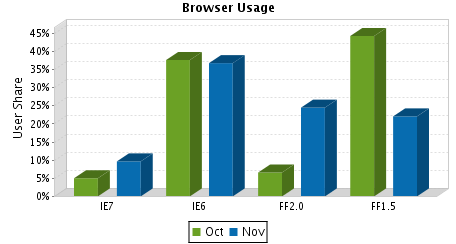
“Browser Usage
- Internet Explorer 7 – October 5.02%, November 9.68%
- IE 6 – October 37.64%, November 36.77%
- Firefox 2.0 – October 6.61%, November 24.51%
- Firefox 1.5 – October 44.26%, November 22.07%
Analysis
Both IE and Firefox have new versions out. Clearly the Firefox community is quicker to switch to new versions. Remarkably quick in fact.”
I’m not sure I’d agree with the analysis: certainly Mike is right, the Firefox community appears to be quicker in switching to new versions, but aren’t we missing a bigger picture? I’ve dropped the data into Zoho Sheet, the web-base spreadsheet app which generated this chart:

The “bigger picture” is that IE gained market share vs. Firefox (something that as a FFox user I’m not happy with
). Clearly, the majority of new IE7 users are not IE6 upgraders, they came from the Firefox camp.
But I’m not here to discuss browser use, nor do I intend to ridicule Mike’s analysis. I picked this example to make a point: the same data set may carry different meaning to you and me. The art isn’t so much in the accumulation of data, but the proper aggregation and analysis allowing customers to benchmark themselves against industry peers – that’s where the real value is, not in raw data. So much so, that I probably wouldn’t entirely give it away; rather market it as a for-fee premium service.
SaaS providers may become the benchmark specialists themselves, but think about it: businesses will likely end up using a few systems from different providers, and if your purchasing, sales, invoicing, service ..etc data are all in different systems (and consequently aggregated by the different providers), wouldn’t you have a better competitive picture benchmarking yourself based on all those aspects? Does this mean we’ll have independent benchmarking consultants in the SaaS world? If so, will there be a secondary market for raw aggregate data?
But wait … whose data is it anyway? Trust in your data being secure, not lost, published, traded with is the cornerstone of the SaaS model’s viability. But we’re not talking about original customer data, rather its derivative – does that change the picture? There’s a potentially huge market opportunity here, yet SaaS veterans like Salesforce.com, NetSuite, RightNow …etc haven’t explored it yet. Why? I suspect for this very trust/ownership issue, which can be a potential mine-field. In the early days of SaaS it simply would not have been appropriate to address it, but now with mainstream SaaS acceptance (MicKinsey predicts 61% of $1B+ corporations will adopt one or more SaaS applications over the next year) it’s high time the industry starts addressing these issues.
Kudos to FreshBooks for being a pioneer in building the service as well as bringing a major industry dilemma to the forefront.
Update (01/04): Jeremiah is thinking along the same lines, discussing how storage companies will (?) eventually pay for your data. Yes, he talks about storage while I talk about applications, he talks about advertising while I talk about benchmarking, but in the end it’s the same: user data being processed to deliever business services.
Update (9/28/2008): Here’s another showcase of benchmarking turned into action messages on CloudAve.
Tags: accounting, benchmarking, crm, data aggregation, data mining, data security, Enterprise Software, erp, freshbooks, netsuite, Office20con, On-Demand, RightNow, SaaS, salesforce.com, small Business, smb, sme, zoho
SaaS: The Cat is Out of the Bag
SMB / SME, SaaS October 12th, 2006
I’m sitting at the Office 2.0 conference watching a barrage of 5-minute product demos. FreshBooks’s CEO just dropped a bomb at the last 20 seconds in his presentation: being software as as service, they can aggregate customers’ data, categorize it by industry, size ..etc, and once they do that, why not turn it into a product?
Customers can receive generalized metrics as well as benchmark themselves against their peers.
Stop here. Think about it. This is big. It’s not about FreshBooks. It’s *the* hidden business model enabled by SaaS. It is so logical, we all had to know it would be coming – but carefully avoids talking about it. No wonder… SaaS adoption is growing but still at an early stage, and security, trust concerns are huge. The last thing software vendors want is to feed those concerns, i.e get their customers worried about the competition accessing their data.
The benefits are obvious: all previous benchmarking efforts were hampered by the quality of source data, which, with all systems behind firewalls was at least questionable. SaaS providers will have access to the most authentic data ever, aggregation if which leads to the most reliable industry metrics and benchmarking. Yet it raises a number of serious questions: How far can they go? What are the security / confidentiality / privacy implications? Are they reselling data that the customer owns in the first place? If the customer owned the core data, who owns the aggregate?
The business of metrics, benchmarking is potentially huge, but it can’t take off until the industry, along with customers, can answer these questions – and more.
Update (10/16): I’ve just checked who else talks about this Unheralded SaaS benefit, and voila! Two posts from fellow Enterprise Irregulars, ex-Gartner Vinnie Mirchandani and Yankee Group’s Jason Costello.
Update (10/30): Read Dennis on Valuing Data and on Freshbooks.
Tags: benchmarking, business model, data security, Enterprise irregulars, freshbooks, industry metrics, office 2.0, Office20con, On-Demand Software, performance metrics, SaaS
(OK, I sinned. Mea Culpa. I’ve just cross-posted an entire article, which is not the best behavior. But it’s not every day that I
P.S. The CloudAve platform is not exactly in nice order yet. It’s work-in-progress.
Zoli Erdos