Bear with me for this somewhat long post, for I am not only discussing the sweeping changes Gmail made today, but in the end will also tell you what they are going to do next year – or perhaps after that.

Gmail Changes

The Gmail label changes announced today and to be released to accounts slowly (you may not see them yet, I only have them on one account) are ones that I’ve long been waiting for, and that most reviewers seem to underestimate, thinking of them as mere cosmetic or usability changes, i.e. “drag and drop”, “right-side labels retired”..etc.  We can always trust good old Lifehacker to call it what it is: Gmail Gives Labels the Folder Treatment.

Folders vs. Labels

Because they are. Folders, that is. Just very few people realize that.  The Folders vs. Labels debate is older than the tenancy debates we discussed recently, with two deeply religious camps (apologies for the extreme characterization):

Continue reading…

Tags: , , , , , , , , ,

First of all, I love Gmail, it’s my one-and-only email system.  And I’m certainly glad to see the ever accelerating rate of enhancements, whether “official” or just the Labs variety.  But oh, please, can we have some control here and call features what they really are?
First there was the multiple inboxes announcement.  Nice. Except that it wasn’t. Multiple inboxes, that is. Think about it: that would defy logic – unless we’re talking about handling multiple email accounts, which is clearly not the case with Gmail.  This feature is multi-pane viewing – no more, no less.

Today we’re getting another new feature: Undo Send. Except that it really isn’t. Undo Send, that is.

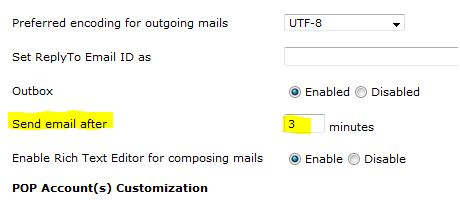
Undo Send is what Outlook has offered for ages: you can actually recall a message that had already been sent, provided the recipient has not opened it yet, and you’re both on Exchange.  What Gmail offers now is a momentary delay of 5 seconds, during which you may just realize you’re emailing the wrong Smith or Brown, and hit the panic Undo button. It’s not really undo, since the message was never sent in the first place – Gmail was holding it for 5 seconds, if you had enabled this option.

Of course, as just about all TechCrunch commenters note, 5 seconds is not enough, the delay might as well be configurable.  Something like this:

Oh, I forgot.  It’s from that other Web-mail system (the one that actually has multiple inboxes, too).

UpdateMG Siegler over @ VentureBeat agrees this is not real  unsend,  and he remembers AOL had a real unsend/recall feature, just like the Exchange theme I described above.

Update #2:  Oh, please… per Wired, Google already plans configurability, but all you get to pick is 5 or 10 seconds.

Related posts:

Tags: , , , , , , ,

Two seemingly unrelated items:

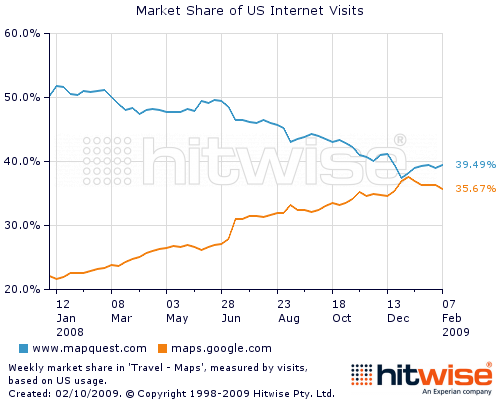
Today Hitwise reported on how Google Maps is catching up on Mapquest, which once was the king of online mapping.

Perhaps more important than just the numbers is the source of traffic:  61% of Google Maps traffic comes from links placed in organic Google Search results.  Contrast that to Mapquest, where 8 out of 10 hits come from searches on the Mapquest brand itself.  Translation: Mapquest is only used by its already dwindling user base, while Google Maps gains steadily, since Google owns Search.  The writing is clearly on the wall.

The second story: Google Gmail Within Striking Distance Of Hotmail – reported Information Week a few days ago.  Wait, wasn’t Gmail supposed to be email for the geeks only, lagging behind the masses of Yahoo and Hotmail users?

Between September 2007 and September 2008, Gmail’s visitor total grew 39%, from 18.8 million to 26 million, ComScore figures indicate. Windows Live Hotmail during this period saw its visitor share decline 4%, from 46.2 million to 44.6 million.

If Google’s Gmail growth rate rises to, say, 46% over 2009, it could reach approximately 43 million unique U.S. visitors by the end of the year. And if Windows Live Hotmail continues to bleed visitors at a rate of, say, 3%, it will finish the year with around 42 million unique visitors per month.

So Gmail may overtake Hotmail by the end of this year, and if the trend continues, it might overtake Yahoo by the end of 2011, concludes Information Week.  Note, these are site visits, not account numbers, but account numbers include all the throw-away, long forgotten dormant accounts that both Yahoo and Hotmail has in abundance.  All these email systems being web-based, visitor stats are a better representation of actual usage.

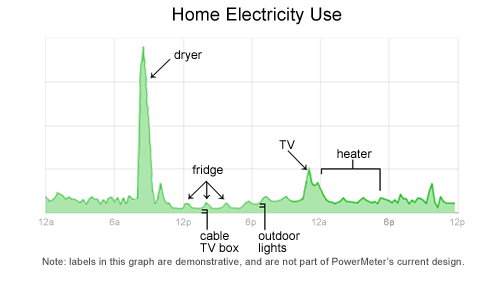
The third story (yes, I promised two, but can’t stop now):  The Google Power Meter., currently being tested by Google employees.  These are smart devices you plug in all around the house, they will report back to the mothership and you get a nice dashboard aimed at helping you making the right energy choices.

I would certainly like to know just how “smart” they can be – any chance of bi-directional communication?  I can’t help but remember the mail campaign from PG&E, my utility company.  They are handing out $25 to anyone who allows them to install a smart thermostat free of charge.  The catch?  At times when consumption reaches peak levels, the utility company can remotely throttle back your air conditioner.  So now you see why I’m hesitant about these Google electricity meters.  Could they be switched from passive reporting to regulating one day?

The fourth story (gee, I really have to stop soon): An opinion piece on Bloomberg discusses how the health provisions slipped into the stimulus bill will effect every one of us in the US:

Your medical treatments will be tracked electronically by a federal system. Having electronic medical records at your fingertips, easily transferred to a hospital, is beneficial. It will help avoid duplicate tests and errors.  But the bill goes further. One new bureaucracy, the National Coordinator of Health Information Technology, will monitor treatments to make sure your doctor is doing what the federal government deems appropriate and cost effective. The goal is to reduce costs and “guide” your doctor’s decisions (442, 446).

Ouch. I’m all for electronic medical records, but I don’t want them to be turned into a Big Brother function.  And I don’t want a computer program to decide on my medical treatment.  But I’ve just complained about the Sorry State of Health 2.0: neither Google Health nor Microsoft HealthVault are up to the job yet.  I want them to get there, and I trust they will (at least one of them).  I don’t want them to run my health care, just help me and my providers manage it – but fear of potential misuse won’t stop my desire for progrees.

Do you see the trend here?  Google is unstoppable.  They want to manage all data, but our life is increasingly all about data and what we do with it.  The former Borg in Redmond is now a toothless veteran, slowly dwindling away – Google is the New Borg.  Resistance is futile.  We’re being assimilated.  And we like it.  Enjoy the video: (better quality if you click through)

Related posts:

(This post originally appeared @ CloudAve.  To stay abreast of Clod Computing, SaaS news and analysis, grab the CloudAve feed here.)

Tags: , , , , , , , , , , , , , ,

Yes, you read it right: the first announcement of Zoho Mail’s general availability, with Google Gears-based offline support did not come from Zoho, but from the Google Gears team, which released this video discussing Zoho’a use of Google Gears, synchronization, the Marketplace and  a lot more a bit prematurely:

Somewhat used to it (see TechCrunch Releases New Zoho Service: Invoice) the Zoho folks decided to play along and released their own announcement.

This announcement somewhat symbolizes the interesting dynamics between Zoho and Google: competitors, yet collaborators.   ReadWriteWeb is probably right:

But also Google probably sees Zoho less as a competitor at this point (even though Zoho does compete directly against Google Apps) and more as an evangelist for its technology – such as Google Gears.

First of all what’s in today’s announcement:

  • Zoho Mail has been in private beta for over a year now. As much as we like to switch to native collaboration using web-based tools, email is still where most productivity workers spend 80+% of their time.  Mail is the glue that brings it all together – so it’s important for Zoho to step out of background testing mode and make Mail publicly available. It’s also an integral part of the Zoho Business Suite.
  • Features: It’s an email service (everyone gets a user@zoho.com email account) and an email program that can consolidate several other email accounts, Outlook-style.  It combines old and new: supports hierarchical folders a’la Outlook as well as Gmail-style labels, chronological view as well as the threaded conversation views made popular by Gmail.
  • Access anywhere, any time: Offline access is provided via Google Gears (for now Firefox and IE only), and it’s also available on the iPhone.
  • Integrated Chat – this is another “glue” application within the Zoho Suite, and several other features listed here.

So with all that, why am I unhappy?  I’m a die-hard Gmail fan, mostly for its productivity boosting features:

  • Conversation threads
  • Labels
  • Search

Zoho Mail handles the latter two well, but I am not too happy with the way conversation threading works.  My business conversations last weeks, include dozens of emails, and on a traditional mail system the threads are basically a pain to put together before responding to someone.  Gmail handles it automagically, and as a side-effect, it presents a lot more information on it’s list screen – since the dozen individual emails are now compressed into one line.

But we all have different usage patterns. When debating the importance of threads, I looked at other Zoho Mail users whose conversations are typically one-off, so they won’t value threading feature at all.  In fact not everyone needs productivity.  Not everyone wants to go through a paradigm change.

AOL, YAHOO, Hotmail are the absolute web-mail market leaders,and they should do whatever it takes to keep their customers.  Their mainstream users are corporate employees who use Outlook in the Office, whether they like it or not is irrelevant, they are used to it. When they go home, they may not email a lot. Some will check their emails daily, once a week, or less. They want a personal email that resembles to what they already know.  For them familiarity is more important than productivity.

As much as I hate to admit it,  I am NOT the mainstream Zoho customer.  I am probably more a part of the TechCrunch 53,651 (even though it’s 1M now) than the mainstream customer base Zoho targets.   And if it wasn’t clear before, the current crisis brought home the message loud and clear: only businesses with real revenues survive.  Which probably means that for all my yelling and screaming, Zoho is quite right coming out with an email system that meets the needs of businesses who actually pay for it.  After all, this is what enables them to offer all the other apps I like for free.  And I like free. smile_wink

(Disclosure: I’ve been a long-time Advisor to Zoho and they are exclusive sponsor of my main gig, CloudAve. This article has been cross-posted there.)

Tags: , , , , , , , , ,

I can’t believe the email is dead theme, popped up again, this time on SocialMediaToday, originally on OnlineMarketerBlog.   I responded in detail on CloudAve.

Image credit: CrunchGear.

Tags: , , , , , , , ,

Yet-another-email-is-dead (OK, just in danger) article, this time by Alex Iskold @ ReadWriteWeb.  Alex adds Twitter’s increasing popularity to the standard “reusable” arguments: teenagers using IM, or increasingly SMS, and most recently Facebook instead of email which they find cumbersome, slow and unreliable – hence email usage will decline.

I beg to disagree as I did before, and before.  Sure, I also get frustrated by the occasional rapid-fire exchange of one-line emails when by the 15th round we both realize the conversation should have started on IM. Most of teenagers’ interaction is social, immediate, and SMS works perfectly well in those situations. However, we all enter business, get a job..etc sooner or later, like it or not…smile_wink Our communication style changes along with that – often requiring a build-up of logical structure, sequence, or simply a written record of facts, and email is vital for this type of communication.  As much fun Twitter may be, I rarely have (or see) serious ongoing discussions there  – in other words Tweets are in addition, instead of email.

Email in business is being “attacked” from another direction though: for project teams, planning activity, collaboratively designing a document, staging an event… etc email is a real wasteful medium. Or should I say, it’s the perfect place for information to get buried. This type of communication is most effective using a wiki, or an increasing number of online tools supporting native collaboration.  Yesterday I reviewed a startup CEO’s ppt deck, and it took us 4 rounds of emailed versions of the same presentation – it would have been a lot easier to collaborate on just one “master” presentation in Zoho Show.

So yes, I agree with Alex, even in business we’re offloading stuff off email.  But email is far from dead, or even in danger, and it won’t be any time soon. We just have to learn to use the right tool in the right situation. As usual, Rod Boothby says it better in a single chart:

Rod’s chart is almost two years old, but still valid – perhaps I would update it to say “Wiki and collaborative documents”.  My own post here is a slightly updated version of an older one from last year, which in turn was an almost verbatim reprint of another one from July 2006. I rarely re-post old stuff, but in this case I felt it still made a valid point.  Next year, when someone brings up the “is email dead?” question, I’ll dust it off again. smile_tongue

Zemanta Pixie

Tags: , , , , , , , , ,

Outlook read backwards is Kooltuo. Wow, it would make a good startup namesmile_wink. No, I did not go crazy, but TechCrunch reports that Microsoft just signed a letter of intent to acquire Xobni. And Xobni = Inbox, backwards.

Not that it’s a surprise: I wish I could predict everything with such certainty. This is what wrote in February, when Bill Gates presented Xobni for Outlook as “the next generation of social networking” at the Microsoft Office Developers Conference:

What does it mean when Bill Gates presents your product, a super-cool Outlook plugin to his crowd of developers?

  1. Gates’s message: now go back and copy this fast. That would be the classic Microsoft style, as many software startups can attest to. It would also put the market introduction to somewhere … around 2015? Unlikely.
  2. Microsoft will acquire Xobni in no time. Sweet and fast deal. Congratulations to the Xobni team and investors!

So, yes, congratulations to the Xobni team! On a personal note, I regret I can’t try Xobni, as I long ago ditched Outlook along with a lot of desktop bloatware, and am in happier land now, using Web-based applications. I’m perfectly happy ( and productive) with the combination of Gmail and the Zoho apps, and if I ever leave Gmail, it will be for another web-mail, not back to the desktop. The air is fresher in the Cloud.smile_regular

Tags: , , , , , , , , , , ,

I wanted to get organized about my ever-growing inbox, so I thought I’d give GTDInbox a try, especially after reading the positive reviews on both WebWorkerDaily and ReadWriteWeb

My experiment has lasted a grand total of two days. Firefox freezes every hour or so, I just can’t stand it anymore.

Of course it doesn’t necessarily prove GTDInbox is the offending party; for all I know it could be any other Firefox extension that was a sleeper until now, yet in combination with all the others it now misbehaves.  But it’s beyond the point: I am a user, not a tester, so I took the easy path out of this nightmare: remove the most recent addition, and the freezes will stop.

I still like the concept, so will look at GTDInbox a few releases later.

Tags: , , , , , , , ,

Actually, I don’t know how, but Xobni apparently does: Bill Gates presented Xobni for Outlook as “the next generation of social networking” (is that why he quit Facebook?) at the Microsoft Office Developers Conference yesterday (video here).

Now, let’s think for a minute. What does it mean when Bill Gates presents your product, a super-cool Outlook plugin to his crowd of developers?

  1. Gates’s message: now go back and copy this fast. That would be the classic Microsoft style, as many software startups can attest to. It would also put the market introduction to somewhere … around 2015? Unlikely.
  2. Microsoft will acquire Xobni in no time. Sweet and fast deal. Congratulations to the Xobni team and investors! martini

Update (2/15): Xobni has a new CEO: Jeff Bonforte, Yahoo’s vice president of social search until now. Did he just escape from one Microsoft acquisition and get into another one? ;-)

Update (3/2): TechCrunch has sources confirming the Microsoft negotiations.

Update (3/20): Bob Warfield believes Microsoft is about to close the deal with Xobni.

Tags: , , , , , , , ,

From Tony Hirst:

If an email comes with an attachment, then I suspect that in a large number of cases the sender is probably using the wrong medium. So for example, this morning I found in my mailbox:

Three seminar announcements with *ALL* the details in an attached word file (nothing in the body of the message). (”Please find enclosed details of our next seminar” – you know the sort of thing…)

Two newsletters as PDF attachments (they’re available on the web as well…)

Yes, I hate that… and if you’re on a slower machine, you spend the next several minutes opening different applications (Word, Excel, Acrobat), wait for the virus scan ..etc, only to wonder how than organize it all…

Here’s Tony’s solution:

So I think I may try a new mail rule:

if attachment then

  • silently delete AND
  • reply-to-sender “Please find another way of letting me see the document you sent as an enclosure – I do have a browser, you know… If the document is for commenting on by several people, try Google docs, Zoho, or Microsoft Live whatever it’s called…”

I love it… like I’ve said before, Attachments are Evil – Link, don’t Send.

Tags: , , , , , , , ,