The Enterprise Irregulars Button Up

Business, Humor November 13th, 2007

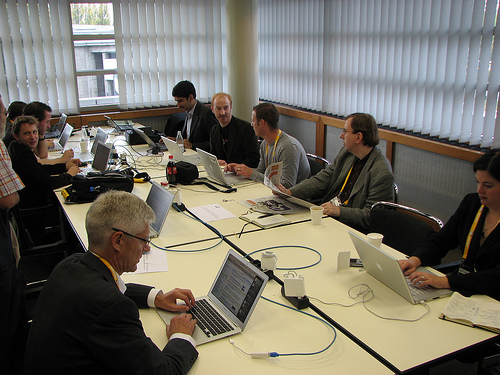
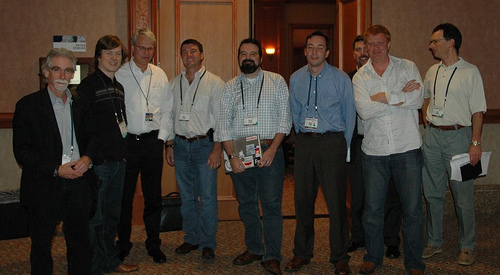
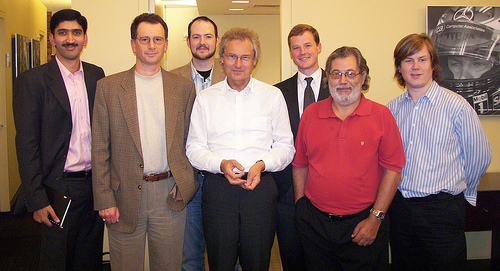
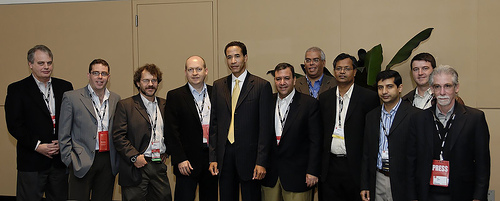
As they say, a picture is worth a thousand words.. so I’ll save you the agony of reading through 3000 words, let the photos speak for themselves:

The Enterprise Irregulars with SAP Board Member Peter Zencke

The Enterprise Irregulars with SAP CEO Henning Kagermann

The Enterprise Irregulars with Oracle President Charles Phillips

Do you see what I see? Is there a trend here? I defer further analysis to our in-house fashionistas. smile_shades

Tags: , , , , ,

Enterprise Bloggers, Openness and a Thriving Ecosystem

Blogging, ERP / CRM, Enterprise Software, Marketing / PR, Social Networking October 21st, 2007

I started this post a week ago, than canned it, not wanting to be part of the “storm in a teacup“, created by Oracle’s announcement that they would open up their annual OpenWorld conference to bloggers for the first time. The software giant also actively reached out to 30 or so bloggers, including several of my fellow Enterprise Irregulars.

It appears that most EI’s will not attend, partly since Oracle does not pay for expenses, partly because there is no word about access to Executives. More important than the expense issue was the reasoning:

“We’re not picking up travel costs or expenses, sorry. This will keep you impartial. If you see me, I’ll give you a pat on the back, how’s that instead?

Ahhh…the enterprise bloggers must be a bunch of prima donnas, used to getting their full expenses paid at SAP’s annual conference and other events.. SAP “bought them” and they are biased, right? Wrong.

The reality is that unlike the press and analysts, the group bloggers are often lumped into, may of us are independents or are in small businesses, don’t have corporate expense accounts to lean on, and simply can’t afford to travel to conferences on our own. Even on a fully reimbursed trip, taking 3-4 days off business is a significant sacrifice. Of course that’s the bloggers’ side, why should Oracle care? Whose loss is it anyway?

What does SAP get for the not-so-negligible travel budget they spend on enterprise bloggers? The one thing they don’t get is bias, “loyal”, positive reviews.
Fellow irregular and ex-Gartner Vinnie Mirchandani can hardly get more critical, regularly beating up SAP on issues like pricing, maintenance, innovation (or lack of) - yet he is invited back to all SAP events. Fund Manager, former SAP investor and blogger Jason Wood is also a regular at SAP events, which certainly does not prevent him from expressing his doubts / concerns. Dennis Howlett is no exception, and the list could go on.
SAP’s recent announcement of their new hosted SMB solution, Business ByDesign is another good example. While most of the media reprinted SAP’s press release, you won’t find it anywhere in the “enterprisey” blogs: what you will find instead is independent thinking, analysis (right or wrong) and dialogue. The bloggers’ verdict was generally positive, mostly about the feature set/ technology, but several of us expressed doubt regarding execution: SAP’s market segmentation, potential self-cannibalization, ability to create mobilize a new, agile ecosystem capable to profitably execute in the new high volume/low price model, and help SAP reach their market goals.

Not exactly paid-off, loyal PR if you ask me… could it be that SAP knows something about the value of dialogue, in fact outright debate? They go the extra mile to provide bloggers with information, engage them actively. Round-table discussions with Hasso Plattner, Henning Kagermann, Leo Apotheker, Peter Zencke (did it all start with Niel’s chance encounter with SAP’s CEO?) and several other executives are highly appreciated, and believe me, it’s not one way PR-style briefing either. James ‘Redmonk” Governor says it best:

“As I have said before, you can buy my thinking, but you can’t buy my opinion.”"

At SAP’s Teched 07 Conference James publicly disagreed with Peter Zencke about market segmentation, and the world did not come to an end; in fact the SAP Board Member happily continued the debate at the bloggers chat afterwards. Two weeks after the “incident” James moderated several sessions at Teched Europe, on SAP’s invitation. Don’t we all know companies where such behavior is the sure way to lose access and get yourself uninvited forever?

Bloggers are critical, opinionated, sometimes right, sometimes wrong, but never dull. But there’s a bigger picture here, other than external communication. I believe it’s not coincidental that the company that understands the power of dialogue has the most thriving online community I’ve seen in enterprise software.

Two years ago, when the external “Bloggers Corner” program started the SAP Developer Network (SDN) counted close to 600K members - today it’s 900K. It’s younger sibling, the Business Process Expert (BPX) network counts 200 thousand members. Between the two, discounting overlaps, it’s fair to say 1 million members participate in SAP’s online communities. This includes blogs, forums, wikis, videos..etc. SDN+BPX is a thriving support system: over 5,500 issues are posted daily, and the average response time is 20 minutes.

I think SAP has discovered something unique: they don’t have to give the code away yet they enjoy the benefits of “Open Source-like community“. The highest rated contributors don’t have to look for projects any more, they are in high demand. SAP Ecosystem Becomes a Booming Economy - declares research firm IDC.

The Ecosystem has become an organic part of how SAP conducts business, and there is no turning back. SAP Executives are quite aware that competitors comb through the SDN / BPX entries daily, and they certainly lose some competitive edge - but there is no other way to “run” the ecosystem. The Genie is out of the bottle, and they don’t want to send him back.

The role of the ecosystem will become even more important now that SAP is more aggressively pushing into the mid-market. This is a high-volume, low-margin market, sales, deployment, support all different from what SAP traditionally knows. Successful partnering will make or break it, and apparently SAP understands it.

I’ve come a long way from the original issue of blogger participation at Oracle’s OpenWorld, and not without reason. This issue has sparked a debate, stirred up some emotions, and I don’t want people to think it’s all about greedy (or hungry) bloggers whining about not getting their expenses paid. Nor is it a SAP Good Guy, Oracle Bad Guy issue. Both companies have their own culture and will continue conducting business their own ways.

I believe Oracle’s first approach to bloggers (late or mistaken as it is) is a welcome move, and it’s good to see they are open to learn and improve:

“This is new territory for a lot of us, and personally, I’d like to hear a lot more opinions and suggestions before I support one path or another.”

Some people in Oracle had to fight for this and they should not be given a (verysmile_wink) hard time. I certainly hope the initiative will not get shut down due to the initial negative feedback. I also hope Oracle management will realize how one step leads to another and that openness actually improves business in the long run. I used SAP as the positive example, because that’s the best showcase I know, and they are pioneering in this field - but if you know any other examples for actively embracing community, please share it in comments below.

Oh, and if you happen to be in the San Francisco Bay Area, by all means, check out Lunch 2.0 @ Oracle tomorrow.

Update (10/24): …and not a happy update, for that matter. Just as I praised SAP for “getting” social media, here’s this disturbing post from Steve Mann, VP at SAP’s Global Marketing. Apparently SAP HR wants him to remove the link to his personal blog from his corporate signature. I guess I should correct my statement: SAP gets social media … just not everyone, all the time smile_sad

Tags: , , , , , , , , , , , , , , , ,

The Long Swim to SAPPHIRE

ERP / CRM, Humor April 12th, 2007

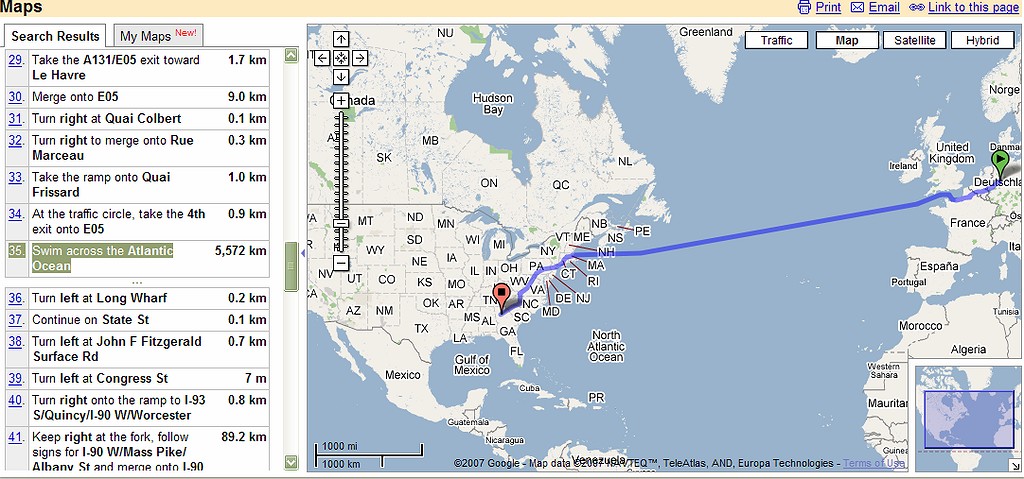
SAP’s Craig Cmehil is excited to come to Atlanta as part of the Bloggers’ Corner at SAP’s annual mega-event, SAPPHIRE. He even included the map of the Congress Center area. Nice … but Craig, you should look at another map - the one that tells you how to get there. Pay special attention to step# 35. I hope you start training soon.smile_shades

, , , , , ,

Tags: , , , , , ,

JotSpot Google Deal - Who Wins, Why it’s Big:First Thoughts

Blogging, Business, Collaboration, Personal Productivity, SaaS, Social Networking, Software, Startups, Technology October 31st, 2006

A few weeks ago the “wikirati” was having dinner with the Enterprise Irregulars in San Francisco, on occasion of the Office 2.0 Conference. Our gracious sponsor was Atlassian’s Mike Cannon-Brookes, and JotSpot’s Joe Kraus showed up, too. Missing from the photo is Socialtext’s Ross Mayfield, who was there for the first part, a briefing for Forrester’s Charlene Li, but left before dinner. (Hm, did Joe eat Ross’s dinner?smile_tongue )

(photo credit: Dan Farber)

I heard a rumor that one of us in the group had likely gotten a few million dollars richer - and it wasn’t me smile_sad… but Joe Kraus, having sold Jot$pot to Google. The source was credible but of course we had already heard about a Yahoo acquisition, then eBay .. so who knows, after all.

I found the timing ironic, just having come back from a Google briefing where they announced Google Docs & Spreadsheets, which left me largely unimpressed. This is what they were missing, I thought.

Today we know it’s a fact: JotSpot is part of Google. After the quick post, here are my first thoughts around who wins, and what it may mean from a user prospective.

Who Wins:

  • Joe, Graham and team for obviou$ rea$ons.
  • Google, for now they have all the pieces for a small business collaboration suite, if they are smart enough to get rid of the junk and integrate the good pieces together - something they have not done before. I’ll talk about this more a few paragraphs below.
  • Some paying JotSpot customers: Jot has had a funny pricing model, where you can start free, but if you exceed a page limit (10?) you have to upgrade. Most users probably don’t realize that because in Jot everything is a page (i.e. add an event to the Calendar, it’s a new page), 10 pages are essentially nothing, if you wanted to do anything but testing, you’d have to upgrade - until now, that is. From now on paying customers will enjoy their current level of service for free.
  • Competitors: JotSpot’s market direction has never been entirely clear; they focused on consumers and small businesses, but were present on the enterprise market, too. I think it’s fair to assume that they are out of the enterprise market at least for a while, leaving only Atlassian and Socialtext as the two serious players.

Who Loses:

  • Some JotSpot customers who’d rather pay but have their data at a company whose business model is charging for services than enjoy free service by Google whose primary business model is to know everything about you. Clearly there will be some migration from JotSpot to other wiki platforms. Update: the competition isn’t sleeping, see migration offers by Socialtext and Atlassian.
  • Me, for having half-written a post about the merits of pure wikis, Office suites and hybrids, which I can scrap now.

Who Needs to Move:

  • Some of the Office 2.0 Suites, including my friends at Zoho. This may be a surprising conclusion, but bear with me for a while, it will all be clear.

So far the balance is good, we have more winners than loserssmile_regular - now let’s look at what Google should do with JotSpot.

They have (almost) all the right pieces/features fragmented in different products, some of them overlapping though. They should kill off the weak ones and integrate the best - a gargantuan task for Google that so far hasn’t pulled off anything similar. Here’s just some of what I mean:

Google Docs & Spreadsheets:
One of the reasons I found the announcement underwhelming was that there really wasn’t a lot of innovation: two apps (Writely and Google Spreadsheets) put together in a uniform look and a file management system. It’s this very file management system that I found weak: how on earth can I work online and manage a jungle of thousands of documents in a flat, alphabetical list? JotSpot may just be the right solution.

Google Groups:
It’s rare for a mature product to go back to beta, but when Google recently did it, it was for good reason: the Groups which so far has been just a group email mechanism, became a mini community/collaborative platform, offering functionality found in collaborative editors like Writely, Zoho Writers, page cross-linking a’la wikis, file management..etc, combining all this with group email and the ability to share with a predefined group. I seriously considered it a major step forward, likely attracting previously “email-only” users to the native web-interface - and we all know why Google loves that.

JotSpot, the “hybrid” wiki:
This will be the somewhat controversial part. First of all, JotSpot is an attractive, easy-to-use wiki, and I believe that’s the value Google should keep.

Second, they’ve been playing around with the concept of being an application platform, which just never took off. The “applications” available in JotSpot are all in-house developed, despite their expectations the world has not come to develop apps on their platform. (Will this change in Google’s hands?). In JotSpot 2.0 they integrated some of the previously existing applications into user-friendly page types: Calendar, Spreadsheet, Photo ..etc, along with regular (text) wiki pages. This is what I considered Jot’s weak part. Just because a page looks like an application, it does not mean it really is:

  • Try to import an Excel spreadsheet into a Jot Spreadsheet page, you’ll get a warning that it does not import formulas. Well, I’m sorry, but what else is there in a spreadsheet but formulas? The previous name, Tracker was fair: it’s a table where you track lists, but not a spreadsheet.
  • Look at a Calendar page: it does not have any functionality. You cannot do group schedules, can’t even differentiate between personal and group events. It’s just a table that looks like a Calendar - reminding me the “electronic” calendars of corporate executives in the 90’s: the Word template that your secretary maintained for you and printed daily…

I guess it’s clear that I am unhappy with Jot’s “application” functionality, but I like it as a wiki. In this respect I tend to agree with Socialtext’s Ross Mayfield, who believes in best-of-breed (whether that’s Socialtext is another question…). Best-of-breed of everything, be it a wiki or other productivity tools. I’ve also stated that my ‘dream setup’ for corporate collaboration: is a wiki with an integrated Office 2.0 Suite. Why?
Other than its collaborative features, a wiki is a map of our logical thinking process: the cross-linked pages provide structure and narrative to our documents, one could think of it as a textual / visual extension of a directory system, resolving the problem of the flat listing of online files that represent fragments of our knowledge. Of course I am not implying that a wiki is just a fancy directory system… au contraire, the wiki is the primary work and collaboration platform, from which users occasionally invoke point applications for number crunching, presentation..etc.

Now Google has it all: they should kill the crap, and combine the JotSpot wiki, their own Office apps ( a good opportunity to dump the lousy Docs & Spreadsheets name), Calendar, Gmail, the Group email from Google Groups and have the Rolls -Royce of small business collaboration.
(Update: Dan Farber over at ZDNet is pondering the same: Is JotSpot the new foundation for Google Office?)

By now it’s probably obvious what I meant by Zoho having to make their move soon: they either need to come up with their own wiki, or team up with a wiki company. Best-of-breed is a great concept and enterprise customers can pick and match their tools on their own. For the SMB market it makes sense to be able to offer a hosted,integrated Wiki/Office solution though. So far Zoho is ahead of Google in Office 2.0, if they want to maintain that leadership, they will need a wiki one way or another.

Of course I could be way off in my speculation and Google may just have bought the team.. either way, congratulations to Joe, Graham and the JotSpot team. thumbs_up

Related posts:

Tags: , , , , , , , , , , , , , , , ,

SaaS: The Cat is Out of the Bag

SMB / SME, SaaS October 12th, 2006

I’m sitting at the Office 2.0 conference watching a barrage of 5-minute product demos. FreshBooks’s CEO just dropped a bomb at the last 20 seconds in his presentation: being software as as service, they can aggregate customers’ data, categorize it by industry, size ..etc, and once they do that, why not turn it into a product?

Customers can receive generalized metrics as well as benchmark themselves against their peers.

Stop here. Think about it. This is big. It’s not about FreshBooks. It’s *the* hidden business model enabled by SaaS. It is so logical, we all had to know it would be coming - but carefully avoids talking about it. No wonder… SaaS adoption is growing but still at an early stage, and security, trust concerns are huge. The last thing software vendors want is to feed those concerns, i.e get their customers worried about the competition accessing their data.

The benefits are obvious: all previous benchmarking efforts were hampered by the quality of source data, which, with all systems behind firewalls was at least questionable. SaaS providers will have access to the most authentic data ever, aggregation if which leads to the most reliable industry metrics and benchmarking. Yet it raises a number of serious questions: How far can they go? What are the security / confidentiality / privacy implications? Are they reselling data that the customer owns in the first place? If the customer owned the core data, who owns the aggregate?

The business of metrics, benchmarking is potentially huge, but it can’t take off until the industry, along with customers, can answer these questions - and more.

Update (10/16): I’ve just checked who else talks about this Unheralded SaaS benefit, and voila! Two posts from fellow Enterprise Irregulars, ex-Gartner Vinnie Mirchandani and Yankee Group’s Jason Costello.

Update (10/30): Read Dennis on Valuing Data and on Freshbooks.

Tags: , , , , , , , , , ,

Socialtext 2.0: Usability vs. Usefulness

Collaboration, Enterprise Software, Personal Productivity, SaaS, Software, Technology October 5th, 2006

Socialtext recently announced version 2.0 of it’s enterprise wiki. The two big news are a completely revamped user interface, aiming to make Socialtext a lot easier to use, and the publication of the REST APIs to support integration and mashup development. For more information watch this screencast by CEO Ross Mayfield, and see this review at TechCrunch.

The revamped UI is a huge deal, and it’s been long overdue. For some background check out Jeff Nolan on the “UI sucks” issue. One may agree or disagree, but as long as there are reviews like this:

I have tried on at least four separate occasions to use and like Socialtext but I can’t…I just can’t use this application.” - well, you definitely know you have a problem.

Interestingly enough Socialtext, the company realizes how important ease of use is, and they are contributing resources to bringing WYSIWYG Wikiwyg editing to Wikipedia. But let’s focus on Socialtext, the product for now.

The new UI is aesthetically pleasing, has nice colors (somewhat reminds me of JotSpot’s blue), but most importantly it’s clean, simple, in short it passes the “blink test“.

thumbs_up The Home Page is of key importance in the new release: a Dashboard gives users a quick glance of a shared whiteboard, personal notepad, customizable watchlist, a listing of what’s new (i.e. recently changed pages) as well as the users active workspaces (i.e. wikis). The Home page has become the central place where you can access all extended features, like a listing of all pages, files, tags, or change settings. You can start adding information using the New Page button, which, just like the Edit and Comment buttons on all subsequent pages clearly stands out, again, passing the “blink test”. I love the new colored side-boxes for tags, inbound links and attachments.

I can’t emphasize enough how important inbound links (backlinks in the previous releases) are - a wiki is all about associating pieces of information with each other, and the inbound link shows you where the information on the current page is used elsewhere. In wiki systems without this feature on would manually have to create them, a task most often forgotten (as it does not fit the natural flow of creating new pages), thus those systems don’t offer the full potential of a wiki. I can’t for the life of me understand why inbound links haven’t yet made it into the standard feature-set in JotSpot 2.0, when it’s been long (for more than a year) available as a downloadable plugin on the Jot Development wiki - but how many users search the development wiki? In contrast, Atlassian’s Confluence has long supported incoming links.

We know from Ross and others that in creating the new design the primary objective was to increase ease of use, and in doing so Socialtext conducted customer usability studies. The number one customer request was to reduce clutter, which was quite abundant in Socialtext 1.x. They certainly achieved this objective - perhaps too much. Playing around with the beta I run into trouble trying to create a page from an already existing page - I simply did not find the New Page button. “This is something too obvious to be a bug”, I thought, and Ross proved me right: It’s all part of “getting rid of the clutter” and doing what customers had requested.

Socialtext believes this helps eliminate a frequent problem: the existence of orphan pages in wikis. (Orphan pages are valid, existing pages that no inbound hyperlinks point to; thus it’s difficult to find them, other than by searching or listing all pages).

I am not sure binding users to the Home page is a good idea (it’s not just the “new page”button, all other extended features/tools are anchored here). To me the natural flow is typically top-down: one would create a subpage from the parent where the summary level thought flows, thus creating a parent-child relationship. In a business wiki, where after a while you’ll end up having a large number of pages, the further away you are from the right place (the parent), the more likely you will forget to create a link to the new page, thus may end up with a proliferation of orphan pages.

Interestingly enough, the most elegant solution to the orphan problem comes from two products at the opposite end of the spectrum: Wetpaint, the friendliest consumer/community focused wiki (actually a blend of wiki-forum-blog features) and Atlassian’s Confluence, the market-leading enterprise wiki. Other than the standard user-created links within the flow of text, these products also offer an automatic index of subpages along with each page. JotSpot’s 2.0 release offers a less foolproof but reasonable solution: when you create a page by using the “new page” button, technically it becomes an orphan, however when you hit “save”, you’ll find yourself at the parent level where a quick alert pops up proposing to create a link to the child page you just set up.

There’s a fool-proof way of creating new pages that can’t become orphans: create a link before the page, and forget the “new page” button. While typing, wherever you want to branch out to a new page, insert a link to the page about to be created, typically by highlighting text and using the “link” icon, or in JotSpot you have the option of simply typing a WikiWord (also referred to as CamelCase), it becomes a link automatically. This “trick” creates a shell, essentially a placeholder for your new page: you can add content later, but since it’s already linked to, it can’t become orphan. All the wikis I’ve talked about allow this method, but Wetpaint and Confluence don’t really need it, since they provide navigation based on the auto-index of child pages. (Update [2/17/07]: I’ve just discivered a perfect existing term for what I am trying to epxlain here: LinkAsYouThink.)

Back to Socialtext, perhaps there is more to the new design than the desire to create a very simple, clutter-free user experience: the underlying philosophical difference between hierarchical structures, parent-child data relationship vs. everything being flat (created at the home page ) and only associated through links embedded in page text. But hierarchy, structure are not necessarily evil; only pre-existing ones are.

smile_wink We tend to think in structures, need organizing principles - there is a reason why books have a table of contents. Wikis, as unstructured as they are in “virgin state” are a good tool to create structure - our own one. The assumption of a parent-child relationship mimics our usual workflow, and it does not impose a rigid structure, since through through cross-linking we can still have alternate structures, no matter where we create a page.

Perhaps that’s the fundamental difference between Socialtext and the other wikis I’ve mentioned - which would explain why it doesn’t have breadcrumbs (navigational line at the top): this standard feature of all the other three products (Confluence, Wetpaint, Jot) does not really fit in Socialtext’s flat world.

My other issue about with Socialtext 2.0: I really would have expected to see document versioning by now: when you upload an attachment (typically doc, ppt or xls file), Jot and Confluence shows the current version, indicating the most recent version number and the user who changed the document last. Click for details, and you get all previous versions and details. Confluence even allows you to label every instance of the attachment with a comment. Socialtext simply lists all documents with the same title (or not), not recognizing them as version of the same file.

smile_sad

Finally, a minor gripe: it would be nice to see threaded commenting, like Wetpaint and Confluence does, allowing users to enter comments to a page itself or to a previous comment. Socialtext, just like Jot, only has a flat list of comments.

Summing up, the new Socialtext 2.0 Beta is really good-looking, but in my view limits functionality for (perceived) ease of use. That said, it’s a beta, and Ross conformed repeatedly that they are seriously evaluating test user comments and it’s possible that the final 2.0 release will have a better solution for the edit/navigation/orphan problem.

fingerscrossed

Last, but not least, let’s revisit document versioning. It’s very-very important. In my “prior life” where as corporate VP I introduced a wiki-based intranet to the company, we used it for document management first, before exploring more of the native wiki functions. But here’s the catch: document versioning in wikis solves a very old problem, but solves it on the bases on yesterday’s (OK, today’s ) technology. Even with proper versioning one has to download documents, locally update them, then upload them back up to the wiki. The process is a lot easier using Office 2.0 applications, be it an editor, spreadsheet or presentation. There is no uploading/downloading, all updates happen online, if need be by multiple users at the same time, and instead of attaching them, one would simply link to, say a Zoho Sheet or Presentation from the wiki.

My ‘dream setup’ for corporate collaboration: a wiki with an integrated Office 2.0 Suite. The next step will be the wiki integration with ‘traditional’ , transactional enterprise systems - that’s a little further away (although … reading this, who knows?

smile_wink ) I hope to discuss many of these concepts with my readers next week in San Francisco, at the Office 2.0 Conference.

Update (9/5): For more insight read Socialtext 2 Design.

Update (11/1): Usability review on InfoSpaces.

Tags: , , , , , , , , , , , , , , , , , , , , , , ,