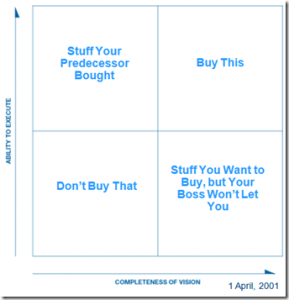
Gartner introduced their Real (Magic) Quadrant:

Not bad. But let’s not forget the customers’ prospective. Welcome to the Magik Kvadrant:

But perhaps most revealing is Phil Fersht’s Painsharing Paradox:
(Cross-posted @ CloudAve » Zoli Erdos)
Connecting the dots ...

Gartner introduced their Real (Magic) Quadrant:
Not bad. But let’s not forget the customers’ prospective. Welcome to the Magik Kvadrant:
But perhaps most revealing is Phil Fersht’s Painsharing Paradox:
(Cross-posted @ CloudAve » Zoli Erdos)
 We’ve had email dead, resumes dead, wikis dead themes, now it’s apparently time for the SaaS is Dead meme, thanks to a recently published Gartner report. My favorite quote from the report:
SaaS is not a panacea, and companies need to evaluate and understand the trade-offs that SaaS presents
Indeed. Here’s another quote from Gartner VP Rob Desisto:
If you’re a small business with no IT staff then the math is a lot easier. You need to buy the hardware. With a larger company, the math doesn’t always work out in favor of SaaS.
Now, where have I heard that before? Wait… I said it, 4 years ago:
…While it’s easy to declare that for small businesses without their own IT resources there is no better option than SaaS, there is no clear “winner” for large corporations. There shouldn’t be. This is not religion; it should be business decisions that these organizations have to make individually. Analysts fighting the SaaS vs. On-premise war often forget that software exist to resolve business problems. As Charles so eloquently points out, it’s the complexity of these business processes, the need for customization, the number of user seats..etc that matters, and as we move up on this scale, increasingly “traditional” Enterprise Software is the answer. I happen to believe that eventually SaaS will grow up to meet those requirements, but am not going to guess how many years it will take. In the meantime the SaaS-fans (admittedly I am one) can claim that SaaS is the future – but that does not mean Enterprise Software is dead.
OK, ego trip done, let’s look at some of the specific points that sparked a debate between Krish @ CloudAve and Ben Kepes:
Gartner argues that long term TCO of on-premise software can be lower for businesses that don’t upgrade often. Krish’s counterpoint is that businesses that stay on obsolete versions of their systems will fall behind competitors. Ben argues that many businesses are simply satisfied with their current system functionality and would derive little value from upgrades (well he refers to moving to SaaS, but that was not the original point by Gartner).
My take: sorry guys, it’s not so black-and-white. Yes, many businesses avoid software upgrades like the plague, but not necessary because they would not benefit from it: it’s all about avoiding the major cost and business disruption traditional Enterprise Software upgrades bring about. (As a background, I spent the 90’s selling and implementing SAP solutions. I still chuckle when I hear there are SAP consulting teams at my 1990-93 clients: the upgrade cycle never ends)
SaaS typically comes with more subtle and more frequent updates that don’t disrupt business. Now, let’s be fair: the SaaS market is still quite nascent, despite the fact that Gartner is ready to bury it. Our experience is with seemless Google and Zoho upgrades, or not-so-seamless but still not disruptive Salesforce.com, NetSuite ..etc upgrades. There is still nothing on the same magnitude of a SAP or Oracle Enterprise Suite, so we really do not have a lot of realistic comparison on that level…
For further details I suggest Ray Wang’s excellent piece on How To Compare Total Ownership Costs.
Gartner says the old enterprise practices are seeping into the SaaS market and we are seeing push for long-term, multi-year deals with upfront payments.
Krish argues that many enterprise customers actually prefer to pay long term to avoid the hassle of monthly billing, while Ben points out the root cause of the issue is SaaS vendors not having the right tools for more granular use-based billing.
Both are right, I don’t even see this a debate (?). Years ago I had been a NetSuite customer, and was given several choices, with multi-year contract carrying significant discounts. But still, the plans were mostly seat-based, with no chance to adjust downward and not enough flexibility to account for functions used / not used. But let me say this: a lot of what we’re saying today is just business decisions, SaaS providers have better technical bakcground to offer very granular, real-usage based pricing for two reasons:
Coincidentally, NetSuite just announced their integration with Zuora, the billing system for the subscription economy. This is an offering for subscription-based businesses who uses NetSuite – in other words NetSuite’s customer. Now, what I really wonder about is whether NetSuite will take this opportunity and consider themselves a customer / user of Zuora’s services: i.e. step up the plate and offer true usage-based subscription models – most likely as an alternative to the current ones.
No, for this to come up as a SaaS-specific problem is just pathetic. Shelfware is as old a concept as Software licencing: it’s the phenomenon of being locked in to more user seats and entire modules you don’t use, often without knowing about it. Here’s a choice quote from Gartner VP Rob Desisto again, although he used it in another context:
many organizations have CRM already because it was bundled with their ERP licenses
There is nothing inherent in the nature of SaaS that would promote shelfware, in fact as I‘ve just pointed out above, technically SaaS vendors have better ability to monitor actual usage than the major nightmare of software audits in the on-premise world. There are good initiatives, like RightNow promising to end shelfware, and I trust competition will lead to more of this.
Again, I offer two great pieces on the subject by Ray Wang:
The debate is on – feel free to chime in.
(Cross-posted @ CloudAve)
Sam Lawrence, formerly of Jive Software and Enterprise Octopus, most recently Blackbox Republic is baaaack. Big Time. Sorry. I mean Go Big Always. This time (actually a month ago) he is presenting the Magik Quadrant from a customer prospective. (Should it not be the Magik Kvadrant?)
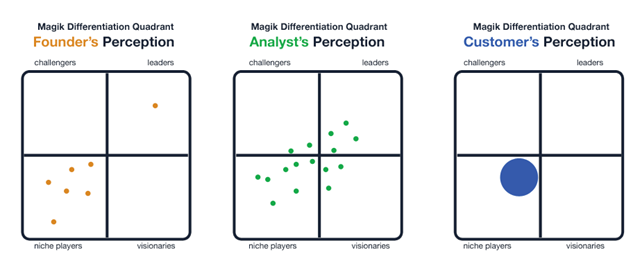
There you have it. But I can’t steal his entire post: for the explanation, Go Big Always. 🙂
(Cross-posted @ CloudAve)
Fellow Enterprise Irregular Vinnie Mirchandani did a good job of un-hyping the Gartner Hype Cycle for emerging technologies.
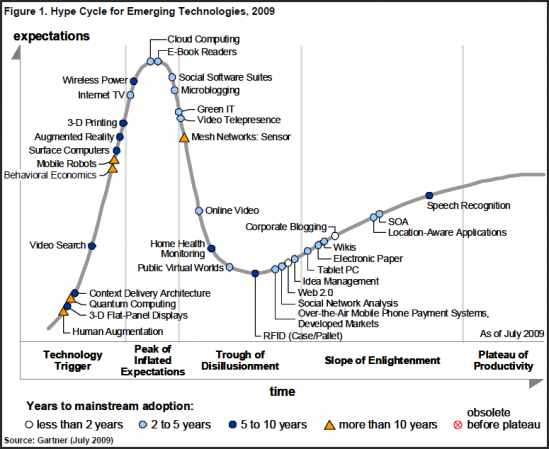
He points out some inconsistencies comparing this year’s chart to the 2007 version. He should know, he is a Gartner Alumnus himself. But I’ve been wondering if there was a way to further simplify it, i.e. make it digestible to average folks like yours truly .. and I’ve just found it.
Ladies and Gentlemen, here’s the simplified, scobleized, oprahized, too-oh-ized version of the Gartner Hype Cycle:
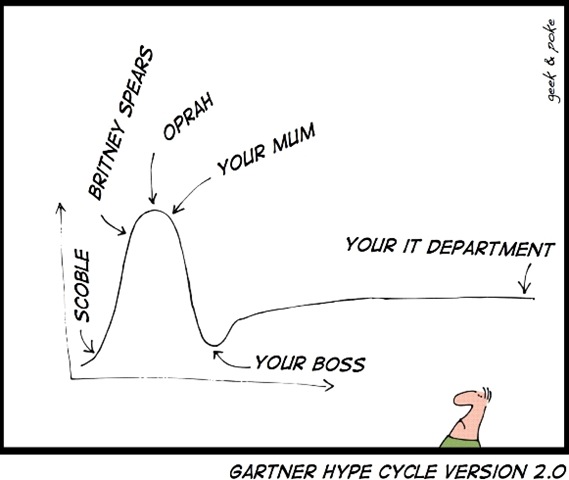
Courtesy of Geek & Poke.
(Cross-posted @ CloudAve)
 (OK, I sinned. Mea Culpa. I’ve just cross-posted an entire article, which is not the best behavior. But it’s not every day that I launch a new group blog – so consider this my shameless self-plug, and please subscribe to the feed.
 )
)
We must be a crazy bunch on a suicide mission. Why else would we launch a new blog focused on Cloud Computing and Business, when it’s just a fad that will collapse in two years?
Harry Debes, CEO of Lawson Software is a respected Enterprise Software industry veteran, but I’m afraid for all his achievements he’ll go down in history as the man who grabbed headlines with a fatally wrong call. Of course not all wrong calls hurt one’s reputation: IBM’s Thomas Watson is still an industry legend despite the famous quote incorrectly attributed to him:
” I think there is a world market for maybe five computers“
The small difference is that what Thomas Watson could not fathom in 1943 ended up putting IBM on an amazing growth trajectory, while Harry Debes’s view may just turn out to be fatal for Lawson – or to quote my Enterprise Irregular friend, Vinnie Mirchandani:
“That’s what American and Delta said about SW. And GM and Ford said about Japanese cars. And Sears and Wards said about WalMart.”
Another quote by Vinnie, closer to our industry:
“Dun & Bradstreet, which GEAC acquired for a song, was one of the most spectacular slides in the software market. In less than 5 years it went from dominant position to a distress sale as it missed the client/server wave in early 90s.”
I’ve seen that one close, fortunately for me from SAP’s side – the winner in that round. We’re witnessing another tidal wave now, the shift to Cloud Computing. It won’t happen overnight, but those who completely ignore it will vanish. Some of my fellow Enterprise Irregulars elaborate more:
I can live with that… it’s only starting… so we’re not a suicidal bunch, after all. But thank you, Harry Debes, for sparking a great discussion.
If you read just the few articles I’ve quoted above, you get a fairly good picture of the many benefits the Software as a Service model offers. Let me add a few of my personal favorites:
We’ll be writing about these and more. I’m a “business application guy”, so I mostly talk about SaaS – but our name is Cloud Avenue, not SaaS Avenue, for good reason: fellow blogger Krish will talk about it soon. By the way, Krish and I got to know each other through our blogs – just like my fellow Editor, Ben Kepes, and just about all other contributors. We also have our CloudLab – for product / service reviews. Yes, we will report on products, but do not strive to be a mini-TechCrunch: we have no intention to report about everything new. We’re not a news-blog. We’d rather sit back, analyze a market, find key players, then produce a series of reviews / comparative analysis. Quality before quantity or urgency.
We’re believers in Cloud Computing, but not over-zealous cheerleaders. Just as I’m finishing this post, another SaaS debate erupted, which prompted Anshu Sharma to note: “there must be a Sky is Falling Support Group“. The really notable part of the Cloud-Filled Debate @Forbes is Nick Carr’s responses: not because of the Big Switch author’s unquestionable “cloud-bias”, but because of how realistic he is:
Forbes.com: Is cloud computing over-hyped?
Nicholas Carr: At the moment, yes, and that’s typical for technological advances.What’s your imagined time line of the adoption of cloud computing? Will it take years? Decades?
If you’re talking about big companies, I would say it will be a slow, steady process lasting maybe 15 to 20 years.On what Gartner Research analysts call “the cycle of hype and gloom,” where do you think cloud computing is currently positioned?
It’s definitely near the peak of its hype. The doom period, when the media and IT managers realize the challenges ahead, is likely coming soon. But regardless of hype or gloom, the technology will only keep progressing.
Overhyped, slow process, doom is coming… has Nick Carr switched sides? No, he is just being realistic – and that’s what we need to do here @CloudAve, too. We will talk about integration problems, security issues, privacy concerns, even legal ramifications – many of these I don’t claim to know much about, which is why it’s great to have a diverse team of authors with complementary areas of expertise. And our door is never closed: we welcome guest posts, and who knows, you may feel inclined to join us as as a regular writer…
Finally, we could not afford to bring you CloudAve without sponsorship. My regular readers know I’ve been an advisor to Zoho for years now – I’ve found them to be a showcase for a lot of my ideals. Zoho stepped up as exclusive sponsor of CloudAve. This does not make us a Zoho PR outlet, in fact they can expect less coverage here than they got on my personal blog. We enjoy complete editorial independence.
What we do not have, and will not have is any form of advertising. None of those flashy banners, boxes, making the site close to unreadable. Just pure content. And since we are not dependent on page views, we can afford to offer our content under a Creative Commons licence. Yes, it’s all yours, take it – just don’t forget attribution.
So here we are – welcome to CloudAve. We hope you will follow us. And once again, thank you, Harry, for all the attention to Cloud Computing.
 P.S. The CloudAve platform is not exactly in nice order yet. It’s work-in-progress.
So for now, all I can do is apologize for the shabby appearance, like I did at a previous move – that one turned out quite well, didn’t it?
And talk about move – I am not abandoning this blog either, so I hope you continue to follow me both here and on CloudAve.
Well, it’s not the Microsoft CEO’s mother – it’s analyst Yvonne Genovese who interviewed Ballmer at the Gartner Symposium.
“My daughter comes in one day and says, ‘Hey Mom, my friend has Vista, and it has these neat little things called gadgets — I need those.'”
Said Ballmer: “I love your daughter.”
“You’re not going to like her mom in about two minutes,” said Genovese, while the crowd laughed.
She went on to explain that she installed Vista for her daughter — and two days later went right back to using the XP operating system.
That must have been one entertaining session. Read the full story at Computerworld. But first, here’s another quote from Ballmer, clearly on the defensive:
“There is always a tension between the value that end users see — and frankly, that software developers see — and the value that we can deliver to IT.”
Yesss. The key word is IT. As in “expert only”. Perhaps it’s time Microsoft recognize that they failed to serve two “masters”, and in catering strictly for IT, delivering a super-secure (?) system they created a monster quite unusable by individual consumers.
I’ve been ranting about Vista enough here, let me just add another gem to prove my point.
It’s probably fair to assume that a lot of Vista (home) users will have at least one older, XP machine around – and if they do, they want these to see these connected on a Home Network. This should be a piece of cake… or not.
This is just one example of the many idiocies crippling Vista. Nothing major, just stupid little things that don’t work and there is no easily accessible info about.
Vista is for the corporate world with IT departments, period. I can hardly think of better promotion for Apple then releasing Vista to the consumer market. Oh, and since a picture is worth a thousand words, here’s one from Princeton University (by way of Espen Antonsen)

Update: It’s not just kids anymore 😉
Update: Ballmer speaks; Can Microsoft be everything to everyone? at Between the Lines. More on the Computerworld Blogs

Publisher / Editor of CloudAve and Enterprise Irregulars.
I do most of my business blogging there, with occasional asides here. More...

Recent Comments