Google thinks I am an earthquake expert simply because I pointed out Twitter was the first to report the recent earthquakes in Japan and China.

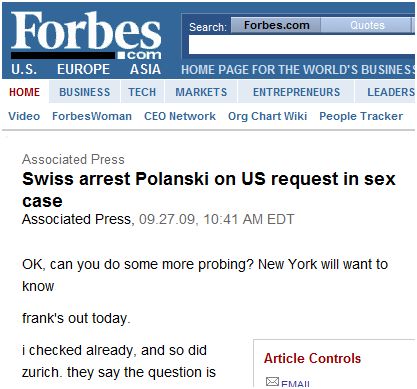
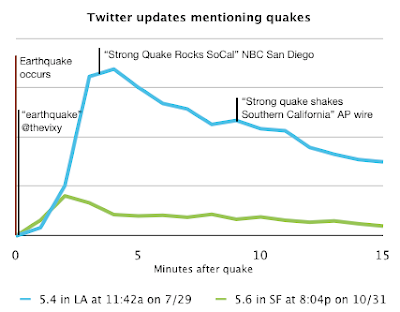
Today the same happened: Twitter was on fire with user reports of the Los Angeles earthquake 9 minutes before the first AP wire came out.

It’s an undeniable trend – but is it important?

I received some flak in comments to the previous two posts, for neglecting to mention that I was comparing apples to oranges.  New agencies have the responsibility to verify information and it takes time. Reliability over Speed.   Fair enough.  ReadWriteWeb asked the question: Did Twitter Really ‘Outshine’ the Mainstream Press?

The only thing Twitter does better than the traditional news is speed. It doesn’t do depth, it doesn’t do fact-checking, it doesn’t do real reporting. It does breaking news, and it does that very well — in many cases these days better than the mainstream press (in terms of how fast it breaks news).

Very well said, and I think we need both: speed and depth.   Ironically, MG Siegler’s post @ VentureBeat describing twitter’s power in such situations provided an example for the opposite by including what appeared to be the very first video footage of the LA quake.

I watched it without sound first, but was immediately suspicious:

I wonder what this video shows. It’s NOT the building shaking. The movement is too fast, and it’s inside the room, relative to the window frames  we see. It looks more like a camera quickly moved left and right.
If this was an indication of how the building moved, we’d see a lot less movement behind the window (inside) and a lot more outside.

It did not take long to get confirmation on Venturebeat:

Update 2: The 12seconds vid was fake, posted after the fact, a co-founder of 12seconds confirmed.

So there you have it.  People do take advantage of the relative naivete of social media and don’t hesitate to post fake news to gain 5 minutes of fame.   But that doesn’t undermine the importance of speed, which in some cases can provide early alerts and potentially save lives.  We need both.

Related posts: CNET News.com, Twitter Blog, Valleywag, Brij’s One More Idea , RexBlog.com, LA Times blog, Live Digitally.

Tags: , , , , , , , ,

I don’t normally do this, but I figured if re-tweeting on Twitter is accepted, then re-blogging should be OK, too.smile_wink

Some of my fellow Enterprise Irregulars are at SAP’s European Conference, SAPPHIRE 08 in Berlin, and James Governor juxtaposed two photos taken there:

James leaves it to the reader to work out which group the bloggers are.smile_eyeroll

Tags: , , , ,

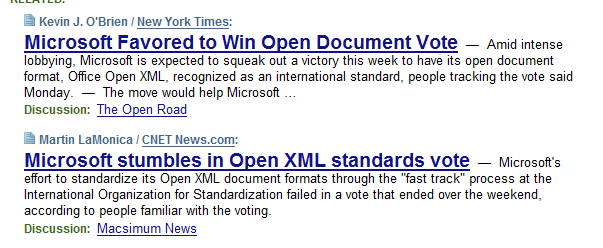
Screenprint from today’s TechMeme:

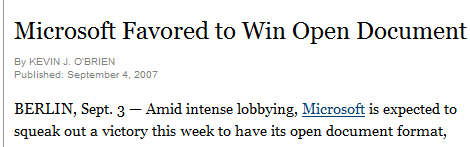
Did MS Win or Lose? Of course by now we know they lost, so what’s wrong here? It’s not Techmeme’s fault, the article they linked here is dated today (Sept 4th), but when you actually look at it, it’s obvious that the Times published a day-old material which simply “expired” before publication.

It’s not everyday to see such obvious contradiction, but since TechMeme started to lean more heavily towards traditional media, it’s quite typical to see the same news twice: first by bloggers, who publish it on the weekend, as the news occur, then by the big papers two days later as journalists come back to work.

Food for thought, Gabe. (Who, incidentally is not this Gabe).

Update: While the NYT clearly just stumbled publishing old information, Microsoft’s reaction: Strong Global Support for Open XML as It Enters Final Phase of ISO Standards Process is clearly a showcase of doctoring the facts.

The results show that 51 ISO members, representing 74 percent of all qualified votes, stated their support for ratification of Open XML…

You have to read through a full page to find this little hint:

Although no date has been formally set, the final tally is likely to take place in March 2008. ISO/IEC requires that at least 75 percent of all “yes” or “no” votes (qualified votes) and at least two-thirds of “P” members that vote “yes” or “no” support ratification of a format in the Fast Track process.

It’s up to the reader to figure out what really happened, as nowhere in the full-page document does Microsoft mention they actually lost a vote. Confused

Update (9/5): Today’s New York Times correctly prints: Panel Rejects Microsoft’s Open Format but this is published as news, without any reference to the previous. conflicting article by the same journalist. Techmeme list it as new…

Related posts: Ars Technica, Channel 9, Computerworld, bsi-global.com, Microsoft News Tracker, The Open Road,

Tags: , , , , , ,