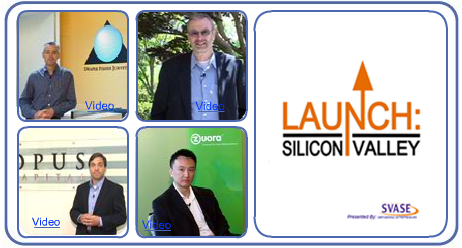
Startups, Present @ Launch: Silicon Valley 2009. Few Days to Deadline.
Bay Area, Marketing / PR, Social Networking, Startups May 4th, 2009
Startup Entrepreneurs who did not make it to the recent Under the Radar event, here’s your second chance: join us at Launch: Silicon Valley 2009, co-presented by SVASE, Garage Technology Ventures and Microsoft.

In fact it will be more than a second chance: while the UtR event focused specifically on Cloud Computing, Launch 2009 is designed to uncover and showcase products and services from the most exciting of the newest startups in information technology, mobility, security, digital media next generation internet, life sciences and clean energy. The inaugural Launch event was in 2006, combined with Guy Kawasaki’s Art of the Start conference.
Are these events worth attending? It’s your call … all I can say is since 2006 presenting startups received a combined $80+ million in venture funding.
So if you are building the Next Great Business in the areas mentioned above, are (almost) ready for launch, meaning that by June 9th, 2009 you will have a product or service available, but have not been out in the marketplace for more than a few months, then by all means send an Executive Summary of no more than 2 pages to Launchsv@svase.org. Submission deadline: May 8th, 2009 – yes, just a few days left. (Garage Technology offers a useful Writing a Compelling Executive Summary guide.)
Last year over 300 companies from all around the country and even overseas applied, so clearly the presentation spots are in high demand. Based on the submissions up to 30 companies will be invited to present at the Launch: Silicon Valley 2009 event on June 9th at the Microsoft Campus in Mountain View, California. Presentations slots are 10 minutes, running in 6 sessions of 5 companies each. Each presenting team will also be assigned a cocktail table in the Networking Room where they can meet with interested audience members one-on-one to answer questions and explore possibilities.
The evening before, on June 8th the presenting companies, registered audience and selected bloggers and media will be invited to a Pre-Event Party at a prestigious location in Palo Alto, providing a further opportunity for networking with Silicon Valley’s movers and shakers.
So if you are a qualifying startup Founder, remember the deadline: May 8th. For additional details and later for updates check http://www.launchsiliconvalley.org/ and you may also want to follow the event (actually the President of SVASE) on Twitter.
Guy Kawasaki called Launch: Silicon Valley “the poor man’s Demo”. SVASE proudly wears that badge, since this is an event with a price tag that won’t keep any startups away. It’s your turn now: send in the Executive Summary and launch with SVASE in June.
(Cross-posted from CloudAve. To stay abreast of news, analysis and just plain opinion on Cloud Computing, SaaS, Business grab the CloudAve Feed here.)
Tags: business events, DealMakerMedia, Demo, entrepreneurship, Garage.com, guy kawasaki, launch silicon valley, microsoft, product showcase, silicon valley, Social Networking, startup pitch, Startups, SVASE, Under the Radar, UtR, vc, vc Funding, venture Capital, xref
US Army Wikified
Collaboration, SaaS March 17th, 2009
WetPaint is one of my early “discoveries”, three years ago I called them the “wiki-less” wiki, as it blended wiki-like, forum-like and blog-like features long before it became fashionable. I haven’t followed them closely, but apparently they’ve been growing nicely, and today I saw this post:
The US Army on Wetpaint! – hm .. let’s see. The PE350 Wiki is a Virtual Classroom, set up by Major Mark Rea, who put his Cadets’ physical education plan online. This is cool on so many levels, I don’t even know where to begin…
First of all, it’s a truly professionally maintained wiki, with a Wiki 101 for new users, then details of the Syllabus, Lessons and Assignements, Cadet Fitness Challenge..etc. They use text, photos, videos, podcasts – you name it, this is a fully featured interactive social site.
Second, I grew up in a country where anything even remotely related to the Army was surrounded with utmost secrecy, and I am still somewhat amazed at the level on information publicly available about the US military. Granted, there are no strategic plans or weapons specs in this wiki, but still … 
Third… quick IM reaction from the first person I shared this news with:
Cool. Why is US Army resorting to free sites? Credit crunch
What a perfect fit for the Power of Less theme I just wrote about earlier today, in my Web 2.0 Expo post. Major Rea and his cadets are using Wetpaint instead of Blackboard, the market leader commercial software for Education. No, the US Army as a whole did not replace Blackboard with Wetpaint – but this particular unit did. It’s a good start – just like corporations using Google Apps or Zoho Business services here and there … usage grows, initially it may just be leverage in licence negotiations with Blackboard, Microsoft and the like… but one day, who knows…
. It’s nice to see the US Army SaaS-ified.
Oh, and for that Power of Less: it’s certainly less when it comes to what hey have to spend on software – but I’m not even sure it’s less when it comes to usability, participation. Could this also become the case of Less is More?
(from the PE350 video page)
(Cross-posted from CloudAve. To stay abreast of news, analysis and just plain opinion on Cloud Computing, SaaS, Business grab the CloudAve Feed here.)
Tags: Army, Collaboration, less is more, military, power of less, Social Networking, US Army, User Generated Content, w2e, web 2.0, Web 2.0 Expo, web2expo, wetpaint, wikis
LinkedIn: One Billion Dream Dollars
Business, Social Networking, Startups June 17th, 2008
Yes, I like LinkedIN, and am one of the very early users, from the early days before social networks become trendy. Simply because, unlike some of the more fashionable networks, I actually found it useful for business.
But is it worth One Billion Dollars? Apparently it is – if you ask Bain Capital Ventures, Sequoia Capital, Greylock Partners, and Bessemer Ventures, who just invested a whopping $53M with the even more whopping $1B valuation. $53 million is a decent exit for some startups – but LinkedIN has about $100M in annual revenues. Still, I really wonder what kind of stratospheric exit (IPO) valuation the current investors expect.
Or perhaps Kara Swisher is right:
Why go public when you can just pretend?
Exactly. 
Update (6/18):Â In celebration of entering the Billion-Dollar Club, LinkedIn is down.
Tags: ipo, LinkedIn, Social Networking, Social Networks, Startups, valuation, vc investment, venture Capital
One Day Left for Early Bird Rate to Launch: Silicon Valley 2008
Bay Area, Social Networking, Startups May 25th, 2008
I’ve pretty much said everything there is to say about Launch: Silicon Valley 2008, a joint event of SVASE and Garage Technology Ventures.
The presenting startup applications are in, being evaluated, and thirty of them will debut on June 10th @ the Microsoft Mountain View Campus.
There is another important deadline now: Monday is the last day you can register at the Early Bird rate, which represents a $50 discount.
See you there in June! 
Tags: Art of the Start, business events, DealMakerMedia, Demo, entrepreneurship, Garage.com, guy kawasaki, IBDNetwork, launch silicon valley, microsoft, product showcase, SDForum, silicon valley, Social Networking, startup pitch, Startups, SVASE, Under the Radar, UtR, vc, vc Funding, venture Capital
DemoCrunch 2008
Bay Area, Social Networking, Startups April 2nd, 2008
This year’s TechCrunch 50 Conference is planned to coincide with DemoFall, the (other) premium startup Launch event.
VentureBeat attempts to (well, sort of) explain it with scheduling, but make no mistake, this is a fairly open move against DemoFall, to establish TechCrunch50 as the premier startup launch event. There’s no question that TechCrunch can pull in just about the entire VC community – in fact given the audience pricing, $2000 early bird, and $3000 regular, it’s hard to believe anyone but VCs can afford to attend. Well, VCs and students, as those with a student ID can get in for $149.
The presenting companies will not be charged – that’s a huge differentiate vs. Demo. As I said before, you almost have to be already funded to be able to afford Demo’s fees. I leave it to you to decide which one is more startup-friendly.
Of course they want a real launch show, so the one hard condition is that your product /service will have to be new (unseen) at the Conference. Several commenters are already complaining that they are launching before September, which automatically disqualifies them.
I have a solution for you “early birds”: come join us at Launch: Silicon Valley 2008 jointly presented by SVASE and Garage Technology Ventures. Five of last year’s 29 presenters received venture funding, in aggregate of $30M. That’s not $140M, but not too shabby, either
.
How to participate? If by June 10th, 2008 (the day of the event) you will have a product or service available, but have not been out in the marketplace for more than a few months, then send an Executive Summary of no more than 2 pages to Launchsv@svase.org. Submission deadline: May 9th, 2008. (Garage Technology offers a useful Writing a Compelling Executive Summary guide.) Last year’s 30 (actually, 29) presenting startups were selected from 170 submissions. For details – and attendee registration – check out http://www.launchsiliconvalley.org/.
See you there!
Related posts: bub.blicio.us, Valleywag, Jason Calacanis, SheGeeks, ValleyWag, News.com, Silicon Alley Insider, : WinExtra, CenterNetworks, mathewingram.com/work, BoomTown, The Drama 2.0 Show, Geek Gestalt, /Message
Tags: Art of the Start, auto repair, business events, DealMakerMedia, Demo, demofall, entrepreneurship, Garage.com, guy kawasaki, IBDNetwork, launch silicon valley, microsoft, Pleasanton, product showcase, SDForum, silicon valley, Social Networking, startup pitch, Startups, SVASE, techcrunch, techcrunch40, techcrunch50, Under the Radar, UtR, vc, vc Funding, venture Capital
Launch: Silicon Valley 2008 – Call for Startups
Bay Area, Social Networking, Startups March 21st, 2008
Startup Entrepreneurs who did not make it to the recent Under the Radar event, here’s your second chance: join us at Launch: Silicon Valley 2008, co-presented by SVASE and Garage Technology Ventures and Microsoft.

In fact it will be more than a second chance: while the UtR event focused specifically on the business-oriented web applications, Launch 2008 is designed to uncover and showcase products and services from the most exciting of the newest startups in information technology, mobility, security, digital media next generation internet, life sciences and clean energy. The inaugural Launch event was in 2006, combined with Guy Kawasaki’s Art of the Start conference.
Are these events worth attending? It’s your call … all I can say is 5 of last year’s presenters received venture funding, in aggregate of $30M. 
So if you are building the Next Great Business in the areas mentioned above, are (almost) ready for launch, meaning that by June 10th, 2008 you will have a product or service available, but have not been out in the marketplace for more than a few months, then by all means send an Executive Summary of no more than 2 pages to Launchsv@svase.org. Submission deadline: May 9th, 2008. (Garage Technology offers a useful Writing a Compelling Executive Summary guide.)
Last year over 170 companies from all around the country and even overseas applied, so clearly the presentation spots are in high demand. Based on the submissions up to 30 companies will be invited to present at the Launch: Silicon Valley 2008 event on June10th at the Microsoft Campus in Mountain View, California. Presentations slots are 10 minutes, running in 6 sessions of 5 companies each. Each presenting team will also be assigned a cocktail table in the Networking Room where they can meet with interested audience members one-on-one to answer questions and explore possibilities.
Guy Kawasaki will deliver the opening Keynote, while the closing keynote will be by Tim Draper, Managing Director of Draper Fisher Jurvetson.
The evening before, on June 9th the presenting companies, registered audience and selected bloggers and media will be invited to a Pre-Event Party at a prestigious location in Palo Alto, providing a further opportunity for networking with Silicon Valley’s movers and shakers.
Here’s a list of companies that launched new products/ services at last year’s Launch Silicon Valley event:
BooRah, Catalog Data Solutions, ClearlyBest.com, Connectance, Datamash Corp., Data Robotics ($10MM venture financing, Q3 ‘07), DivinR, d.light design, Eyejot, fix8, Fog Screen,GroupScope, H3.com, Industrial Origami, Jaxtr ($9MM venture financing, Q3 ‘07), Kongregate ($5MM venture financing, Q3, ‘07), LogSavvy, MyShape (Undisclosed venture financing, Q3, ‘07), Nuvora, Ready Solar, Redwood Renewables, Sensl, Shapewriter, Smaato, SnapJot, Spresent, TelId, Truemors, Wrike, and Yodio.
So if you are a qualifying startup Founder, remember the deadline: May 9th. Registration fee (incl. Networking Table + 2 tix) for the invited finalists is $695 if SVASE members, $850 otherwise. For audience members, Early Bird registration is available at $145 / $195 until May 19th, after which only full price registration will be possible. For additional details and later for updates check http://www.launchsiliconvalley.org/.
Guy Kawasaki called Launch: Silicon Valley “the poor man’s Demo”. SVASE proudly wears that badge, since we’re bringing this event at a price that won’t keep any startups away. It’s your turn now: send in the Executive Summary and launch with us in June.
Update (3/21): I was just informed that the SVASE site as well as launchsiliconvalley.org is down, and will likely be so for the next 48 hours. Bummer, apologies for the inconvenience. In the meantime, Executive Summaries can still be sent to Launchsv@svase.org, and the , Early Bird registration works, too.
Tags: Art of the Start, business events, DealMakerMedia, Demo, entrepreneurship, Garage.com, guy kawasaki, IBDNetwork, launch silicon valley, microsoft, product showcase, SDForum, silicon valley, Social Networking, startup pitch, Startups, SVASE, Under the Radar, UtR, vc, vc Funding, venture Capital
Your Digital Friends: Less is More
Social Networking, Software January 11th, 2008
It’s almost two years ago that I “cleaned house” at LinkedIn, dropping from 500+ connections to about 300.
I had no clue about Dunbar’s number ( the maximum number of people one can maintain active, stable social relationships with, estimated at 150 by British anthropologist Robin Dunbar), I simply felt I had been to open accepting invitations from unknown people, and as a result, I barely recognized names on my LinkedIn contact list. I thought the very idea of LinkedIn was that it should be an online reflection of my real-life relationships.
Fast-forward two years, now we have FaceBook, Plaxo Pulse, Twitter, and a zillion of other places, and get inundated by friends request from new and new “social networks” never heard of before. Perhaps the rules changed a bit – people do “befriend” each other in cyberspace, without having met first. I can accept that to a certain extent, but I still think Dunbar’s number has merit, even in today’s world. Of course it’s not fixed at 150, for some it may be 80, for the uber-social ones 3-4-500? JP Rangaswami, blogging at Confused of Calcutta, (also pioneering adopter of social software as former CIO at Dresdner Kleinwort Wasserstein) thinks his digital Dunbar number is higher than 150:
I’ve sensed that I have a Dunbar number of around 300 in the digital world, and I’ve been delighted to find I know most of the steady ones. Over the years I’ve actually met most of the community of readers, usually at conferences. The face-to-face contact, in turn, leads to a deepening of the relationship, and we land up creating and developing links in FaceBook and Twitter.
JP is wondering if there’s a trend here, and asks his readers:
How many FaceBook friends do you have, how many regular readers of your blog, how many followers in Twitter, do you see a correlation between the three, if not why not, and so on. Do you tend to meet a core of this number on a face-to-face basis, if not why not?
I’m not a regular reader of JP’s blog – discovered this post via Anne Zelenka at Web Worker Daily, but even if I was a subscriber, I would not consider myself a “friend”. I might want to follow his ideas on Twitter (if I was twittering at all) but that’s still passive mode. I think this commenter to Anne is right:
I don’t think that “following” people on Twitter would be considered “stable social relationships”. A social relationship implies a two-way street, and in my book, one that I value with some significance. That’s not to say that online social tools can’t be part of real relationships, but you can’t just add up all the numbers and think it means anything.
Now, if I commented on JP’s blog several times, and he responded, we’d establish a form of conversation, which, over time would allow us to get an insight into each other’s mind – i.e. getting to know each other to some extent. Perhaps at that point it would be appropriate to “befriend” each other on FaceBook. (Not that I actively use FaceBook, which is increasingly becoming an advertising platform, and even before that I had found it somewhat of a time-waster.)
I still don’t think we’d be ready to become LinkedIn contacts, because that network is all about trust, and recommending / referencing “friends” in a business context. Call me old-fashioned, anti-social, but I think that level of trust requires more of a real-life relationship, so my LinkedIn numbers would be close to my Dunbar-number, the number of active social contacts I am able and willing to maintain.
Before they cracked down on them, LinkedIn got polluted by contact-hunters, so-called superconnectors who amassed thousands, in a famous case 16,000 contact records. Note the emphasis on records. It’s just that. Data records, not real relationships. FaceBook (possibly learning from LinkedIn) limits the number of contacts to 5,000, which some users, including Robert Scoble find inadequate:
I think it sucks because it isn’t scalable and falls apart at 5,000 contacts. It pisses me off more and more every day because of that scaling wall.
Robert is a celebrity, and the 5000 or so are in his fan-club. Just like the Twitter example above, he has followers, not active friends. Hyper-social or not, he also has a Dunbar-number. It may be in the higher hundreds, but not in the thousands. For the rest of us, non-celeb types, I still believe less is more, and our online networks should reflect our real-life one, instead of being an inflated collection of data records. (This line became Doc Searls’ Quote du jour
).
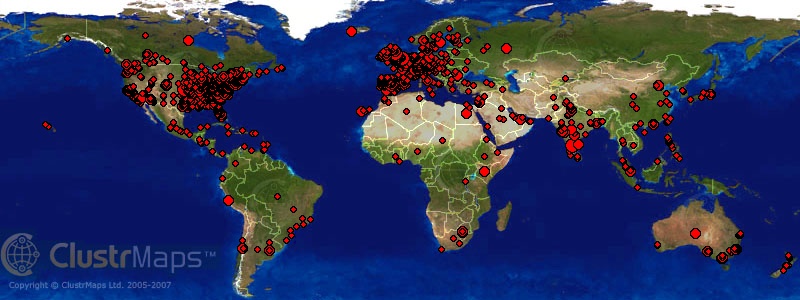
Finally, somewhat off-topic, here’s an observation from JP’s post: he’s using to ClustrMaps to monitor and illustrate where his readers come from. I understand the concentration in Europe, and also in the US, but what I am amazed at is the picture inside the US: what is this magical East / West divide? How come his readership drops so significantly in the Western half of the US?

Update (5/29/08):Â How Many Friends is Too Many? asks Josh Catone @ ReadWriteWeb .
Tags: contact management, digital friends, Dunbar, Dunbar number, facebook, LinkedIn, Social Networking, Social Networks, Social Software, superconnectors, Twitter
SVASE Event: How To Build A Lean, Mean, Global Operation From The Get Go
Bay Area, Social Networking, Startups October 28th, 2007
(reposted from SVASE)
The traditional model for startups of gaining traction in your home market and then expanding internationally is under extreme pressure. Some VCs say they only look at deals that come to them with well defined global strategies, and it’s no longer unusual for a startup to develop its technology in Israel, Finland or the UK, secure its funding in the U.S. and have its founders to be first generation immigrants from China, Europe or India.
Offshore? Onshore? Nearshore? Noshore?
VCs who once bragged about never driving more than half an hour to visit a portfolio company are jetting to Australia for optical engineers, Israel for security whizzes, India and Kazakhstan for brute software coding, South Korea for online gaming and Japan for graphics chips. And many say a global view is required just to keep pace with foreign firms quick to copy an idea.
• When does having a global strategy become a strategic imperative?
• How can cash strapped startups realistically address global markets without blowing up their limited resources?
• Is offshore product development really effective for a startup? Or is it just an endless wait for S/W that never quite works as you’d like?
• Do you really need to create different products for each international market?
• If you’re planning on operating on 4 continents, where does your management team reside?
• How important are international patents? Are they worth the time & cost?
• How do you gain traction in an unknown geography?
• What added value can the right investor bring to the party?
The Panel:
• Andrew Filev, CEO, Wrike
• Girish Gaitonde, Founder & CEO, Xoriant Corporation
• Faraz Hoodbhoy, Founder, EVP & CTO, PixSense, Inc.
• Peter Rip, General Partner, Crosslink Capital
• Sridhar Vembu, Founder and CEO, Zoho
Moderator: Peter Laanen, International Trade Director, Netherlands Business Support Office
WHEN:
Thursday, November 1
6:00 – 7:00 pm: Networking and hors d’oeuvres
7:00 – 8:15 pm: Panel discussion and Q/A
8:15 – 8:30 pm: Additional networking
LOCATION:
Wilson Sonsini Goodrich & Rosati (WSGR Campus), 950 Page Mill Road, Palo Alto, CA 94304
Tags: business models, business networking, crosslink, entrepreneurship, global startups, Outsourcing, panel, pixsense, Social Networking, Startups, SVASE, xoriant, zoho
Another Mashup Bites the Dust – or NOT.
Humor, SaaS, Startups October 17th, 2007
I already used this title, a little more then a month ago, and it’s no coincidence: back then I wrote about Gmap Pedometer, a handy little Google Map hack that allowed you to calculate the lenth of your planned hike. When all of a sudden Google Maps encorporated the same feature, that pretty much eliminated the reason for this mashup to even exist (although it still does).
It’s that time again: now that Google Maps went social, allowing user profiles, let’s spend a moment of silence in memory or of the mashup that has been doing the same for a long time: Frappr.
And remember: not all mashups get acquired by Google. Some just get assimilated. Resistance is futile. ![]()
Related posts: Google Operating System, Screenwerk, Search Engine Land, TechCrunch, mathewingram.com/work, ParisLemon and Mashable!
Update (10/18): In this case I’m glad to be proven wrong: a day later, Frappr is acquired. Also read Read/WriteWeb and Mashable!
Tags: Frappr, Gmap Pedometer, google maps, google mashups, mashups, Social Networking
Facebook Just Ain’t For Business, Get Over It (Business Needs Social Networking in Context)
Collaboration, Social Networking, Startups October 14th, 2007
I’ve stolen the first part of the title: Sam Huleatt’s best contribution to the New York Times article is giving it a new title that says it all. ![]()
The Facebook vs LinkedIn debate heated up again today, for the millionth time. The Facebook Fanclub’s recurring theme in comparing LinkedIn to Facebook is just how resume- and jobsearch-oriented LinkedIn is: go there, get what you want, then there’s nothing else to do there.
I’m sorry, but since when is this a complaint? Isn’t business all about having an objective and efficiently reaching it with minimum the time and effort? I suspect most of the LinkedIn “deserters” who switched to Facebook are independent types who have the time to hang around in Facebook, and are striving to enhance their personal brand.
Jeremiah’s Web Strategy Group is thriving which certainly helps boost his own brand. Robert Scoble wants to have more than 5,000 friends:
I think it sucks because it isn’t scalable and falls apart at 5,000 contacts. It pisses me off more and more every day because of that scaling wall.
Robert is a celebrity, and this is his fan-club. For the rest of us, I still believe less is more, (update: Doc Searls feels the same) and our online network should reflect our real-life one, instead of being an inflated collection of data records. We already saw the initial “link-mongering” on LinkedIn, but after a while things settled down, and the majority of LinkedIn users max out with 2-300 contacts, which is about the number of people you really, truly can know well. Now, somehow with Facebook all the netiquette is thrown away: I’m sure I’m not the only one flooded with invitations by people whose name does not even remotely sound familiar, and frankly, it’s frustrating.
I also fail to see the usefulness of seeing when my contacts watch a movie, pack for a trip, make coffee, or go to pee. This is a lot of noise with the sole purpose of gluing us to the screen (it works!), and made sense for on-campus dating, Facebook’s heritage, but let’s be real: how is this relevant to business? I’m not saying Facebook can’t be used for business at all – Jeff Nolan quotes a few examples:
Victoria Secret has a group for their Pink product line, 380k members and great interactivity, downloads, user generated content.
Ernst & Young is recruiting through Facebook and experiencing great results as a result of being connected with their candidates where they live.
So, yes, Facebook can be used for business, but these examples are all about external outreach, marketing, communication, recruiting. The point I’m making is, let’s not, while bringing everything Web 2.0 into the Enterprise 2.0 umbrella try to push Facebook to the corporate market – is has no value there. Let’s not equate Facebook to Social Networking, which is, and will be important for the Enterprise, but it needs context.
To illustrate my point, I’ll bring an example originally not “labeled” as Social Networking – oh, and the story has a Facebook-y twist, too.
ConnectBeam started their life as del.icio.us for business, but arguably they have developed into a business-focused social networking tool: in context, with purpose. Ironically, it was Facebook that drove ConnectBeam into this market in the first place.
Founder Puneet Gupta launched CourseCafe in 2005, with the intention of becoming for students’ academic life what Facebook has become for their social Life – in fact I called it “The Other Facebook” for a reason: We thought that while Facebook dominated 80% of students’ life, the fun part, there was room for CourseCafe to help organize the remaining 20%, their studies. They had a good product, received good reviews and started to get traction, spreading through several colleges. Ultimately Puneet became worried about potentially clashing with FaceBook, and at the same time he received interest from the corporate world, so he reinvented his business, this time focusing on the Enterprise.
The new business, ConnectBeam is social bookmarking for the Enterprise – but soon they took a new spin, expanding towards social networking. But doing it in the right way, in context. The context is finding co-workers who are likely engaged in similar activities to yours, or at least have similar interests, since they execute similar searches and are using the same tags you do. Their product is tightly integrated with Google’s Enterprise search, showing a combined result of what Google finds, what is tagged by how many people, and the list of users sharing that item or tag.
Tight integration to Google has become their “secret sauce” in terms of sales success, too: just about any large organization has already a Google (or Fast ..etc) appliance, a dedicated person with a mission and budget to spend on Enterprise Search – so in fact what they sell is “search enhancement”. ConnectBeam has only launched recently, but they already have Honeywell, CSC, Booz Allen Hamilton and other big names as paying customers.
They’ve come full circle: driven away from the college market by Facebook, now offering context-specific social networking, beating Facebook to the Enterprise. They will not get 40 million users, and Puneet will not become a billionaire, like Mark Zuckerberg (likely) will. They follow the good old-fashioned model: deliver value to businesses, who pay for it. That’s pretty good in my book. ![]()
Update: Of course the “LinkedIn vs Facebook” and “Facebook Sucks” stories are all over TechMeme:
TechCrunch, All Facebook, vanderwal.net Off the Top, CenterNetworks, Workbench, bub.blicio.us, Scripting News, /Message, WinExtra, Insider Chatter, mathewingram.com/work, Thomas Hawk’s Digital …, even Mini-Microsoft (wow!), PDA/Guardian,
Update #2: The you-don’t-need-more-friends lobby by Robert Scoble. I still belive he does not have 5,000 “friends” but a 5,000 (or more) strong fan-club. When you have 5,000 contacts, it’s a Rolodex (a term Robert used, too), not “live” contacts. And I suggest you read the comments to my old less is more post – re. the same subject, even though it’s on LinkedIn.
Update #3: Pfizer teams with Sermo, the “doctors’ Facebook” – Nick Carr writes about another contextual social network.
Update (10/15): Getting (Anti-) Social, the Web 2.0 Way – @ Wired & TechCrunch.
Wow! I’ve became Doc Searls’ Quote du jour. I’m honored.
Update (10/26): Naughty “Business” on FaceBook
Update (10/28): Beginner’s 5 Step Guide to Using LinkedIn and Facebook
Facebook Isn’t A Social Network, LinkedIn Is
Aussies as Adults: an Enterprise Facebook Story
LinkedIn and The Future of Business Networking
Tags: Collaboration, ConnectBeam, coursecafe, del.icio.us, enterprise search, facebook, link-spam, LinkedIn, search, social bookmarking, Social Networking, Social Software, social tagging, tagging


Zoli Erdos