SocialText Becomes Really Social

Collaboration, Social Networking September 30th, 2008

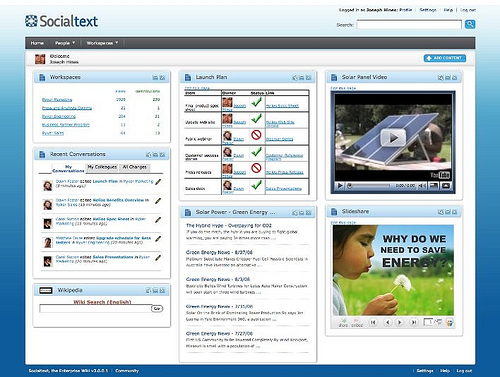
Socialtext, the enterprise wiki company is no more… a wiki company, that is.  Not since Socialtext 3.0, the new release announced today.   Founder and Chairman Ross Mayfield calls his new baby a Connected Collaboration Platform, that’s modular, built on a widget framework, and consists of:

A fourth piece, Socialtext Signals is in the works, in private beta testing – I guess we could call it Twitter (Yammer?  ESME?) for the Enterprise.  Actually more, since it involves active microblogging – quick messages – as well as pulling in what users do elsewhere (FriendFeed?)

The platform is flexible, easy to customize via widgets, clearly the vision is that in an enterprise environment actionable information is pulled in from the transactional systems, too – i.e. ERP, CRM.

Knowing Ross as the uber-social guy something tells me this is what he always wanted to to: create Social Software.  But I tend to agree with Jevon MacDonald, who differentiates social software from the wiki, which is primarily a collaboration tool.  So Ross was really in the collaboration business and given his name became synonymous with wiki evangelism, he will no doubt have a hard time changing that image. smile_wink

This is not to say the wiki part, should be neglected… It is the primary collaboration facility for anything not well handled by process-driven, transactional systems, and all this social layer is just the glue that holds it all together.  (Hint: you will hear a lot more about Glue soon).

I had in the past been quite critical of Socialtext’s wiki component, and am looking forward to revisit it, as part of our wiki-series in the coming weeks @ CloudAve.  In the meantime, enjoy this video:

Tags: , , , , , , , , ,

Your Digital Friends: Less is More

Social Networking, Software January 11th, 2008

It’s almost two years ago that I “cleaned house” at LinkedIn, dropping from 500+ connections to about 300.

I had no clue about Dunbar’s number ( the maximum number of people one can maintain active, stable social relationships with, estimated at 150 by British anthropologist Robin Dunbar), I simply felt I had been to open accepting invitations from unknown people, and as a result, I barely recognized names on my LinkedIn contact list. I thought the very idea of LinkedIn was that it should be an online reflection of my real-life relationships.

Fast-forward two years, now we have FaceBook, Plaxo Pulse, Twitter, and a zillion of other places, and get inundated by friends request from new and new “social networks” never heard of before. Perhaps the rules changed a bit - people do “befriend” each other in cyberspace, without having met first. I can accept that to a certain extent, but I still think Dunbar’s number has merit, even in today’s world. Of course it’s not fixed at 150, for some it may be 80, for the uber-social ones 3-4-500? JP Rangaswami, blogging at Confused of Calcutta, (also pioneering adopter of social software as former CIO at Dresdner Kleinwort Wasserstein) thinks his digital Dunbar number is higher than 150:

I’ve sensed that I have a Dunbar number of around 300 in the digital world, and I’ve been delighted to find I know most of the steady ones. Over the years I’ve actually met most of the community of readers, usually at conferences. The face-to-face contact, in turn, leads to a deepening of the relationship, and we land up creating and developing links in FaceBook and Twitter.

JP is wondering if there’s a trend here, and asks his readers:

How many FaceBook friends do you have, how many regular readers of your blog, how many followers in Twitter, do you see a correlation between the three, if not why not, and so on. Do you tend to meet a core of this number on a face-to-face basis, if not why not?

I’m not a regular reader of JP’s blog - discovered this post via Anne Zelenka at Web Worker Daily, but even if I was a subscriber, I would not consider myself a “friend”. I might want to follow his ideas on Twitter (if I was twittering at all) but that’s still passive mode. I think this commenter to Anne is right:

I don’t think that “following” people on Twitter would be considered “stable social relationships”. A social relationship implies a two-way street, and in my book, one that I value with some significance. That’s not to say that online social tools can’t be part of real relationships, but you can’t just add up all the numbers and think it means anything.

Now, if I commented on JP’s blog several times, and he responded, we’d establish a form of conversation, which, over time would allow us to get an insight into each other’s mind - i.e. getting to know each other to some extent. Perhaps at that point it would be appropriate to “befriend” each other on FaceBook. (Not that I actively use FaceBook, which is increasingly becoming an advertising platform, and even before that I had found it somewhat of a time-waster.)

I still don’t think we’d be ready to become LinkedIn contacts, because that network is all about trust, and recommending / referencing “friends” in a business context. Call me old-fashioned, anti-social, but I think that level of trust requires more of a real-life relationship, so my LinkedIn numbers would be close to my Dunbar-number, the number of active social contacts I am able and willing to maintain.

Before they cracked down on them, LinkedIn got polluted by contact-hunters, so-called superconnectors who amassed thousands, in a famous case 16,000 contact records. Note the emphasis on records. It’s just that. Data records, not real relationships. FaceBook (possibly learning from LinkedIn) limits the number of contacts to 5,000, which some users, including Robert Scoble find inadequate:

I think it sucks because it isn’t scalable and falls apart at 5,000 contacts. It pisses me off more and more every day because of that scaling wall.

Robert is a celebrity, and the 5000 or so are in his fan-club. Just like the Twitter example above, he has followers, not active friends. Hyper-social or not, he also has a Dunbar-number. It may be in the higher hundreds, but not in the thousands. For the rest of us, non-celeb types, I still believe less is more, and our online networks should reflect our real-life one, instead of being an inflated collection of data records. (This line became Doc Searls’ Quote du joursmile_teeth).

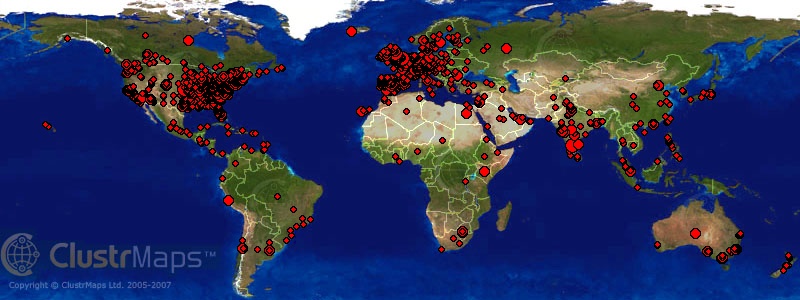
Finally, somewhat off-topic, here’s an observation from JP’s post: he’s using to ClustrMaps to monitor and illustrate where his readers come from. I understand the concentration in Europe, and also in the US, but what I am amazed at is the picture inside the US: what is this magical East / West divide? How come his readership drops so significantly in the Western half of the US?

Update (5/29/08):  How Many Friends is Too Many? asks Josh Catone @ ReadWriteWeb .

Tags: , , , , , , , , , ,

Facebook Just Ain’t For Business, Get Over It (Business Needs Social Networking in Context)

Collaboration, Social Networking, Startups October 14th, 2007

I’ve stolen the first part of the title: Sam Huleatt’s best contribution to the New York Times article is giving it a new title that says it all. thumbs_up

The Facebook vs LinkedIn debate heated up again today, for the millionth time. The Facebook Fanclub’s recurring theme in comparing LinkedIn to Facebook is just how resume- and jobsearch-oriented LinkedIn is: go there, get what you want, then there’s nothing else to do there.

I’m sorry, but since when is this a complaint? Isn’t business all about having an objective and efficiently reaching it with minimum the time and effort? I suspect most of the LinkedIn “deserters” who switched to Facebook are independent types who have the time to hang around in Facebook, and are striving to enhance their personal brand.

Jeremiah’s Web Strategy Group is thriving which certainly helps boost his own brand. Robert Scoble wants to have more than 5,000 friends:

I think it sucks because it isn’t scalable and falls apart at 5,000 contacts. It pisses me off more and more every day because of that scaling wall.

Robert is a celebrity, and this is his fan-club. For the rest of us, I still believe less is more, (update: Doc Searls feels the same) and our online network should reflect our real-life one, instead of being an inflated collection of data records. We already saw the initial “link-mongering” on LinkedIn, but after a while things settled down, and the majority of LinkedIn users max out with 2-300 contacts, which is about the number of people you really, truly can know well. Now, somehow with Facebook all the netiquette is thrown away: I’m sure I’m not the only one flooded with invitations by people whose name does not even remotely sound familiar, and frankly, it’s frustrating.

I also fail to see the usefulness of seeing when my contacts watch a movie, pack for a trip, make coffee, or go to pee. This is a lot of noise with the sole purpose of gluing us to the screen (it works!), and made sense for on-campus dating, Facebook’s heritage, but let’s be real: how is this relevant to business? I’m not saying Facebook can’t be used for business at all - Jeff Nolan quotes a few examples:

Victoria Secret has a group for their Pink product line, 380k members and great interactivity, downloads, user generated content.

Ernst & Young is recruiting through Facebook and experiencing great results as a result of being connected with their candidates where they live.

So, yes, Facebook can be used for business, but these examples are all about external outreach, marketing, communication, recruiting. The point I’m making is, let’s not, while bringing everything Web 2.0 into the Enterprise 2.0 umbrella try to push Facebook to the corporate market - is has no value there. Let’s not equate Facebook to Social Networking, which is, and will be important for the Enterprise, but it needs context.

To illustrate my point, I’ll bring an example originally not “labeled” as Social Networking - oh, and the story has a Facebook-y twist, too.

ConnectBeam started their life as del.icio.us for business, but arguably they have developed into a business-focused social networking tool: in context, with purpose. Ironically, it was Facebook that drove ConnectBeam into this market in the first place.

Founder Puneet Gupta launched CourseCafe in 2005, with the intention of becoming for students’ academic life what Facebook has become for their social Life - in fact I called it “The Other Facebook” for a reason: We thought that while Facebook dominated 80% of students’ life, the fun part, there was room for CourseCafe to help organize the remaining 20%, their studies. They had a good product, received good reviews and started to get traction, spreading through several colleges. Ultimately Puneet became worried about potentially clashing with FaceBook, and at the same time he received interest from the corporate world, so he reinvented his business, this time focusing on the Enterprise.

The new business, ConnectBeam is social bookmarking for the Enterprise - but soon they took a new spin, expanding towards social networking. But doing it in the right way, in context. The context is finding co-workers who are likely engaged in similar activities to yours, or at least have similar interests, since they execute similar searches and are using the same tags you do. Their product is tightly integrated with Google’s Enterprise search, showing a combined result of what Google finds, what is tagged by how many people, and the list of users sharing that item or tag.

Tight integration to Google has become their “secret sauce” in terms of sales success, too: just about any large organization has already a Google (or Fast ..etc) appliance, a dedicated person with a mission and budget to spend on Enterprise Search - so in fact what they sell is “search enhancement”. ConnectBeam has only launched recently, but they already have Honeywell, CSC, Booz Allen Hamilton and other big names as paying customers.

They’ve come full circle: driven away from the college market by Facebook, now offering context-specific social networking, beating Facebook to the Enterprise. They will not get 40 million users, and Puneet will not become a billionaire, like Mark Zuckerberg (likely) will. They follow the good old-fashioned model: deliver value to businesses, who pay for it. That’s pretty good in my book. smile_wink

Update: Of course the “LinkedIn vs Facebook” and “Facebook Sucks” stories are all over TechMeme:

TechCrunch, All Facebook, vanderwal.net Off the Top, CenterNetworks, Workbench, bub.blicio.us, Scripting News, /Message, WinExtra, Insider Chatter, mathewingram.com/work, Thomas Hawk’s Digital …, even Mini-Microsoft (wow!), PDA/Guardian,

Update #2: The you-don’t-need-more-friends lobby by Robert Scoble. I still belive he does not have 5,000 “friends” but a 5,000 (or more) strong fan-club. When you have 5,000 contacts, it’s a Rolodex (a term Robert used, too), not “live” contacts. And I suggest you read the comments to my old less is more post - re. the same subject, even though it’s on LinkedIn.

Update #3: Pfizer teams with Sermo, the “doctors’ Facebook” - Nick Carr writes about another contextual social network.

Update (10/15): Getting (Anti-) Social, the Web 2.0 Way - @ Wired & TechCrunch.

Wow! I’ve became Doc Searls’ Quote du jour. I’m honored.

Update (10/26): Naughty “Business” on FaceBook

Update (10/28): Beginner’s 5 Step Guide to Using LinkedIn and Facebook

Facebook Isn’t A Social Network, LinkedIn Is

Aussies as Adults: an Enterprise Facebook Story

The Facebook Fad

Tags: , , , , , , , , , , , , ,

Enterprise 3.0: Where Is It Headed? - Interesting Panel with the Wrong Title

Bay Area, Collaboration, Enterprise Software, SaaS, Social Networking August 13th, 2007

I’m not a big fan of the whole 2.0 /3.0 theme, but I have to accept the fact that Web 2.0 and related concepts have become commonplace, everyday terms that today we’re taking for granted. Enterprise 2.0, on the other hand is far more debated. Definitions range from loosely saying “Web 2.0 tools in the Enterprise” through Harvard Prof Andrew McAfee’s “Use of emergent social software platforms within companies, or between companies and their partners or customers” to MR Rangaswami’s much broader synergy of a new set of technologies , development models and delivery methods that are used to develop business software and deliver it to users.” Then we have a set of attempts to simply “get to the point”, without long academic debate, like lightweight software, or Meet Charlie, a simple yet effective slideshow that personalizes the story.

One thing there is agreement about is that there is no agreement - in terms of a definition, that is… but that does not prevent us from attending conferences like Enterprise 2.0 or Office 2.0, and more importantly, businesses from embracing Enterprise 2.0 to varying degrees. It is happening, whether we have a “final” definition or not.

However, I really don’t think we’re ready for Enterprise 3.0 - not now, not ever. There are quite a few articles on the subject, but they all come from the same author, Sramana Mitra (except for two old ZDNet articles quoting Shai Agassi and JP Rangaswami). Sramana has certainly “cornered” the market - except there really is no “market” if she’s the only one using the term. Her definition: Enterprise 3.0 = SaaS + EE. What’s EE? Extended Enterprise:

The modern enterprise is no longer one, monolithic organization. Customers, Partners, Suppliers, Outsourcers, Distributors, Resellers, … all kinds of entities extend and expand the boundaries of the enterprise, and make “collaboration” and “sharing” important.

Let’s take some examples. The Salesforce needs to share leads with distributors and resellers. The Product Design team needs to share CAD files with parts suppliers. Customers and Vendors need to share workspace often. Consultants, Contractors, Outsourcers often need to seamlessly participate in the workflow of a project, share files, upload information. All this, across a secure, seamlessly authenticated system.

Sounds familiar? Of course, back in the 90’s this is what we called (Extended) Supply Chain. I’m not sure we need to create another label just yet. But if and when something is so significant that it deserves a new name, let’s get a bit more creative … I’m with fellow Enterprise Irregular Thomas Otter, who humorously ranted:

  • The car isn’t called horse 2.0.
  • The lightbulb isn’t called candle 2.0
  • Fax (Facsimile) isn’t called letter 2.0

If we are so innovative in the 21st century, the least we can do is to think of some new terms that inspire. Think ROBOT, Television, Velcro, Radio, even scuba (Self-Contained Underwater-Breathing Apparatus) … If this stuff is really that innovative then it deserves a proper word.

Back to Sramana and “Enterprise 3.0″: next week she will be moderating a panel discussion of the MIT Club of Northern California, with the ambitious title: Enterprise 3.0: Where Is It Headed?. Excerpt from the event description:

Collaboration, wikis, blogs and social networking are new tools igniting the enterprise market. Service based models are emerging as alternates to desktop software and enterprise servers. In March 2007, Cisco acquired WebEx for $3.2 billion, stepping in with a splash in the enterprise collaboration space. Meanwhile, Google has assembled a whole suite of word processing, presentation, and spreadsheet tools and just acquired Postini, an email management company. Microsoft has been adding collaboration and knowledge management capabilities to its Windows Platform and just announced plans to offer Web-based versions of its applications. Then, there are exciting startups that are offering alternatives.

This panel will explore the impact of Web 2.0 on the prosumer i.e. the individual user in the enterprise and the evolution and integration of office tools, communication and collaboration technologies.

Sounds vintage Enterprise 2.0, if you ask me.smile_wink That said, I think it’s an exciting subject, and they will certainly have a first-rate panel:

  • Tom Cole, General Partner, Trinity Ventures
  • Cliff Reeves, GM, Emerging Business Unit Team, Microsoft
  • Jonathan Rochelle, Product Manager, Google Docs and Spreadsheets
  • Sridhar Vembu, Founder, CEO, Zoho / Adventnet last minute change: the event site now lists Tim Harvey, VP Planning, Webex, Cisco Systems instead of Sridhar Vembu.

Whatever we call it, I plan to be there. If you are reading this blog, chances are you’re also interested in these subjects, so if you happen to be in the Bay Area Wednesday evening, perhaps I’ll see you there. Here’s the registration page. (Warning: the form is way too long, asking for way too much information - vintage 1.0 stylesmile_omg)

Additional reading: Open Gardens, Portals and KM, Anne Zelenka, Luis Suarez, the FASTForward Blog, Read/WriteWeb, Chris Pirillo, Fake Steve Jobs smile_tongue , just to name a few…

Update (8/21): as much as I hate this 2.0-3.0 labeling, I like Don Dodge’s new formula: Web 2.0 = web app + 2 founders + 0 revenue

Tags: , , , , , , , , , , , , , , ,

Atlassian Taking On the World

Business, Collaboration, Enterprise Software, SaaS, Social Networking, Software, Startups, Technology August 15th, 2006

(Update: apologies for the dead video links, Youtube is apparently down, here’s their message: ”

We’re currently putting out some new features, sweeping out the cobwebs and zapping a few gremlins.“)

I’ve recently had a chance to meet Mike and Jonathan in Atlassian’s San Francisco offices, and frankly was blown away by their enthusiasm, the company’s growth, but most importantly by a demo of Confluence, the market-leading enterprise wiki.

Market-leading? Never heard of them, you may say …. Certainly they enjoy a lot less brand recognition than let’s say JotSpot or Socialtext, both of which enjoyed abundant PR from the moment they launched, largely thanks to Joe and Ross’s star-power. (Hey Joe, you were my early inspiration to get started with blogging, time for YOU to post again!). Lacking the “instant brand”, Atlassian spent their money on product development instead of PR, and it has obviously paid off. Watch this video for background:

Less PR or not, they are not exactly unknown to customers, as Confluence’s corporate market share is more than the others put together. From what I understand Confluence’s sweet spot is larger organizations, where administration, sophisticated permissioning schemes (groups, pages, activities…etc.) scalability, performance are increasingly important. (Yes, permissioning kinda goes against the social, “we’re-all-contributors” nature of wikis, but it’s a fundamental corporate requirement). The largest implementations currently run up to 30k users, but Atlassian is working on a clustered release that will be scalable to hundreds of thousands of users. Pricing also reflects the focus on large corporations: while at the entry-level Confluence is typically more expensive, at the high end (large user-base) it costs less then either Socialtext or Jot.

Despite it’s impressive feature-set and favorable price Confluence is not an available choice for some customers; namely those who are determined to use SaaS solutions. Confluence is strictly on-premise, download and install-behind-the-firewall software. Being a big believer in SaaS of course I would like to see them offer a hosted version, but today’s market reality is that only 10% of all software sold is SaaS. Atlassian’s own customer experience is that a lot of larger organizations do want their wiki behind the firewall, and competitors must have been receiving similar feedback, as both Socialtext and JotSpot are adding an installable product to their offering. However, Confluence may be missing out on the bottom-up, grassroots adoption by business users that both Jot and Socialtext are enjoying - at least until it becomes available on-demand.

And while the Founders did not have the star-power of their competitors 4 years ago, they are getting closer, having just received the 2006 Ernst & Young Eastern Region Young Entrepreneur of the Year award.. Watch the video of the Awards Ceremony here:

Congrat’s, Mike and Scott!


Tags: , , , , , , , , ,

Software 2006: Wikis Win

Bay Area, Collaboration, Enterprise Software, Personal Productivity, SaaS, Social Networking, Software, Startups April 6th, 2006

(Updated)
Wikis and blogs -social software in general - were the “latent” subject at Software 2006, popping up at several sessions throughout the conference.

In his opening keynote Ray Lane talked about the inter-personal enterprise: collaboration, increased participation through friendlier, better user experience; the user as an individual, “consumer” has to like the software, then will use it, and usage spreads within the company: a pull process, rather than push – the traditional enterprise sales model. This is exactly the model wikis are “sold”, as we discussed earlier. Ray specifically mentioned how useful they found using a wiki at Kleiner Perkins.

Then during the last panel, Toby Redshaw, CIO of Motorola talked about how he installed wikis and blogs: turned it on, decidedly not telling anyone “above” or laterally until it was too late for anyone worried about “control” to interfere. People discovered the new tools, started to use them, and before he knew there were 1900 blogs and 2000 wikis used in Motorola. Grassroots action at it’s best, just like Ray explained. Joe (JotSpot) and Ross (SocialText) could not have asked for a better plug of wikis, just minutes prior to their software showcase.

On the way from this session to the showcase room Ross was showing me his latest baby, Miki, the mobile wiki. One of the conference attendees (Director at a major organization) walked alongside us, overheard the conversation, and jumped in: “where can I get it?” Wow, I think Ross just closed a 30–second sale

There is something funny about these product names, though. Ross just found out that Miki in Irish slang means male genitalia… hm… close .. here’s the Urban Dictionary definition. Never mind, it didn’t hurt Jobby, won’t hurt Miki either. Incidentally, Miki in Hungarian is nickname form for Nicholas, and in Japanese a female name meaning “flower stalk.” Not bad.

The Miki launch was the last announcement of the day, then we headed off for some “Open Source” cocktails and appetizers.

Related posts – Miki seems to enjoy a warm welcome:

Update (4/8): It was fun to see JotSpot and SocialText together - would have been even more fun to see the third (and by the number of enterprise customers definitely not last) product: Confluence by Atlassian.

Tags: , , , , , , , ,