Archives for May 2006

post

SAP Without SAP – Duet

(Updated)
More than a decade ago as Project Manager implementing SAP solutions I could not understand why the Client’s PM showed absolutely no interest in getting SAP-trained, or even attempting to log on to the SAP system. The only software product he ever touched was email. Years passed, and as I climbed the ladder, I found myself in a similar situation: locked in to Office products most of the time – just like millions of corporate employees whose daily life does not involve actively conducting transactions in their Enterprise system (SAP). They need to occasionally review/approve an item or react to an exception alert though. They are the (often management-level) employees who will not directly use SAP, even though timely access to SAP data is critical to their decision-making process – or to somebody else’s daily job.

Thanks to Duet they can now have the SAP data at their fingerprints without touching SAP itself. The long-awaited (and often promised ) SAP-Microsoft Office integration has finally arrived.

What was announced at last years’s SAPPHIRE in Europe as the Mendocino Project became a product, the second preview of which was released a week before SAPPHIRE 06 under the name Duet. Considering Microsoft’s role, just having a friendly name is a major achievement itself – it could have been something as friendly as Microsoft Office Extension to mySAP ERP 2004, Enterprise Version, Release 1.0. (read Microsoft Uber-Blogger Robert Scoble on product naming…)

I’ve seen a presentation of some of the current features as well as the roadmap for the next year, and also had a chance to sit down with Dennis Moore, GM of Emerging Solutions, who provided the blogger group with additonal insight.

Currently Duet (which is a boxed product) supports MS Office 2003 and mySAP ERP 2004, and there are 4 business scenarios available:

  • Leave Management
  • Time Management
  • Organization Management
  • Budget Monitoring

The final release is due in June 06 and will soon be followed by two value packs.

Value Pack 1 is due in Q3 06, new scenarios will include recruitment and travel management, enhanced analytics and support for mySAP ERP 2005, the current platform which, per Shai Aggassi will stay for years to come.

Value Pack 2 is expected in Q4 06 with some line of business functionality becoming available, e.g. Sales contacts, activity, Purchasing. MS Office 2007 will be supported.

It’s important to clarify that Office will not become the primary user interface of the “transactional worker”, i.e. you will not be creating product masters, running a shop-floor, etc. What Duet is, is a natural fit for a workflow (think of roles, limits ..etc) -based processing of messages and underlying data triggered by events, rules and exceptions.

Duet’s importance by far exceeds what the limited number of currently available scenarios might imply: for SAP it means potentially tripling / quadrapling their user base, even if indirectly, and for Microsoft it’s another way to lock users into their Office suite.
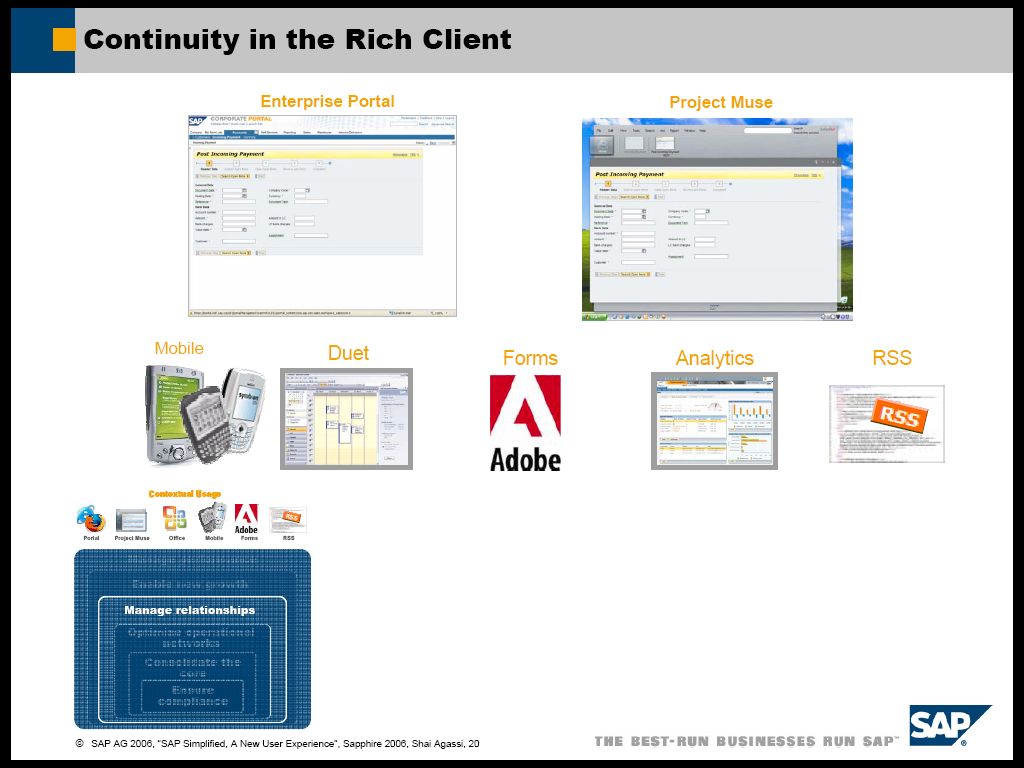
Duet is a step in SAP’s declared strategy of opening up access to their data and processes via a number of user interfaces, including Office, Portal, Mobile devices ..etc. It also fits in the “Sap Simplified” philosophy of owning the Business Processes and letting go of the user experience.

I tend to disagree with AMR’s concern on the large number of prerequisites: mySAP ERP 2004 or 2005, MS Office, Exchange server, and specific applications for some scenarios, e.g. E-Recruiting 6.0 for Recruitment Management, mySAP SRM 5.0 for purchasing management and CRM 4.0 for sales activity management. Yes, these are prerequisites, but the point is that even though Duet is a boxed shrink-wrapped (thanks for the comment!) product (I’ve seen a white box at SAPPHIRE, whether real or mock-up), it is not expected to sell as a standalone product on it’s own merits. It will expand access to additional users within corporate customers already using both SAP and Microsoft products, i.e. likely to already have the prerequisites.

Talk about prerequisites, pricing for Duet, and specifically the underlying SAP access will be an interesting challenge, since SAP’s model is typically charging $$$$ a smaller user base, while MS relies on $ from a large number of users – there has to be a model in between.

Not everyone in Microsoft welcomes Duet: the folks at MS Dynamics are clearly unhappy. They even produced a so-called White Paper comparing Duet to their own solution, Snap. “So-called”, because it does not even attempt to be unbiased. It praises Dynamics and Snap, while listing the dry facts about Duet, completely forgetting the fact that as Enterprise systems Dynamics and SAP are really apples and oranges… or I should say Ford vs. Rolls Royce.

IBM isn’t sleeping either: IBM to sing in Harmony with SAP to match Duet. IBM’s Harmony, which I haven’t had a chance to see, claims to play a similar role with Lotus Notes. It clearly is a competitive product, as far as Duet (which is jointly owned by MS and SAP) is concerned – but from SAP’s point of view, it’s just one more user interface, exposing more knowledge workers to SAP. The more the merrier.

Related blog posts:

Update (5/23) : Fellow SAPPHIRE blogger and SAP/MSFT investor Jason Wood posted a very detailed, thorough analysis on his blog – with screen prints and all the bells and whistles. Oh, and Jason – here’s my pick for a famous duo whose duet (pun intended) had an impact on the world. Update (5/30): Here’s an entire new blog dedicated to Duet (well, actually discussing Duet while promoting a 3rd-party solution). Thanks, Vinnie for pointing it out.
post

Cold Cash – Literally

Now we know the real meaning of “cold cash“:

A congressman under investigation for bribery was caught on videotape accepting $100,000 in $100 bills from an FBI informant whose conversations with the lawmaker also were recorded, according to a court document released Sunday. Agents later found the cash hidden in his freezer. (story by AP)

Related posts:

Tags: , , , , ,

post

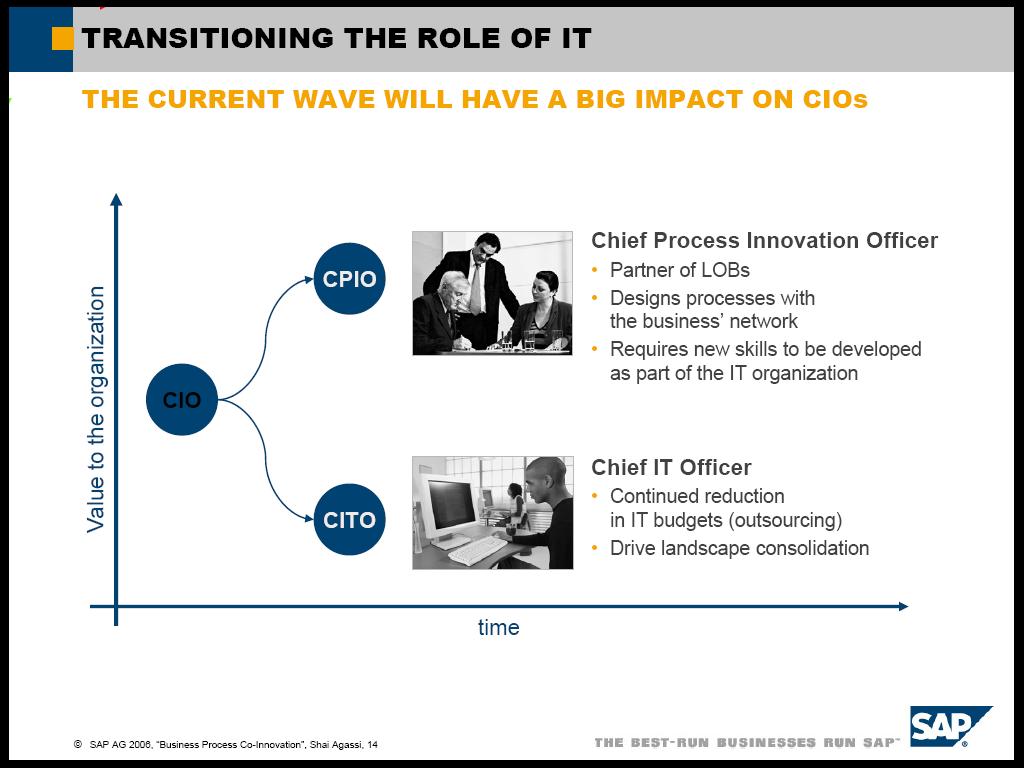
SAP’s Vision on the Changing Role of CIO’s

(Updated)
SAP is not a technology company, it’s the world’s leading business process company – says Shai Agassi, President of SAP’s Product and Technology Group.

Niel Robertson, one of the SAPPHIRE bloggers (or the Brotherhood as we’re often referred to) thinks through the consequences in an excellent article, The New Corporate World Order. It’s a very deep, thoughtful post, simply too good to summarize, please just read it. I was trying to find where I heard Shai express similar thoughts, and I realized it wasn’t at SAPPHIRE 2006, but at Software 2006, just a few weeks earlier. Here’s the relevant slide:

The entire presentation, titled Business Process Co-Innovation; “Enterprise 3.0” is available in PDF format here.

Update (5/23): Niel’s original posts created quite a debate, so he reposted the comments here. Wow, comments take over.. this is the real conversation!

post

Graduation Day – Class of 2006

Anywhere I go I see graduation gift commercials, so I thought this would be a timely post:

The embedded video will likely not work in feeds, so here’s the video link.

Tags: , , ,

post

The da Wiki Code

The (likely) most controversial movie of the summer, the da Vinci Code opens today.  Why just watch it?  Be part of uncovering the  Secrets Behind The Da Vinci Code.  This site is put up on the WetPaint platform, an easy-to-use mix of wiki / blog / forum software which the founders hope will facilitate interesting and vibrant online communities.  I wrote about them in the past, although at the time did not fully understand what they were all about.

Since most pages are “unlocked”, i.e. anyone can edit them, this will be an interesting social experiment to watch participate in.

Related posts:

Tags: , , , ,

post

Open Source Hotel Rooms

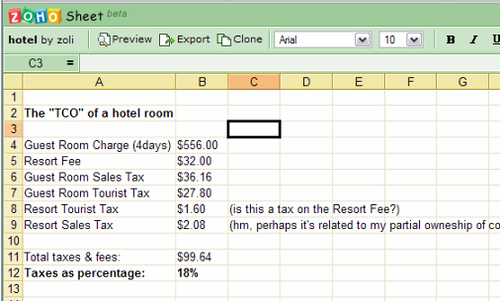
I’ve just checked out of my hotel at SAPPHIRE 06 and am shocked looking at the bill:

You can click to view the original Zoho Sheet.

Since I am still in a “software state of mind” (and btw, will return to SAPPHIRE posts soon), I can’t help but draw the analogy to the software industry:  Support and Maintenance charges in the Enterprise Software business are in the 20-25% range.  There is an ongoing debate about the viability of Open Source as a business model but several companies are experimenting with giving away the product and focus on additional revenue sources, i.e. support, maintenance, training ..etc.

Since the hotel industry is up to 18% in surcharges, why not make a dramatic move, “opensource” the rooms and make their numbers on all these other (bogus) fees?    (OK, before I get ripped apart, yes, I do realize running hotel rooms has actual material costs vs. downloading software, and that the Open Source model is a bit more complex … in other word, my analogy is far from perfect, but hey, it’s Friday afternoon, I am waiting for my plane and can have a little fun, can’t I?)

I see a lot more potential surcharges (on top of  the free rooms), like: clean hotel fee, airconditioning surcharge, towel fees at the pool, hot water fee in the bathroom, warm water fee at the pool,  low-noise airconditioning surcharge, no-cigarette-smell fee in the nonsmoking rooms, Broadband fee (yes, I know they already have it, but this would be extra for connection that actually works vs. trickles), private room fee (that is when you don’t get the keys to a room already occupied like it happened to me), fast or medium service surcharges at the restaurant..etc.  Of course when you can’t sleep at night because the damn airconditioning is so noisy, or when your nonsmoking room smells.. .etc, you don’t have to pay.  This could become the feedback / QA mechanism for the hotel industry, a’la the Open Source community support / QA in software.

The opportunities are tremendous, and we should not stop at the hotel industry.  Open Source the World!

post

S-type at SAPPHIRE 2006

No, this is not my car…but there is a reason why it’s here .. hold on tight … for the news ..


Update:  Since the news is out, the Jaguar S-type was obviously a reference to SAP’s announcement of CRM 2006s-release – of which I’ll write more soon.

Tags: , ,, , ,

post

SAP’s New On-Demand SRM Offering through Acquisition of Frictionless Commerce

Quick news from the press conference at SAPPHIRE 2006: Shai Agassi has just announced the all-cash acquistion of Frictionless Commerce, a leading Supplier Relationship Management (SRM) software provider. As a result of the acquistion, On-Demand SRM will be the second SaaS offering by SAP, following the recent introduction of On-Demand CRM. Second, but certainly not last, as Leo Apotheker clarified during the Press Conference, over time all SAP’s offering will be made available in the “hybrid” model.

Update: See initial analysis by AMR Research.

Related posts:

post

TiEcon 2006: Software Luminaries Panel : The Software Richter Scale: 1, 3 or 7?

Liveblogging the Software Luminaries Panel at TiEcon 2006.  (Note: I am obviously publishing this, as well as other TiEcon posts after the Conference, but will only do very basic editing, and some linking, essentially posting my original notes.   I’ve also deviated from the role of passive note-taker here, as this is a subject where I am somewhat competent, and can’t help but insert my own comments here and there – you will see those in italics.  I invite Panelist, participants to feel free and correct / add to my notes in the form of blog comments. Thanks).

There were parallel sessions run with industry luminaries in ballrooms next to each other. Moderator  M.R. Rangaswami opened on the humorous side: the audience picked the right session, as he peeked into the next room where the Semiconductor luminaries session would take place, and saw a sign there saying “semi-luminaries” 🙂   M.R. is Co-Founder of the Sand Hill Group and host of the recent Software 2006 conference (an annual event).  .

As introduction he uses his Software 2006 slides about  Software’s quiet revolution. Three major realities:

  1. Changes represented by SaaS , Open Source, while CIO’s indicate increased spending on software.
  2. Real business is in the Enterprise (but consumer technologies find their way into the Enterprise)
  3. Thriving ecosystem critical

Panelist(s)

  • Larry Augustin , Angel Investor, Founder VA Linux, SourceForge …etc.
  • Amit Chatterjee , VP Strategy SAP
  • Mark Gorenberg , Partner Hummer Winblad Venture Partners
  • Jason Maynard , Research Analyst Credit Suisse
  • Zach Nelson , President and CEO Netsuite
  • Sanjay Parthasarathy , Corporate Vice President Microsoft Corp. (Chief Evangelist of Microsoft Church)

Starting with a few canned questions for warmup, then taking audience questions.

Question:  Will there be a billion-dollar software company in SaaS? 

Jason:  Yes, Salesforce, NetSuite to begin with.. Client-server, on-premise screwed customers, overpromised, underdelivered. SaaS will be huge, it has barely  scratched the surface so far. 

Mark: Agrees.  Hummer Winblad did 12 pure-play SaaS investments. SaaS is most disruptive.  Siebel was the uncontested market leader and the appearence of Salersforce.com killed it. (I can’t help but insert my own opinion here: Sure, Salesforce squeezed Siebel from the bottom up, but two other factor were just as significant in their demise: the “overpromise, underdeliver” syndrome, i.e. customer dissatisfaction after expensive and lengthy projects; and the fact that SAP that already owns the Enterprise market significantly improved their own CRM  offering, and the integrated approach offers a better value proposition to their customers then the standalone Siebel CRM-only solution).  

Sanjay: We’ve already seen billion-dollar  SaaS companies:  eBay and  Google, just not in Enterprise.

Amit:  SaaS by itself is not a business model… for larger organizations hybrid models work better …with increasing process complexity and integration requirements there is a need for a mix of  on-demand and on-premise solutions.

Question specifically to Zach: Larry Ellison (Oracle CEO, owns over 50% of NetSuite, which is expected to pull off a billion-dollar IPO this year) stated that SaaS is only for SMB’s not for large corporations. Is that so?

 Zach: He is generally trying to avoid speaking for Larry. (They clearly have an interesting relationship, Larry has to be somewhat anti-SaaS, and Zach can’t really get into a public debate with his absolute majority owner. It seems to me that Larry is betting on two horses at the same time)  Nobody will switch software because they want to, or because SaaS ismore fashionable. First and foremost customers have a functionality challenge, which the software company has to meet.. Functionality is the primary consideration, and the delivery model supports it.

Sanjay:  We shouldn’t be talking about software as a service, it’s actually software + service.

Mark: A number of companies are selling to both small and large organizations. What’s exciting is that this is the very first time when medium sized companies can get the same functionality as the large guys! ( I tend to think the same is true for small businesses, in fact that may be an even more radical change, and it’s a mistake that analysts often only think of the midsize market when they speak SMB )

Jason: Disagrees with SAP’s Amit on the notion of need for hybrid.  Software needs to become a utility.  There is no room for innovation in most corporate  IT budgets, 80% of which is spent on running the infrastructure.  Let go of thee server!  I know it’s hard …it’s your baby … you may get visitation rights at your SaaS provider:-) (huge laughter at audience)

MR  makes a comment/question on recent high-profile outages in the industry, largely at salesforce.com but elsewhere, too.

Zach: Not all delivery models are created equal.  Sforce runs on “big iron”, (find article here) while Netsuite opted for a grid-like system based on cheap boxes. When a salesforce.com server goes down, it effects the majority of customers,  when NetSuite loses a box, a maximum of 50 customers are effected. This setup  also helps rolling out new versions smoothly, in a phased fashion,  while  Salesforce.com has to do it in “big bang” style.   Zach predicts Salesforce moving to a grid-like environment soon.

Larry: It’s about ease of adoption.  Software has become a lot easier to create, it’s acquisition is a painful process, and that’s the part that SaaS improves.

Sanjay: Service orientation helps picking best-of-breed solutions, mix and mach. The current trend of consolidation in the industry is actually contrary to it.

Amit: SOA is critical, some services in the cloud, others in the enterprise. 

Zach: Picking composite applications to mix and match is difficult, especially as business processes get more complex.. Composite transactional  applications are a fantasy –  far to difficult to synchronize.  Example: Microsoft CRM and Great Plains are hard to synchronize, even though MS owns the code for both.  Integrated transactional systems are unbeatable – that’s why SAP owns the Enterprise.

Question:  Consolidation, Oracle acquisitions .. getting bigger and bigger – is there room left for innovation?

Larry: Oracle is buying since it’s not doing a great job of innovation itself.  Startups have the benefit of new distribution mechanisms, SaaS, Open Source, user base helps them.

Amit: Lot of room for innovation by partners id they participate in verticals.  He “only” has 6000 developers, cant cover the whole world.(audience laughter)  Larry interrupts: I’d like that problem, I have 12. With 6000 how can you NOT cover the world? (even bigger laughter). Amit: Citibank has more developers then SAP.

Question about data privacy, Security. 

Zach: Especially for small, midsized businesses NetSuite’s security is better than running on local server next to coffee machine. 

Larry: Security is still a huge  unsolved issue.

Sanjay: The real data challenge is mashing structured and unstructured data. 80% of corprate data is unstructured  without business processes: xml is the glue. 

Larry: Html amplified the problem of huge amount of unstructured data, the future will be to move to have data in xml and html is just the presentation.

Question: Are there profitable SaaS companies?.  Sforce is barely profitable.

Mark: Salesforce.com is barely profitable, .Rigthnow is making decent profit,  employees (?_) is largely profitable.

Jason: Many are profitable,  SaaS lowers the cost of distribution – there is price elasticity in the market.  SaaS also helps reducing R&D, support costs – salesforce only needs to support one version, SAP, Oracle multiple ones.

Zach: When he joined NetSuite their sales model was direct. Now with success ecosystem develops.  Typically start with direct, build customer base, then ecosystem develops.

MR‘s comment/question: Software 2006 had a panel: Open Source: money machine or money pit? 

Larry: Open Source is a young model, there can not be a lot of profitable companies yet,  Red Hat beng an outstanding example.  On $10M in R&D Salesforce.com spends 100M in Sales & Marketing..  It’s cheaper to create software then sell it > Open Source helps eliminating the huge sales costs.

Jason concurs,  sales is 80% of cost.  Enterprise Software companies don’t make a lot of profit on software sales, their profit comes from maintenance.  Smart Open Source companies jump out of this expensive sales cycle and focus on support only.  They will increase botttom line while reducing top line.

Larry:  There is also a culture change: people did not understand software, they had to be educated and had to pay for that education.  Now everyone is computerized, carries a PDA, cellphone ..etc.  This means the  education need is reduced, good opportunity for Open Source’s pull model.

Question: SAP , MSFT will you be giving away your products free? 

Sanjay: Fuzzy answer on giving away software and promoting distribution. 

Amit: Support, explore Open Source, but not fully embrace.  SAP does not have the distribution channel that MS has. SAP needs to build ecosystem.

Question:  Will MS look into buying SAP?  Tried. Jason: pragmatic approach: it won’t happen, if for no other reason, the fight with the  EU..

Question: What Open Source opp’s exist? 

Mark: Recently made two investments into companies that develop applications for the lamp stack.  Issue: IP ownership, integration.  Sales issue: agree with the Open Source effect on lead generation, but how to close sales?  What happens when you move to markets that people don’t understand?

Question: any Open Source  companies to go public?  

Jason:  Potentially MySQL.  Markets pay 10-times sales, 30-times cashflow. Fewer, but better , more sustainable companies.

Question (more a remark) on SAP’s new compensation plan. Hasso Plattner recently  announced he is aiming at doubling the market, if they achieve that, the top 100 execs will make 100’s of millions.  Is that a realistic objective? 

Amit: The announcement certainly helps: -) but the true driver for growth  is product innovation.  

MR askes the panelists for their final remark

Mark: We’re in the greatest disruptive times. Hummer Winblad invested more in the past few years than in the previous 17..

Sanjay: Software industry does not spend enough time with users. 

Larry: Fantastic time to be a software entrepreneur.  Small team , little $, reach to market – not possible 10 years ago

Zach: It’s a great time to start a software company, when you do it, remember  you need a great application to run the business. (audience laughter; good plug for NetSuite …possibly the last one before going into pre-IPO silent period?)

Amit: Customers matter. SAP needs to focus more on the ecosystem.

Jason: MS announced spending additional $2B on emerging areas. Look at areas they are spending… go in those “white spaces”, since  they are good in seeing the  opportunities, but can’t exploit them properly.

Tags: , , , , , , , , , , , , , , , , , , , , , , , , ,

post

TiEcon 2006: Web 2.0 – Why Now?

Liveblogging  Mike “TechCrunch”  Arrington‘s  Web 2.0 – Why Now? panel at TiEcon 2006.  (note: I am obviously publishing this, as well as other TiEcon posts after the Conference, but will only do very basic editing, and some linking, essentially posting my original notes.  My added comments appear in italics)

Panelists:

  • Manish Chandra: Founder, CEO Kaboodle,  5 jobs so far, started at Intel, then 4 startups
  • Emily Melton: Associate, Draper Fisher Jurvetson. Left DFJ in 2002, re-joined 2005
  • Kevin Rose, Founder,  Digg. Prior to that Hosted national TV program, TechTV
  • Tony Conrad, Founder, CEO Sphere, also Investor
  • Jeff Nolan, SAP , Apollo Group,the  “Attack Oracle” team (he actually has this on his business card), until recently with SAP Ventures, top blogger.

Mike:  For warmup, let’s talk about the individual companies. Kaboodle is basically bookmarking, social shopping. Statistics show that 80% of all Internet activity is research, not transactions. Kaboodle does not close deals, trying to make money on research side. How did Manish come to the idea?

Manish: Was remodeling home, a lot of pain to find stuff – hence the idea (do all consumer sites really start based on personal experience, or are these just sellable stories?) 

Emily: Since she is a VC, will talk about a portfolio company that she’s a Board Member of: TagworldMike: That’s a  little startup that’s going up against MySpace and others – how can it have any chances? (The little guy vs. big guy issue came up in the morning session as well) and Emily’s reaction is similar: people want to  have presence on the web, relationships ..etc – Tagworld provides tools.

Mike: Huge fan of  Digg:.  50% of TechCrunch’s traffic comes from digg. TechCrunch has significant traffic on its own, but when one of his articles gets digged, the combined traffic typically brings startup sites down.  Kevin: It started as an experiment giving power back to community. Coolness is not determined by editors like it is on Slashdot, but by member votes – “diggs”.  It’s also a social application, digging an item also bookmarks it to your name, you can share, set up friends…etc. 

Tony: Sphere, the new blog search engine. Previously he invested in Oddpost, (acquired by Yahoo, fastest return of all his investments), that’s when idea started. He saw when celebrity bloggers like  John Battelle and Dave Viner blogged about them, their traffic spiked: that was his “aha” moment re. blog-power.  Blog search engines typically bring posts in reverse chronological order… trying to dig up interesting stuff using a more intelligent algorithm.

Jeff didn’t get to talk about his company (SAP), since it’s not exactly a startup or a Web 2.0 🙂 However, previously as VC he backed several startups and in his current role (or outside that role?) he is SAP’s internal Web 2.0 evangelist.

After the warmup round Mike moved on to audience questions.

Question to Mike on criteria for picking what gets covered in TechCrunch.  –

 Mike: anything new, exciting Web 2.0-related.  What is Web 2.0?  He has a user-focused definition. Web 2.0 is about conversation.   In the years after the crash the Internet did not “go away”,  innovation continued behind the scenes. Joe Kraus’s famous quote about how cheap it is to build a company (new cheap tools).

Kevin: Spent $99 on a shared server, used Open Source stuff … total pre-launch cost for Digg was less than $1K. 

Jeff: LAMP stack important.  Php, Python powerful. Tension  between what developers built and what users want resolves itself in the increasing number of  mashups.

Emily: There is a major mindset-change. everyone has access to computers, pdas, cellphones .etc. Even the kids have web presence.  It’s become a lot easier to self-publish and even  build applications.

Question: Is Web 2.0 real or a bomb waiting to go off?

Mike: There is real innovation.   Web services, mashups. 

Jeff:  Web 2.0 is not really new, it’s the realization of everything that’s been happening for 5 years.  Barrier of entry for startups is low.

Manish: Closed platforms are out of fashion , the trend to opening  up leads to  mashups. Power goes back to the individual. People create new shopping pages of their liking on Kaboodle.  This is like walking into a store and rearranging the shelves the way we want it.

Tony:  Brings up the example of the Chicago Crime Scenes mashup. Nice application, hugely popular, even useful, but likely not a business.  Business opportunities are for those that open up their API.  The Blog space brings about businesses (e.g Technorati) with significant core IP, but most mashups are just nice presentation layers without core IP.

Question:  How to market?  Importance of early adopters? 

Mike: refers to the Same 50K people meme – echo chamber.  TechCrunch readers themselves often  re-blog his posts. They are all early adopters, which is demonstrated by  the browser stats:  65% use FireFox.  

Emily: VC’s also check out TechCrunched applications – then forget them, don’t come back (I have positive personal experience on this, when VC’s who earlier heard about SQLFusion  came back with renews interest after the Open Source Fusion beta.  So it does not hurt to to get on VC’s “keep an eye on” list).  Emily: Simply quoting high registration numbers is not compelling to her – repeat user base is.

Manish: Blogs can create  good initial exposure, then incresingly use  SEO, SEM… early days 6-7% was organic search (google, yahoo), now it is 20%.  Real viral effect occurs  when people start marketing your product.

Tony: Despite the criticism, the early adopter crowd makes sense, after all we’re in tech businesses, of course we attract the geek crowd… like if you’re in the sailing business, you go after sailing enthusiasts.

Mike: Asking Panel for example of successful marketing that gets beyond early adopters.

Tony: Flickr is definitely way beyond the early adopter crowd.  Mike:  Flickr is geeky,  overall it has a lot less users  than Yahoo photos (even though Yahoo acquired Flicker, they are treated as two separate domains for now), or even Easyshare by Kodak. 

Short debate between Tony , Jeff, Mike on the role /importance of early adopters.  Tony : blogging needs to get into topics that attract the mainstream, be it the Chicago Cubs, christianity .. whatever.

Manish: Skype forced adoption by uncles & aunts in Chicago, Ohio …etc. since it has a very attractive value proposition compared to expensive telephone services.

Jeff: many companies are building features ONLY for the early adopters – they will not transition to mass market, will not become businesses, just features.

Kevin: Digg has 9 million page views, 1 million unique users a day, with $0 spent on marketing.  He still thinks they are early adopters, the site hasn’t hit mainstream yet.

Tony : Sphere received 1 million pageviews in the first week, from  136K unique users. 

Jeff: Blogs are key in early adoption:  Even if you’re not a techie you will  search on a car, a new TV ….etc,  you’ll get blog entries mixed with other search results (My personal experience confirms this, blogs even penetrated news at “elite” positions).

Tony: Bloggers have huge influence.  Rob Hof is here in the audience, he is the  Silicon Valley bureau chief for Business Week and also writes a personal blog.  Jeff: Matt Marshall is here, too – I don’t read the Merc anymore, but SiliconBeat.

Manish: Print media still has bigger effect. He suggests Web 2.0 companies should look at both print media and blogs for marketing.

Mike: The New York Times is crap.  .

Question: Can open API’s can bite you in the ass? (pardon my French, I’m just quoting here)  Giving away your best stuff, people won’t come back to your site – i.e. Google or Craigslist if the mashup is better.

Manish : Open API’s bring huge adoption.  Get users first then figure out how to make money.

Mike: At the same time ate least you can’t have negative margin – this could be Youtube’s problem.  There are essentially three types of business models:

  • advertising revenues
  • fees
  • no revenues at all

Tony: There were debates in the early days about email as a business, since it’s supposed to be free. But would Yahoo exists without email?

Jeff on network effect: Flickr, del.icio.us are used in a lot of other applications..

Question:  Is the barrier of entry different between Web 1.0 and Web 2.0? 

Mike: It’s become easy to to recreate applications.   I could hire offshore programmers and recreate Digg cheaply (especially considering Kevin’s own statement that it cost less then $1K to launch).  This is where the network effect and being first to market becomes important.  We need to understand how network effect and first to market are related.  Tony has the 8th or 9nth search engine (Sphere), Emily’s Tagworld is also a “latecomer” yet they have a chance to make it, they are not dependent on the network efffect of the huge existing user base, and they have new IP.  Digg is a different story, it’s not core IP, it’s all about the huge network effect.

Kevin: There are too many copycats doing he same things…like online notepads… Disagreeing with Mike, does not see value in being a me-too, startup should do new things.

Out of time, (session got cut short due to security for the Schwarzenegger keynote) Mike asked all panelists to name their favorite Web 2.0 companies (except their own).  The list:

Flickr, Myspcae, Digg, Digg Spy, (yes it is part of Digg, but Emily made the point of specifically listing Spy) TechCrunch, Youtube, Akismet, WordPress, Del.ici.us, Riya, Skype.

If you were a panelist /participant in the discussion and I misinterpreted you, please feel free to correct / expand on your ideas in the form of comments.  Thanks.

Tags: , , , , , , , , , , , , , , , , , , , , , , ,