Archives for June 2006

post

Vonage not giving Customers a Break – Why Should it?

(Updated)
I can’t believe this madness… everyone crying foul, provocative titles like Vonage not giving customers a break create a feeling that somehow Vonage screwed (pardon my French) their customers and somehow should compensate them. That’s Nonsense!

Now, let me just say I called the Vonage IPO a dud several times, first based on fundamentals, then the last straw being the customer-solicitation, that was as bearish an indicator as it gets.

But that has nothing to do with the fact that customers who bought the shares are responsible for their own decision, and can’t expect to be bailed out after the fact. I certainly agree with Jason, Caveat Emptor still applies. The stock market is not for everyone. Jason goes on saying everyone had access to the company’s S-1 filing – well, not everyone can interpret those documents, but in this case there really was no need: all one had to do was do a simple search on Vonage IPO and there was a barrage of highly sceptical articles in plain everyday language. It really must have been difficult not to see any of these warnings. But none if that matters; customer-investors made their own decision and are responsible for it. If they went to Vegas and lost thousands a night, they would not claim their money back, either.

So let’s get some facts straight:

  • Vonage is a technology innovator, they pioneered the VOIP market.
  • They had a chance for an IPO 1.5-2 years ago. Yes, I know the overall market was not favorable, but back then they were the VOIP industry, they had to expect competitors to rain on their parade sooner or later
  • The VOIP market is now being commoditized, they will become a marginal player. Thank you, Vonage, for bringing us this technology, you’ve done your job, now you can go.
  • Stock trading is dangerous to one’s health, the IPO market especially. It’s the Big Boy’s game, little guys get scr***d.
  • Availability of pre-IPO allocation to retail investors is a fool-proof sign that the stock will tank.

On a personal note, I am not pretending to be particularly smart here, I paid heavy tuition when I was stupid enough to actively trade in 1997. In fact back then I seriously considered writing an anti-daytrading book – had blogging been available, it would have been so much easier…

Update (6/2): Jason brought up a really interesting point in his comment below:Let’s say the average customer lost $300-$400 on the IPO (i.e., they got 100 share allocation), and that’s got them angry enough to leave Vonage? Hmmmm…sure doesn’t sound like Vonage is providing a service that customers can’t get elsewhere, does it?

It sure doesn’t , Jason. Now, I’ll be the contrarian again . Just like Vonage’s poor business performance had nothing to do with the fact that investors need to pay up, I don’t think their loss should be linked to continued use of service. Of course it will be, since we tend to be emotional, but c’mon people, let’s learn to make rational, not emotional decisions.
You should judge the usefulness of Vonage service on it’s own merits, and that of the competitors, not on whether you lost money on the stock or not.

The real bad sign for Vonage is that even on it’s own merits I find less and less reason to maintain service. It was great while it lasted, but I barely use my phone now, Skype or VoipStunt is so much more convenient to use. That’s what Vonage should be worried about… not that they can do much about it.
Of course, for Jeffrey Citron Apr

post

Animal Farm, 2006

This is insane, ridiculous, racist, shameful, Orwellian … I am speechless. And I am shocked that it is broadcast on TV, in fact “being considered” by politicians in Washington:

Scott Silverman, Chairman of the Board of VeriChip Corporation, has proposed implanting the company’s RFID tracking tags in immigrant and guest workers. He made the statement on national television earlier this week.

Silverman was being interviewed on “Fox & Friends.” Responding to the Bush administration’s call to know “who is in our country and why they are here,” he proposed using VeriChip RFID implants to register workers at the border, and then verify their identities in the workplace. He added, “We have talked to many people in Washington about using it….”

Related posts:

Update (11/14/07): Read Sheep at Between the Lines.
Tags: , , , , , ,

post

You Know Wikis Have Arrived When ….

You Know Wikis Have Arrived When …. they become the feature post in your regular junk mail – this time from an Executive Recruiter firm:

What in the World is a “Wiki”?

If you don’t know what a Wiki is, you probably should.
The term “Wiki” refers to both a collaborative site on the web or your company’s intranet/extranet and the software that runs the Wiki.

A wiki is a website designed for collaboration. Unlike a traditional website where pages can only be read, in a wiki everyone can edit, update and append pages with new information, all without knowing HTML, simply by using a MS Word type interface.

Wikis are the latest, greatest tool for group collaboration, project teams, document editing, etc. And, best of all, they are easy to use, affordable, and extremely flexible.

The easiest way to learn more is to click on the link at the end of this section of the newsletter and try it for yourself!

What can you do with a wiki?
Whether you’re at work or at home, you can access and use a wiki. The wiki allows free-form collaboration, but most wiki software providers and hosts also offer structured applications that allow you all kinds of very helpful functionality.

Here are some of the things that can be done (depending on whose software you use and what applications may be available:

  • Create an intranet
    Publish company information, such as news or employee guidelines
  • Project management
    Schedule project deadlines, assign tasks, and define product specifications
  • Document collaboration
    Multiple users author documents with aid of version history
  • Manage a group’s activities
    Utilize event calendars, discussion forums, blogs and other apps
  • Collaborate with virtual teams
    Communicate with remote contractors or clients
  • Track software bugs
    Log defects and build custom queries
  • Call center support
    Access case histories and increase customer support

A wiki can be hosted on your company servers or there are a number of hosted versions available. There are a number of suppliers, each touting advantages over their competitors, of course.

One important aspect of a wiki — it is highly cost- effective and versions/solutions range from those for the smallest teams on the most limited budgets scaling up to full enterprise versions.

If you are unfamiliar with this explosive growth phenomenon, you may want to take a look for yourself. [Company name] has found one supplier offering free trials. It’s pretty neat stuff and has become indispensable in our own operations. Click the link below for a free trial.

This is not a [Company name] product but we have used the free trial ourselves and had no problems, no hassles, and no sales calls. It just takes 30 seconds or so to sign up.


For spam, this is actually pretty good. The original letter pointed to the signup page of one particular provider, and of course the sender forgot to disclose the paid referral relationship … So instead of just one, here’s a list of a few wiki providers:

Confluence and Socialtext are both Enterprise Wiki’s , robust, well-supported, targeting corporate customers.
JotSpot is more geared towards smaller businesses and consumers and in fact it’s a mix of a wiki plus a few basic applications.
Central Desktop is a “wiki without the wiki”, more of a full-featured collaboration platform with calendar, task, project ..etc features.
WetPaint blurs the line between wiki, blog and discussion group, providing an amazingly easy to use interface, but it’s currently at beta stage.

The above list is by far not complete, it’s just a few of the top of my head – feel free to contribute in the comments section.


post

Growing Faster than TechCrunch – Thank You, Netvibes

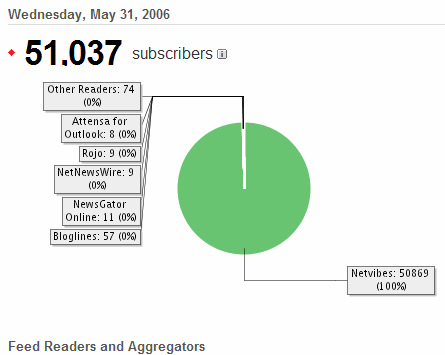
Don’t worry, dear reader, TechCrunch is still doing OK – their Feedburner subscription base grew almost 100% overnight.  But it pales in comparison to my 2.5million % growth rate … yes, I went from 200 or so to 51k.   Jeff Clavier did quite well, too, at 56k, but hey Jeff, I am catching up!

OK, now that I had my coffee and am awake (?),  let’s look at what really happened. 

The culprit is clearly Netvibes – or to be precise, I don’t know if the error is on the Netvibes or Feedburner side, but clearly the Netvibes numbers are solely responsible for the inflated stats.  The “fluff factor” is not a multiplier, they simply appear to have added a base of 50K or so to all statistics.

Hm… perhaps it’s not a glitch, it’s a “feature”, since NetVibes just installed an upgrade Hey Netvibes (or Feedburner?), I hope I get a “finder’s fee” for pointing this out: when you fix this, could you please leave my base at… say at a tiny 10K bonus level… I promise I won’t tell.

Related posts:

Tags: , , , , ,