Archives for January 2008

post

Can the Software Sector be Resilient to Recession?

I was very lucky in the early 90’s being in an industry that was not only shielded from recession, in fact it was thriving.  Corporate America was taught to fight their way out of the slump by Business Process Reengineering, and what better way to execute it than by implementing new integrated business information systems.  The slump for the rest of the country was a major boom for SAP, and the entire ERP industry born in their footsteps.

Today we’re amidst another technology change, one that may just ensure relatively smooth sailing through a recession for the Software sector – at least those who are on the right side of the change.smile_wink  The belts will be tightened, says the New York Times, but technology will still grow, just at a slower rate:

Overall growth in technology spending may fall from 7 percent last year to 4 percent or less this year, according to estimates by IDC, a research firm.

But that won’t be nice 4% growth for the entire industry; I strongly believe pioneers of Software as a Service (SaaS) will be amongst coming out of a slow-down as winners, leaving others in the dust. 

TechCrunch is optimistic for the entire Web 2.0 business:

All of those Enterprise 2.0 startups out there, or even Amazon trying to sell Web-based computing infrastructure, are actually at an advantage. Customers are more likely to try cheap cloud computing when they can no longer afford the alternatives.

ZDNet’s Dan Farber disagrees:

Most of the Web/Enterprise 2.0 startups can’t get a hearing with CIOs and tech buyers at corporations. While consumer applications are influencing corporate applications and coming in through the back door, Enterprise 2.0 apps (blogs, wikis, predictions markets, social networking, mashups, collaborative cloud-based apps and technologies such as RSS and tags) are just beginning to reach the radar of larger corporations, and they are not considered mission critical, which is where the money is funneled first

I think they are both right – and wrong.  I don’t agree that the entire Web 2.0 sector is immune to a down-turn: the advertising market will shrink,  the “lets-grow-insanely-who-needs-a-business-model” types will suffer. As Software VC Will Price says:

It may well be that Slide raising $55m from mutual fund companies at $500m+ pre-money will be the “what were we thinking” moment of the current cycle.

I also agree with Will, that a movie we’ve all seen will be playing again:

The last downturn saw the valley swing violently away from consumers to the enterprise – bastions of value, hard ROI, tangible value propositions, enterprise pain points and budgets, etc became the mainstay of investment decisions and the consumer, I kid you not, was literally a bad word…
The valley became all enterprise, all the time.

It will not be all, and not only Enterprise, but Business Software, whether for the Enterprise or small businesses will come back with a classic, “old-fashioned” business model of actually charging for value (product or service) delivered.  Of course there is still the dilemma of selling business software – much better if you don’t have to, it is getting bought instead. smile_shades  Yes, Dan is right, “Web/Enterprise 2.0 startups can’t get a hearing with CIOs and tech buyers at corporations” and their  apps are not considered mission critical, but the whole point is that a lot of these Enterprise 2.0 tools are not sold at the CIO level.

The after-bubble nuclear period of “no IT spending at all” found me at a startup. We did not exactly hit it big, but did not go under, either, and that’s because our model allowed us to get in the door way below the threshold that would have required higher authorization. Not classic SaaS, rather SES (Software Enabled Service), we were essentially data providers and often got into an “enterprise” account at $3k for the first month … ramping up to $60-$100K annually.   Anyone familiar with Enterprise Sales knows the term Economic Buyer:  typically getting involved later at the sales cycle, approving or nuking the deal.  Well, we saw no Economic Buyer: being under the threshold, we sold to the User directly.

As Zoho CEO Sridhar Vembu adds to the discussion:

It is useful to remember that both Salesforce & WebEx thrived during the last recession – in fact they were relatively unknown during the last boom. Cost was a major part of the reason they thrived in the bust.

Indeed. Software as a Service and the typically associated pay-as-you-go model allows businesses – enterprise and SMB – to use software without the typical upfront investment the traditional model would require, therefore SaaS providers have a good chance of withering a Recession.  Another noteworthy idea in Sridhar’s response is that they really don’t have to have a “massive win”, a total move from the desktop to the cloud: a “marginal” business  is good enough.

Of course this “marginal business” is not as attractive to many startup entrepreneurs as fast forwarding to the IPO, preferably over $1.5B. In fact it’s really boring… building a business gradually; no IPO thrill; serving millions of customers, helping them actually conduct business.  Oh, and making millions of dollars of real revenue in the process – not bad, if you ask me.  And it’s quite bubble-proof. smile_wink

Related posts: Vinnie Mirchandani –  Why it will be very different this time, Fred Wilson- This Time Will Be Different.

Update (1/28): Forrester Research predicts gains for Enterprise Web 2.0 apps in 2008.   Also read: Between the Lines, ReadWriteWeb.

post

Translating Art for Geeks


There’s a lot more in this set by “Paul the Wine Guy”.

(Thanks, Eszter).

post

Startups: Executive Hiring Challenges or Beware of the Suits

In a recent post about Atlassian’s quest to hire a VP of Marketing, I hinted at a bigger subject: the dilemma almost all successful and fast-growing startups face at some point.  When they reach 150-300 employees, should they still hire “startup talent”, or is it time for them to bring in some grey hair, and the corporate experience that comes with it?

I’ve seen this movie too many times, and it’s not a particularly good one. In the 90’s startup Founders rarely had the chance to make the decision themselves: they typically were heavily VC funded, and the VC-dominated Board’s standard formula was to bring in “4-star generals”: ex-corporate VPs, SVPs, who would likely have  the experience to take the business to “the next level”.  Or not.  I’ve seen too many of these  fail, in fact I personally experienced the pain of two businesses: aggressive growth, 300 or so employees, hiring top-notch (per their pedigree) Executives and mid-management, and a year later the Founders were wondering just where their ROI was… big $ spent, nothing got done.   With more of the corporate-types on board, politicking began, and soon the early employees, really more members than employees, who defined the very fabric of the company started to leave.

During the post-bubble, nuclear 2000-2002 when the job market was essentially dead, this trend only got worse. The surviving startups still had loads of VC money, and their Boards  felt survival depended on smart hiring.  In came the Executive Recruiters, who often did not even understand the business, they just ticked off items on their shopping list.  Experience, experience, experience: you had to have been there, done it – in the exact same position, title, and preferably five times.

The only problem with this hiring mentality was that it completely ignored human nature. If you’ve “done it all”, there’s little challenge left in the new job.  And challenge you need: that’s what makes you strive to become an over-achiever, which is what a startup needs.  The “been there, done that” types often have a sense of entitlement, having descended on the startup world, they expect smooth sailing till the IPO, than retirement.  Smooth sailing is not what you need in a startup: you need fighters.  Don’t hire somebody who steps down into the role for the equity; ideally don’t even hire someone making a lateral move.  You need hungry, driven fighters, who while have the skills and experience, will truly step up to the new job.  You need someone who does not want a job, but a passion, a lifestyle.

Another problem with hiring former corporate hotshots is that they  often turn out to be quite incapable of performing without their previous support infrastructure and staff.  They are leaders, not doers – a startup needs both in one person.

I remember interviewing for a VP position at a well-funded startup: the rounds with the CEO and his co-founders went well,  not only did we “click”l on a personal level, but my enterprise software background was a perfect match and  we had intense business conversations right from the first moment. Then I met the freshly minted VP of Sales, who just got hired from Siebel (which was a good brand back than).   Mr. Sales was a corporate BS-er who had absolutely no clue about the business. He avoided answering any specific questions on market positioning, differentiation,  giving me the “our product is best” generic BS, and any initiatives we discussed started with “I’m about to hire a manager for this”.  In minutes I knew that not only it was the end of my application there, but worse, the company was in big trouble, too.  I felt bad for the founding team: they were so proud of their latest hire (“big fish from Siebel, so he must be good, so we’re on track with sales…) – but as an applicant I was in no position to open their eyes.  Lo and behold, a good year later the company was out of business: they got picked up in a garage-sale.

But enough of the negative examples:  let’s look at the success stories.  Back to Atlassian, where this story started: when Mike Cannon-Brookes and Scott Farquhar started their business in 2001, drawing $10k against their credit cards,  they had no clue just how successful a business they would build – yet 7 years later they are now running a $30 million fast growing international business, and are celebrated as Entrepreneurs of the Year.   Back then they certainly would not have been hired for *this job* by a recruiter firm.  And perhaps the best testament comes from Google: I read one of the Founders say that their current recruiting filters are so excruciatingly tough hat he himself could not get hired by Google today. ( I can’t locate the quote – would appreciate any reader help).

Perhaps the invasion of the suites is inevitable in any business – I don’t know if it happens at having 1000 employees… 5000.. or more, but it should certainly not happen at the 1-300 level, when a (former) startup is about to implement some management structure and processes for the first time.   Experience, some track record of course never hurts, but I think startups and “recent graduates” of startup-life owe it to themselves to hire someone with exceptional skills, drive, who would have major challenges and for whom the current job is a clear step up.  That’s the growth engine you give up when you bring in the suits, and IMHO, you should put it off as long as possible.

Disclaimer: I’ve been a Management Consultant, Startup Executive (President, VP), but not Founder of a successful startup… so what do I know?  I know I have CEO readers, also VC Board Members, so please come in here and comment below.

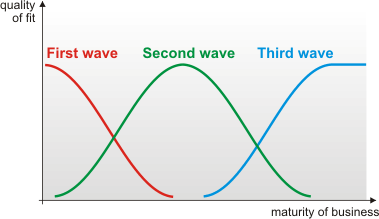
Update:  With perfect timing this old post showed up in my reader again.  Xobni’s Gabor Cselle talks about the three waves of startup hires:

    1. First-wave people want to create success from nothing.
    2. Second-wave people want to make something popular more successful.
    3. Third-wave people want to join a successful environment and preserve the status quo.

I was surprised to find my own comment on Gabor’s old post, essentially summarizing the above long rambling in one sentence:

Startups typically get into trouble when the Founders realize they need 2nd-wavers, work with “pro” recruiters and end up with a bunch of “big name” expensive 3rd-waivers.

Update (9/1/08): Since I started this post with Atlassian’s quest to hire a VP of Marketing, it’s only appropriate to follow up on it.   Atlassian President Jeffrey Walker reports:

All but one of our best candidates came from referrals

None from recruiters.   Even though many are smarter than this.   Takeway: network, network, network.

Related posts:

Update: This quick rant by Bob Warfield is worth reading:  Startups Need Starters

post

Not All Presentation Managers Are Created Equal…

Sorry if this post feels a bit tongue-in-cheek. It is.  But I can’t help making the comparison when I see both Google and Zoho announcing new features of their Presentation Managers the same day.

We can’t stop adding features!  – announces the Google Docs Blog.  Today’s newbies are PDF support and adding vector shapes.  Some shapes.. the pic to the left shows the available inventory.

The pic below lists the shapes available in Zoho Show:


Add to the above hundreds of clipart items in Zoho Show, all of which, as well as the shapes can not only be moved and resized, like those in Google, but also flipped, rotated directly by dragging them.  And of course there’s Zoho’s theme gallery to jumpstart your presentation with… and a zillion more features.

Oh, well… draw your own conclusion.  Bias alert:smile_embaressed  I am an advisor to Zoho.  Don’t just take my word – go and play with Show yourself.

Related posts: Download Squad, Googlified , Google Operating System, Google Blogoscoped

post

Time to Clean Your Monitor

But don’t worry, this site will take care of it 🙂

(hat tip: Christopher Carfi)

post

SmartTurn: Inventory & Warehouse Management SaaS-style

Here’s further proof that the Software as a Service (SaaS) model will not be limited to CRM and Accounting: SmartTurn, providers of the first On-Demand Inventory and Warehouse Management System (WMS) announced today its $5M Series A financing led by New Enterprise Associates (NEA) and Emergence Capital Partners.

I admit the announcement took me by surprise; I have not heard of the company before. A quick look at the Oakland address made me suspicious though, and yes, I was correct: this company is a spin-off of Navis, who are veterans of Warehouse Management systems, from the “old”, i.e. on-premise world. Old-world or not, the Navis team carries the SaaS DNA: a little-known fact is that their CEO, currently Chairman of SmartTurn John Dillon was CEO of Salesforce.com before Founder Marc Benioff took the reins back in 2001. The investors are not exactly new to SaaS either: Emergence Capital were early investors in Salesforce.com, and they specialize on SaaS and nothing else (I believe they are the first Valley VC firm to do so).

Warehouse Management is an awfully complex area (I know first hand, having lead SAP logistic projects in the 90s), so if SmartTurn is successful, it will truly be a validation of all aspects of “Enterprise Software” being eligible for the On-Demand model.

There are very few Enterprise SaaS players around, but SAP’s (SAP)new SaaS product, Business ByDesign for the SMB market and NetSuite (N) for small businesses are worth mentioning: they both offer complete, integrated systems, including Inventory and WMS. The opposite of the integrated systems is the best-of-breed approach, in which case one of the most difficult decisions in enterprise systems is where you draw your functional boundaries, and for companies implementing a multi-system scenario what functions are left in which systems, where to cut overlaps. Inventory Management is planning and accounting for your inventory levels; Warehouse Management is the extension of the concept down to physical locations (warehouses, buildings, down to bin levels). SmartTurn appears to support the Procurement and Order Fulfillment processes as well, which, from a logistics point of view are the inflows and outflows to/from your warehouse.

This is an area worth keeping an eye on and I expect to revisit it once I know more about the company and their customers.

On a lighter note… $5M to manage the inventory of major businesses vs. $50M to superpoke FaceBook users… am I the only one sensing imbalance here? smile_wink

Update: No, apparently I am not the only one… Will Price, Managing Partner at Hummer Winblad Venture Partners:

It way well be that Slide raising $55m from mutual fund companies at $500m+ pre-money will be the “what were we thinking” moment of the current cycle. I think, however, the investor who leads a $4 on $4m Series A in a company with a differentiated technology and a direct tie to hard ROI will feel calm in the storm.

post

Proof that Vista is Slooooow

No comment.smile_angry

post

SVASE Event: Clean Tech – What Corporate & Venture Investors Really Want to See

Clean-tech investing is at an all time high and is expected to flourish in a range of sectors, including renewable and distributed energy, advanced materials, transportation, and water purification and management. Many clean technologies are experiencing double-digit annual growth rates.
With the demand for cleaner technologies on the rise, Clean Tech is fast becoming one of the hottest areas of investment and technology development to be embraced by the corporate and venture capital communities.

But what technologies and business models are they looking for?

The panel discussion at this SVASE event will explore this topic to provide answers to the following questions and more:
• What are realistic financing strategies for Clean Tech companies?
• What sort of returns are investors expecting from Clean Tech, and over how long?
• What are the emerging hot technologies in this sector?
• What opportunities are there for entrepreneurs?

The Panel:
• Steve Eichenlaub, Managing Director, Intel Capital
• James F. Fulton, Jr., Partner, Cooley Godward Kronish LLP
• Steve Goldby, Partner, Venrock
• Susanne Zechiel, Director of Business Development, MMA Renewable Ventures
Moderator: Ed Ring, Editor, EcoWorld

WHEN: Thursday, January 24th, 6-8:30pm in Palo Alto.

I can give away a few complimentary tickets only via this URL.  When they are gone, you can still register at the standard rate of $20 for SVASE members, $49 for the general public.

post

The New Apple Logo

Not a very artistic rendering, but a better representation of the slice bitten out of Apple’s (AAPL) market cap in the past 3 weeks.  From 201 to 128…down 35% and dropping. 

For less graphic, but more analyticalsmile_omg details: Fortune, Silicon Alley Insider, Paul Kedrosky’s …, Hardware 2.0Seeking Alpha, Between the Linesbub.blicio.us, Mashable!, Roughly Drafted, and the rest of the world…

P.S. does it start looking like a buy? fingerscrossed

post

Morsels from the Crunchies, or Whatever Happened to Business Software?

Now that The Crunchies, the Internet Startup world’s equivalent of the Oscars are over, the winners announced, a lot of champagne consumed, let me go back to a few thoughts that have been on my mind throughout the whole show.

First of all, it was nice to see so many startups recognized, meet familiar faces again, and I join the chorus in thanking TechCrunch, ReadWriteWeb, VentureBeat and GigaOm for putting the show together. Special kudos to Om Malik for coming only three weeks after his heart attack.

Second, I can’t help but think that some of the categories were .. well, almost deterministic, leaving zero chance of winning for the “little guys” lumped together with a giant. Right out of the gate, the first category, Best gadget/device: iPhone, Kindle, Ooma, Pleo, Wii. C’mon, did anyone doubt for a minute the iPhone would win? Or look at the Best mobile startup, where the finalist were AdMob, Fring, Loopt, Shozu, Twitter. Oh, please, 3 relatively unknown names against Twitter, a mega-phenomenon… smile_sarcastic

The other thought I’ve been pondering ever since the show is whatever happened to business software? The Crunchies were yet another proof that “enterprise isn’t sexy“: this was all about consumer-glitz, with a few startups who cater to businesses. That said, at least there was an Enterprise startup category, and I was really glad to see my friends at Zoho win it. Although I wholeheartedly believe they deserve it, this was by far not a slam-dunk category, with Zoho and 37signals, which has a religious cult-like fan-base being the two chief contestants.

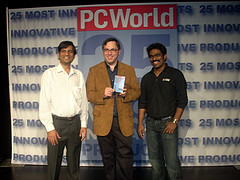
Perhaps the Zoho team felt a bit of extra satisfaction, given that 37signals originally questioned their viability, and called them copycats rather than innovators. Well, the innovation debate definitely ended a few weeks ago, when PC World picked Zoho’s Notebook as one of the 25 Most Innovative Products of the Year. While the Crunchies were clearly a popularity contest (with over 100,000 votes) PC World’s list was compiled by professionals. This list was notably full of gadgets, and the only other software products preceding Zoho were Google Gears and the Facebook API.

Back to the Crunchies, Enterprise category, 37signals and Zoho are diametric opposites in many ways: 37signals product philosophy is all about simplicity, “products that do just what you need and nothing you don’t” while Zoho believes in functional richness, and their customer service attitude is quite different, too. Yet I believe they are both good companies, and there’s a clear demand for their products, which is well proven by the hundreds of thousands of loyal customers. Neither of them are really Enterprise software companies though. 37signals caters for what they call the “Fortune 5,000,000” and Zoho clearly stated their mission to be the “IT for Small Business” – not that a subset of their portfolio, the Office Suite could not become Enterprise-ready, but for now it’s not their primary focus. And focused they are …

I think the Crunchies used the term Enterprise quite liberally – I would have called this category Business Software. Now, if the names IBM, HP, SAP, Citigroup, Boeing, BMW, Shell, McDonalds, Pfizer sound familiarsmile_wink, I’m sure you agree that the company who claims these and others customers is truly an Enterprise Software company. Yet Atlassian ended up in the International category, to their bad luck, as they got paired up with Netvibes. The two are apples and oranges. Atlassian is a very successful company, but the people who buy enterprise software are not the types who hang out at the Web 2.0 tech blogs or vote for the Crunchies; Atlassian stood no chance against Netvibes, with their tens of millions of individual users, all potential voters in this popularity contest.

What do three so different companies, Atlassian, 37signals and Zoho have in common? All three are bootstrapped, fast growing, financially successful and follow the “old-fashioned” business model of making good products and charging for it. I could not help but think of these guys while listen to the announcement of the Best Bootstrapped startup category, decided between FriendFeed, PoliticalBase, ProductWiki, Techmeme, UpNext. Or while listening to the panel discussion moderated by Dan Farber, where Matt Marshall expressed his astonishment how far the ad-based business model propelled us, and was wondering if advertising as the only business model would work in the downturn (no R-word!). If we had to pick the survivors of a potential downturn, these three companies are certainly safe candidates. The good old business model of charging for your product, which, incidentally, your customers love works wonders. smile_regular

Of course there was a lot more to the Crunchies, but it’s been all more then adequately covered, and I wanted to focus on business software now. But…well, I am a guy and guys love cars… so I have to mention the Cleantech category, won by Tesla, makers of this beautiful electric sports car. The only problem is, the car does not exist yet, release date has been pushed out repeatedly, the company had to go back for repeat funding, just fired a bunch of people, including the VP Manufacturing, Lead Engineer if the motor team… but hey, why not give them the Award and keep on dreaming (about the car). smile_embaressed

Update:  Apparently I am not the only one questioning the rationale of some category assignments at the Crunchies; read CenterNetworks on user-generated content.