Archives for January 2008

post

Dream Job for a Software Marketing VP @ Atlassian

Atlassian, a fast-growing, successful enterprise software company is looking for a VP of Marketing. I don’t normally broadcast job searches here, but am breaking that rule now for I believe this is a truly exceptional opportunity with a truly exceptional company. (Disclaimer: I have no business affiliation with Atlassian, but admit to being positively biased, as the company exemplifies a lot that I stand for.)

They are best known for two products: Jira, the issue tracking & software project management application was their first hit, putting the company on the fast growth track and establishing a loyal fan-base in the IT community.  Their existing reputation in the IT community certainly helped the second product, Confluence, the enterprise wiki gain traction: it is now equally popular in the IT and business community.  Wikis in general  have become more commonly known in the past two years; once a tiny market niche, today a growing field where new entrants pop up left and right, claiming to be best in this and that….  But numbers talk, and the verdict is clear: Confluence is the undisputed enterprise wiki market leader. 
Atlassian is not sitting on their laurels: in the past year they diversified, acquiring several companies and launching new products on their own.  Frankly, I lost track, but I believe  their portfolio currently includes 8 products, all part of an “IT toolkit”, with the exception of Confluence, which is seeing fast adoption amongst business users, too.  

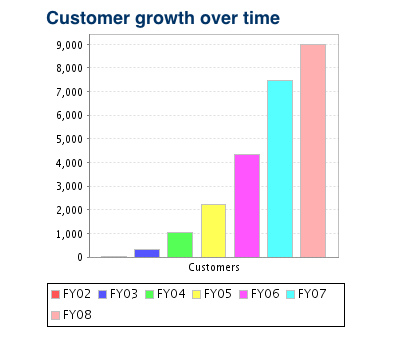
The customer list is impressive: IBM, HP, SAP, Citigroup, Boeing, BMW, Shell, McDonalds, Pfizer … just about all the Fortune 1000, as well as non-profits, Universities, Government Agencies, totaling over 9000 customers worldwide. (The chart is a bit misleading: Atlassian’s fiscal year starts in June, and the FY08 bar shows the current figure only, excluding projections.)

How did they achieve this?  They must have an excellent sales force.  Wrong! Atlassian has no sales force at all.  They don’t sell: customers simply buy their products on their own.   I often talk about  the pull-model that’s replacing the traditional, expensive enterprise sales process (6-9 months, high touch, flights, meetings, wine-and-dining, entertaining, in the end often nuked by politicssmile_baringteeth) – but that’s typically in the context of Software as a Service, and in the SMB (small business) market.  Atlassian’s products are mostly on-premise (although they now have a hosted version of Confluence) and their primary market is the large Enterprise.  Yet they pulled off what amounts to a small miracle:  essentially took the download.com, tucows style model we all know as consumers, and ported it to the enterprise space. 

Of course having customers try-and-buy through the Internet is not as simple as firing your Sales team ( or not hiring one).  It’s not a matter of a decision: it’ s a consistently applied philosophy, that you have to implement in every aspect of your business.  The key components are:

  • lightweight software
    • well-defined function set, meets specific user need, small user groups can get started
    • ease of use (both easy to learn and easy to use)
    • well documented, well supported
  • transparency
    • features (what you’re getting, no surprises)
    • issues (Atlassian’s bug tracker is open to the public)
    • pricing (simple, upfront pricing, no fill-out-contact-form-wait-for-sales-to-call-back BS)
  • low price (“expensable, not approvable” – to quote a former competitor)

The “pull-model” means customers will need to find you- which is why Marketing is a critical function.  With Sales gone, Marketing becomes sales (actually, Atlassian’s CEO proudly says everyone is in Sales, especially Support).  So if you are a marketing superstar,  or know one, want to be part of a successful team, work for celebrities , you owe it to yourself to apply.

Atlassian is not only about business – it’s about people.  I know, old cliche.. but here it works.  The unique culture this team maintained throughout their super-growth even now that they have 130 people is a large part of their success.

So what is this culture like?  Tough. When he doesn’t make his numbers, Atlassian President Jeffrey Walker is forced to make up for it as ticket-scalper on the street. smile_omg OK, joke apart, this photo was shot last August, when the entire San Francisco office went to see a Giants game together. (Incidentally, just a day before Jeffrey became cancer dude). This wasn’t a rare occasion, either: both the San Francisco and the Sydney teams have a lot of fun together:  Cutlassian, Mission: Atlassian, theme-filled staff events, abound throughout the year.   Their new office  building in Sydney is right next to a pub (hint: when will you guys realize you’d be better off buying the entire pub?beer)  I wonder when the San Francisco office will move into a winery…  Perhaps you get the picture by now: Working for Atlassian isn’t just a job  – it’s a lifestyle.  But don’t for a minute think it’s a bunch of rowdy kids having fun only:  they bring in $30 million a year.  And if you don’t perform, this is what awaits you.

So that’s the magic formula: combine business success with a fun, team-focused culture and you’ve got the makings of the ultimate job.  (Are you still reading, or have you alerted your Marketing superstar friend yet?)

Now, if this is the ultimate job, there’s one question unanswered: How come it hasn’t been filled yet?  I wanted to hear the answer straight from the horse’s mouse so to speak, so I asked Atlassian President Jeffrey Walker, who responded below:

We were inundated with resumes, and found a few excellent capable candidates. Unfortunately, one of the growing pains of companies like ours is we were not quite ready for the right candidate. Incorporating someone of the caliber we need takes preparation. Our search began prematurely. Lesson learned. After the founders and I took another few ‘long walks’, we came out aligned and ready. This time I fully expect to complete the search. Just need the right remarkable individual.

Well, I did not walk with Jeffrey and the Founders, but I certainly hope they will not change a lot:smile_wink.  I have a lot to say on the subject of hiring, but it’s not specific to Atlassian, so I’ll break it out to a separate post.  In the meantime, if you are that “remarkable individual”, what are you waiting for?
post

LinkedIn Outage

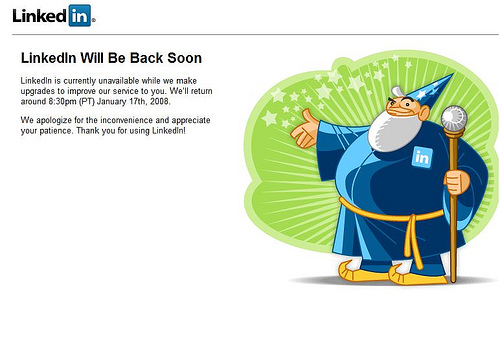
This may very well be the first LinkedIn outage I’ve caught, and it comes on the day Google’s Blogger was down, and the Technorati Monster popped up it ugly head again.  Oh, well, at least this one is cute.

post

SVASE VC Breakfast: Hummer Winblad, Focus On Software

After a long break I’ll be moderating another SVASE VC Breakfast Club meeting this Thursday, January 17th in San Francisco.  As usual, it’s an informal round-table where 10 entrepreneurs get to deliver a pitch, then answer questions and get critiqued by a VC Partner. We’ve had VC’s from Draper Fisher,  Kleiner Perkins, Mayfield, Mohr Davidow, Emergence Capital …etc.  This week’s we’ll welcome Prashant Shah, Managing Director, of the first exclusively software-focused venture firm, Hummer Winblad Venture Partners.
These breakfast meetings are a valuable opportunity for Entrepreneurs, most of whom would probably have a hard time getting through the door to VC Partners. Since I’ve been through quite a few of these sessions, both as Entrepreneur and Moderator, let me share a few thoughts:

  • It’s a pressure-free environment, with no Powerpoint presentations, live demos, Business Plans…etc, just casual conversation; but it does not mean you should come unprepared!
  • Follow a structure, don’t just roam about what you would like to do, or even worse, spend all your time describing the problem, without addressing what your solution is.
  • Don’t forget “small things” like the Team, Product, Market..etc.
  • It would not hurt to mention how much you are looking for, and how you would use the funds…
  • Write down and practice your pitch, and prepare to deliver a compelling story in 3 minutes. You will have about 10 minutes, the first half of which is your pitch,  but believe me, whatever your practice time was, when you are on the spot, you will likely take twice as long to deliver your story. The second half of your time-slot is Q&A with the VC.
  • Bring an Executive Summary; some VC’s like it, others don’t.
  • Last, but not least, please be on time! I am not kidding… some of you know why I even have to bring this up. (Arriving an hour late to a one-and-a-half-hour meeting is NOT acceptable.)

Here’s the event info page, and remember to register – the previous event with Hummer Winblad sold out in advance. 

See you in San Francisco!

post

Macworld Live Blogging via CoveritLive? Nope. CoveritDead. Twitter Dies, Too.

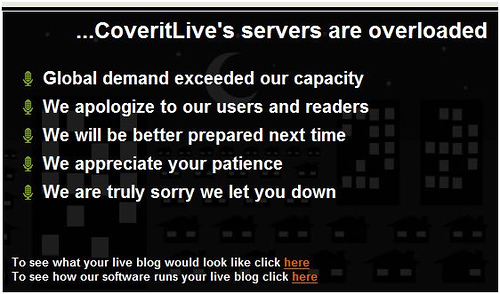
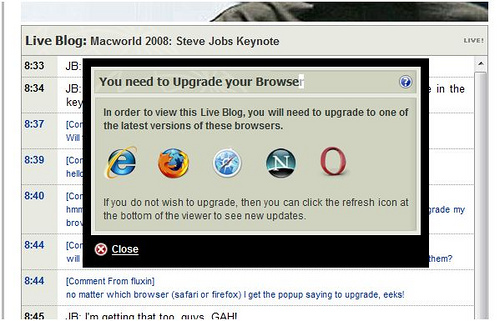
CoveritLive is supposed to change live blogging. What better opportunity to debut than Macworld? Except that I am off to a shaky start trying to watch Crunchgear’s coverage:

Upgrade? I’m already on the latest FireFox, thank you. smile_sad

Update: Now the CrunchGear CoveritLive page does not load at all. Coveritdead. thumbs_down

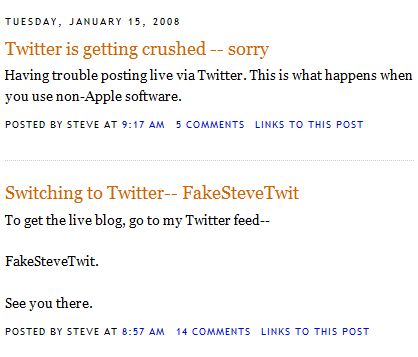
Update: Fake Steve Jobs also tried CoveritLive, then attempted to switch to Twitterwhich died, too.

Well, at least CrunchGear’s mothership, TechCrunch stayed with the conservative, manual updates… their coverage works.

Update (1/21): Here’s a new review on CoveritLive @ReadWriteWeb. We’ll just have to wait for another major event to see it truly “live”.

Update (2/27): Jeff Nolan and Dennis Howlett praise CoveritLive.

Related posts: Mashable, mathewingram.com/work, Paul Kedrosky’s Infectious Greed, Data Center Knowledge, Furrier.org, Mashable!, Valleywag, CenterNetworks, TechCrunch.

post

Gizmodo Calling Themselves Names

I really did not want to write about Gizmodogate again.  But instead of letting it die, today Gizmodo found it important to defend themselves as saviors of journalistic independence:

Our prank pays homage to the notion of independence and independent reporting. And no matter how much access the companies give us, we won’t ever stop being irreverent. That’s what this prank was about and what the press should understand.

How heroic!  And hypocritical, as I pointed out before.  After all, it was Mighty Hero Gizmodo themselves who not only trashed the TV-B-Gone 3 years ago:

Mitch Altman is an asshole. And not just any asshole, but one of those snotty holier-than-thou types who has nothing better to do with the money he made as a founder of 3ware than to develop a device with the sole purpose of imposing his viewpoint on others…
…Essentially a universal remote that cycles through every possible code, the TV-B-Gone has a single purpose: to power off televisions whenever the user feels like being a dick.

(Emphasis mine). So who is the dick now?

Related posts: Scobleizer, mathewingram.com/work, kottke.org, IP Telephony, VoIP, Broadband, Venture Chronicles and The Secret Diary of Steve Jobs, Webware.com

post

Gizmodo’s Prank Was Fairly Harmless, After All

OK, time to put things in prospective.  Yes, I believe the Gizmodo prank of switching off LCD’s at CES, disrupting presentations was immature, and they deserved to be banned.  But let’s realize they were still relatively harmless; could have done a lot worse with the almighty TV-B-Gone, just like this Polish kid did:

A teenage boy who hacked into a Polish tram system used it like “a giant train set”, causing chaos and derailing four vehicles.

The 14-year-old, described by his teachers as a model pupil and an electronics “genius”, adapted a television remote control so it could change track points in the city of Lodz.

Twelve people were injured in one derailment, and the boy is suspected of having been involved in several similar incidents.

(Full story at The Telegraph)

post

Too Bad Gizmodo / Gawker Media is Not Public

(Updated)
This would be a good time to short their stock.  The biggies hurt at CES would sue their a***s off.  The video is really fun to watch.  Except if you’re one of the people who worked hard to prepare, stage and deliver their presentation which the pranksters  sc***ed with – let alone the companies that spent millions to participate at the show.


Not everyone agrees, and frankly, I am amazed how people I normally respect find it a laughing matter.

Update (1/12): Must be a slow weekend, this is still the hot topic on TechMemeWebware, Hardware 2.0, TECH.BLORGE.com, Valleywag, bub.blicio.us, Crave, Geek News Central, The Stalwart, Laughing Squid, Silicon Alley Insider, Bloggers Blog, Scobleizer… you name it.  They all (including me) missed this irony:  Gizmodo themselves trashed the TV-B-Gone 3 years ago:

Mitch Altman is an asshole. And not just any asshole, but one of those snotty holier-than-thou types who has nothing better to do with the money he made as a founder of 3ware than to develop a device with the sole purpose of imposing his viewpoint on others…
…Essentially a universal remote that cycles through every possible code, the TV-B-Gone has a single purpose: to power off televisions whenever the user feels like being a dick.

So who is the a**hole now?  And who feels like being a d*ck?   Was this Altman’s ultimate revenge?  smile_baringteeth
(hat tip: Anonymous commenter)

post

Your Digital Friends: Less is More

It’s almost two years ago that I “cleaned house” at LinkedIn, dropping from 500+ connections to about 300.

I had no clue about Dunbar’s number ( the maximum number of people one can maintain active, stable social relationships with, estimated at 150 by British anthropologist Robin Dunbar), I simply felt I had been to open accepting invitations from unknown people, and as a result, I barely recognized names on my LinkedIn contact list. I thought the very idea of LinkedIn was that it should be an online reflection of my real-life relationships.

Fast-forward two years, now we have FaceBook, Plaxo Pulse, Twitter, and a zillion of other places, and get inundated by friends request from new and new “social networks” never heard of before. Perhaps the rules changed a bit – people do “befriend” each other in cyberspace, without having met first. I can accept that to a certain extent, but I still think Dunbar’s number has merit, even in today’s world. Of course it’s not fixed at 150, for some it may be 80, for the uber-social ones 3-4-500? JP Rangaswami, blogging at Confused of Calcutta, (also pioneering adopter of social software as former CIO at Dresdner Kleinwort Wasserstein) thinks his digital Dunbar number is higher than 150:

I’ve sensed that I have a Dunbar number of around 300 in the digital world, and I’ve been delighted to find I know most of the steady ones. Over the years I’ve actually met most of the community of readers, usually at conferences. The face-to-face contact, in turn, leads to a deepening of the relationship, and we land up creating and developing links in FaceBook and Twitter.

JP is wondering if there’s a trend here, and asks his readers:

How many FaceBook friends do you have, how many regular readers of your blog, how many followers in Twitter, do you see a correlation between the three, if not why not, and so on. Do you tend to meet a core of this number on a face-to-face basis, if not why not?

I’m not a regular reader of JP’s blog – discovered this post via Anne Zelenka at Web Worker Daily, but even if I was a subscriber, I would not consider myself a “friend”. I might want to follow his ideas on Twitter (if I was twittering at all) but that’s still passive mode. I think this commenter to Anne is right:

I don’t think that “following” people on Twitter would be considered “stable social relationships”. A social relationship implies a two-way street, and in my book, one that I value with some significance. That’s not to say that online social tools can’t be part of real relationships, but you can’t just add up all the numbers and think it means anything.

Now, if I commented on JP’s blog several times, and he responded, we’d establish a form of conversation, which, over time would allow us to get an insight into each other’s mind – i.e. getting to know each other to some extent. Perhaps at that point it would be appropriate to “befriend” each other on FaceBook. (Not that I actively use FaceBook, which is increasingly becoming an advertising platform, and even before that I had found it somewhat of a time-waster.)

I still don’t think we’d be ready to become LinkedIn contacts, because that network is all about trust, and recommending / referencing “friends” in a business context. Call me old-fashioned, anti-social, but I think that level of trust requires more of a real-life relationship, so my LinkedIn numbers would be close to my Dunbar-number, the number of active social contacts I am able and willing to maintain.

Before they cracked down on them, LinkedIn got polluted by contact-hunters, so-called superconnectors who amassed thousands, in a famous case 16,000 contact records. Note the emphasis on records. It’s just that. Data records, not real relationships. FaceBook (possibly learning from LinkedIn) limits the number of contacts to 5,000, which some users, including Robert Scoble find inadequate:

I think it sucks because it isn’t scalable and falls apart at 5,000 contacts. It pisses me off more and more every day because of that scaling wall.

Robert is a celebrity, and the 5000 or so are in his fan-club. Just like the Twitter example above, he has followers, not active friends. Hyper-social or not, he also has a Dunbar-number. It may be in the higher hundreds, but not in the thousands. For the rest of us, non-celeb types, I still believe less is more, and our online networks should reflect our real-life one, instead of being an inflated collection of data records. (This line became Doc Searls’ Quote du joursmile_teeth).

Finally, somewhat off-topic, here’s an observation from JP’s post: he’s using to ClustrMaps to monitor and illustrate where his readers come from. I understand the concentration in Europe, and also in the US, but what I am amazed at is the picture inside the US: what is this magical East / West divide? How come his readership drops so significantly in the Western half of the US?

Update (5/29/08):  How Many Friends is Too Many? asks Josh Catone @ ReadWriteWeb .