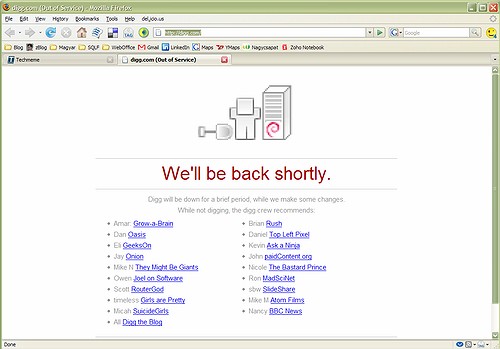
I guess “shortly” has a a subjective definition. In this case it’s been hours half a day – so far.
Tags: digg, digg outage
Connecting the dots ...

I guess “shortly” has a a subjective definition. In this case it’s been hours half a day – so far.
There’s a crazy meme going on which has the potential of turning Technorati ranks upside-down. Now, that may sometimes be good, giving fresh views more visibility, like Seth Godin or Steve Rubel’s recent initiatives. The new 2000 Bloggers craze is nothing comparable though: it’s random, viral, and has to potential to turn links, the glue of the blogosphere completely meaningless.
If you blog, there’s a good chance you’re one of the 2000: when Tino Buntic launched his project he seeded the initial collage with photos/links of 300 or so bloggers. The initial roster included A-listers like Robert Scoble, Guy Kawasaki, Ross Mayfield, Matt Cutts, Doc Searls, celebrities like Donald Trump, Rosie O’Donnell and “regular” bloggers like yours truly. The rest of the slots got filled on a sign-up basis.

It may all have started innocently: “let’s discover our blogging neighbors”. Several bloggers I respect embraced the idea, pointing out the “social networking” effect. Most of the A-list remained silent, but France’s top Blogger, Loic Le Meur welcomed it as a “cool initiative“. I’m amazed that no one seems to recognize what this project really is: blind, unselective, dumb link-exchange.
Links are good, but they are supposed to refer to content. Not here. No-one can seriously claim that we’re really “discovering” 2000 bloggers this way …. the whole game is not about checking out new blogs, it’s just an efficient copy/paste link-generation machine. I can somewhat understand the enthusiastic response the 2000 Bloggers scheme received: who would not be happy with hundreds of new inbound links, a major improvement in their Technorati rank? But if you think *that* will make you an A-lister, think again…and again.
First, what’s the point of getting a few hundred or even 2000 new inbound links when everyone else has it? Your link-wealth will be worth less and less as the 2000 Bloggers do a good job of devaluing their currency. Word will get out and unless Technorati finds a way of ignoring these inflated link-counts, the whole value system based on links and Technorati ranks becomes a joke, and will collapse. Now, that’s my doomsday scenario, my bet is that Dave Sifry and team will find a way to disarm the monster soon. Update (2/5): They did. Even so, any service that lists inbound links has just become useless: I now have to sift through pages of crap to find the links that I care about – which is when people actually red my posts and found them interesting.
And don’t think it’s only Technorati – this is gaming Google and any other search / indexing service, too. It can backfire, too: I wouldn’t be surprised if Google’s almighty algorithm decided the entire 2000 bloggers neighborhood was a linkfarm and penalized the sites accordingly.
Earlier I said this whole project may have started “innocently”. Well, on second thought, perhaps not: Tino Buntic’s blog is all about linking, SEO, blog-advertising, he certainly knows what he is doing. But I do believe most of the 2000 community is just going along for the ride, without realizing the consequences. If you’re one of the 2000, all I ask you is think. Think and draw your own conclusion.
Update : I wrote this post late Friday and planned to release it on Monday. In the meantime I’m glad to report to have discovered the first signs of sanity: Jeremiah Owyang rejects the scheme, and I suppose so does this French-language blog, too – if I guessed the title right. Anybody else? Hello, World!!! Update (1/6): Apparently I missed crediting Amy Gahran for being first to raise the linkfarm issue.
Tags: 2000 bloggers, 2000 bloggers meme, 2000 bloggers project, seo, links, linking, blogs, blogging, technorati, technorati rank, google, link-exchange, linkbait, linkfarm, spam, blog spam, a-list
Believing is one thing – facts are another. The recent McKinsey study confirmed that contrary to popular belief SaaS is really not just a small-business toy; it is indeed becoming mainstream amongst large corporations: “61% of North American companies with sales over $1 billion plan to adopt one or more SaaS applications over the next year.”
A new study by Nucleus Research confirms these findings: 63% of companies with over 1000 employees adopted some On-Demand solution, vs. 46% of those with less then 1000 employees. The study turned up a few more “surprises”, perhaps the most striking one being the market-share of particular types of applications. Salesforce.com is the poster-boy of SaaS, in fact many would argue they created this market, yet CRM appears to have a relatively low adoption rate amongst SaaS customers, only 32%. Project Management comes close, 23% of the responding organizations deployed PM solutions.

Even more surprising (?) is future buying intention:

(Charts by Zoho Sheet)
If we compare the two sets of numbers, CRM has already peaked and Content Management, Project Management will be the new growth areas:

A word of caution: I’m not sure these numbers represent true market share. 198 companies of all sizes from under 100 employees to over 500 participated in the survey, and the results are not weighted by number of users. I tend to believe that Web-based Project Management is often used for small-team efforts, and in this setup a small startup with 5 Basecamp-users counts equal to a large company with 200 salesforce.com seats (theoretical numbers). Draw your own conclusions. Oh, and since it’s the weekend, here’s a statistician joke:
A business owner asked job applicants the same question: “how much is 2+2?”
The engineer pulled out his slide rule and shuffled it back and forth, and finally announced, “It lies between 3.98 and 4.02”.
The mathematician said, “In two hours I can demonstrate it equals 4 with the following short proof.”
The social worker said, “I don’t know the answer, but I’m glad that we discussed this important question.
The attorney stated, “In the case of Svenson vs. the State, 2+2 was declared to be 4.”
The trader asked, “Are you buying or selling?”
The statistician looked at the business owner, then got out of his chair, went to see if anyone was listening at the door and pulled the drapes. Then he returned to the business owner, leaned across the desk and said in a low voice, “What would you like it to be?”
Tags: nucleus research, saas, on-demand, crm, project management, content management, ecm, statistics, zoho sheet

 I did not want to believe my eyes when I saw the “light” version of Tropicana Orange Juice at the supermarket today. Tropicana OJ is 100% fruit, how do they make it light? Hm.. the box says “½ Less Sugar & Calories”, let’s check the ingredients:
Filtered water, not from concentrate pasteurized orange juice, modified food starch, citric acid, malic acid, natural flavors, sucralose (Splenda), and acesulfame potassium; Vitamins & Minerals: potassium citrate, ascorbic acid (vitamin C), beta-carotene, tocopherol (vitamin E), magnesium phosphate, niacinamide (vitamin B3), thamin hydrochloride (vitamin B1), riboflavin (vitamin B2), and pyridoxine hydrochloride (vitamin B6)
Wow, I only recognize one “legitim” item on this list: the orange juice. Light juice? Yeah, right. I’ve got news for everyone: half the juice will naturally have half the Calories and Sugar in it. The rest is just water, plain and simple. (well, not that plain considering all the crap added to it).
Of course I shouldn’t be surprised, this comes from the industry that sells us tap water in bottles.
Need I say the water/juice mix and the pure juice are sold for the same price? So here’s my “light juice recipe”: buy the original, mix half a glass juice with half a glass water on your own, free of extra charge, and PayPal me half of what you saved.:-)
Update (9/9/08): See Consumerist on Apple Juice.

 Well, we did not have to wait long: barely two weeks after Omnidrive announced their integration with the Zoho online applications, competitor Box.net followed suite: they now support online editing via Zoho Writer. The result of the edit process will be saved back to your Box as a .doc file.
Box CEO Aaron Levie assures me this is just the start of many future integration projects, which is great. After all, it should not matter where a document starts its life: I should be able to access and work on it online or offline.
I fully expect other services to join the camp: For example, the better business-class wikis all handle document attachments, but to edit those docs you still need to download, edit, save, upload back up again – way too cumbersome, why not enable online editing? And if you read Tim Barker’s comments to my writeup on Koral, you can expect this amazingly easy content collaboration system to offer online editing soon.

P.S. Aaron, I’m still waiting for that sync

Additional posts: /Message, CenterNetworks, Web Worker Daily,
Harvard Prof’s Andrew McAfee and Karim Lakhani have just completed the first ever Harvard Business School case on Wikipedia, which largely focuses on the infamous Enterprise 2.0 debate. Enterprise 2.0 has undeniably become mainstream since the original debate – just check out the Enterprise 2.0 Conference in Boston.
There is some irony in this situation though: The deletionist argument was that “Enterprise 2.0” is not original and there are not enough independent references. Well, what better reference and validation that a Harvard Case Study? (Of course hard-core deletionists could still argue that the Study is not about  Enterprise 2.0 as such but the debate itself, and as such self-referential and unacceptable as an independent source…)
Why Epilogue to the Epilogue? Because I’ve already written an epilogue to the debate.
(Photo: Prof. Andy McAfee moderating a panel on Enterprise 2.0 with fellow Enterprise Irregulars Jeff Nolan, Ismael Ghalimi, Rod Boothby and yours truly).
Tags: wikipedia, enterprise 2.0, wikipedia debate, deletionists, inclusionists, harvard business school, hbs, harvard case study, enterprise irregulars
 Ross Mayfield points to another interesting wiki-experiment: the authors of Wikinomics, a fast-selling new business book opened up Chapter 11 (no, this is not *that* Chapter 11) to collective editing, leaving it to the public to “finish” the book.
The Wikinomics Playbook is a Socialtext-based wiki with minimum initial content that anyone can contribute to. It will likely never be “finished” as such. Unlike the recent Wired Wiki experiment, this project is open-ended, without a firm deadline. It will be interesting to observe how the absence of any incentive to wait for last minute edits (a’la eBay auction sniping) leads to different behaviors.
For now, I sense the experiment is going somewhat sideways: page content is not growing as much as comments are. I guess it’s easier to talk about it than actually doing it (hm… that’s what I am doing, too ), but that carries the risk of the Playbook becoming just another discussion forum. Perhaps we should all heed the advice under Be Bold:
“Being bold is necessary advice in wikis: most people aren’t accustomed to editing each other’s sentences. In a wiki participants must be bold because it is only by many iterative edits that mass intelligence can occur and wisdom can triumph over verbosity. If we are bold the content will evolve.”
Tags: wiki, wikinomics, wikinomics playbook, socialtext, wired wiki, collaboration, collaborative book editing, open-ended book, online book
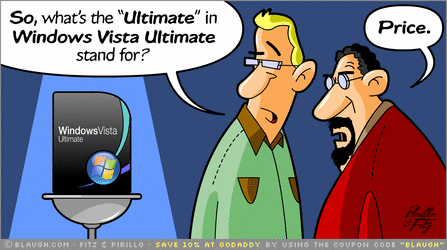
And if Ultimate is not enough, go for MWVULNSE: Microsoft Windows Vista Ultimate Limited Numbered Signature Edition.
And if you’re still wondering what you pay for, don’t miss this Value Analysis.
Headlines from my Drudge feed:
Emergency Shutdown at Russian Nuke Plant…
GLOBAL WARNING: ‘BILLIONS TO GO WATERLESS’ IN CLIMATE SHOCK…
ALL-STAR GROUP: 10 years to save the planet…
Otherwise … have a nice day, everyone.


(Updated)
The Zoho folks will be announcing yet another product at DEMO – this time it’s a multimedia NoteBook. Since whenever they release a product, the Microsoft / Office analogy is quite unavoidable, let’s just get it out of the way: this is Zoho’s “OneNote” – and a lot more. (Bias alert: I am an Advisor to Zoho).
Notebook is an online application to create, aggregate, share, collaborate on just about any type of content easily – all in one place, without having to switch applications. You can create multiple books and within that multiple pages. There are a number of page-types to begin with, including Sheet, Writer, Calendar, Contacts, Planner, Task – these correspond to Zoho applications – or simply start with a blank page.
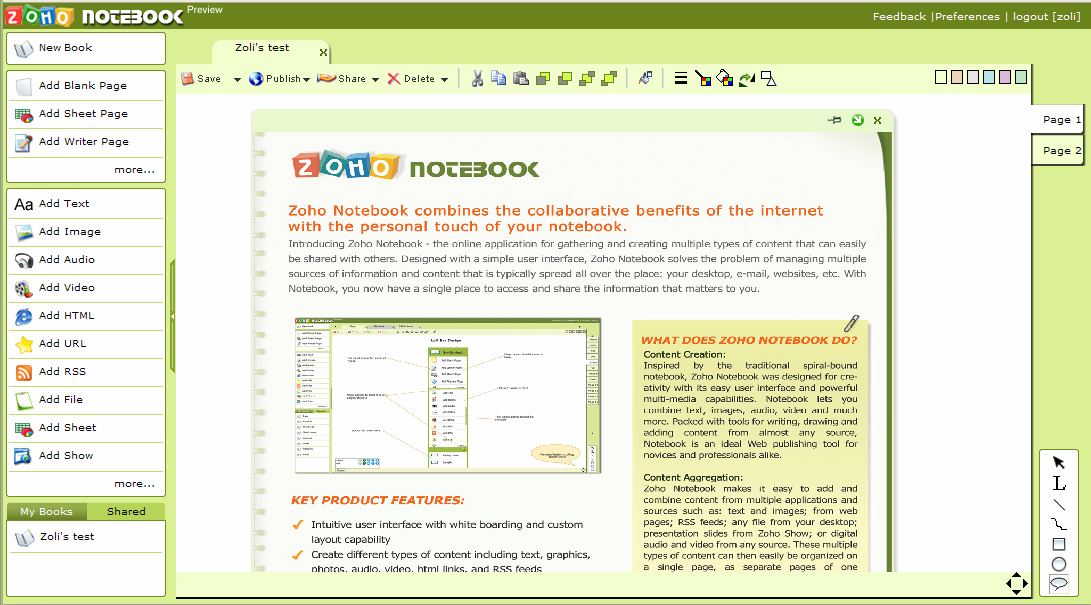
You can easily create any type of content within a page: text, image, drawings, audio, video – these could be embedded youtube videos or record from your own camera / microphone directly into Notebook. Place your content anywhere in the page by freely dragging it around, resizing, reshaping it. Aggregate content from multiple sources: embed Show, Sheet data, web pages, RSS feeds, file attachments. IE and FireFox plugins allow easy clipping of web-content.
If it’s Zoho, it has to be collaborative; but this time NoteBook brings real-time online collaboration to a new level: you can share book-level, page-level or individual object-level information. This means you can selectively collaborate with certain users on your text, while sharing the chart with yet another group, and hiding the rest. Updates to any of these objects are reflected in the NoteBook real-time. Integration with Skype allows Skype presence indicators in the individual shared object as well as direct IM-ing over Skype. Needless to say, version-control is taken care of at the object-level, too.
Now, for the bad part: NoteBook is currently in limited Alpha mode … so hang on for a while ..
 and in the meantime, enjoy this demo video:
NoteBook is unquestionably the sleekest of all Zoho apps, and a technological marvel. There are clearly specific target demographics, like students, where an All-In-One notetaker is the killer app. In a more typical business environment one might wonder where it fits in the range of products available, and what application to use when. Update (1/31): Dennis lists much better use-cases:
“I can see huge potential for this among those professionals who need to assemble audit and M&A resources for example. It makes the creation of a multi-disciplinary team very easy with the ongoing ability to collaborate as projects evolve while remaining in an organised, controllable environment.
I can see other use cases arising in forensic work, planning, budget management, time and expense management – the list goes on. In this sense, Zoho Notebook could become the de facto desktop for knowledge workers because you don’t need to leave the service to do pretty much all the tasks you’d expect a knowledge worker to undertake. I can also envisage some interesting mashups using accounting data from a saas player that gets pulled into Notebook on and ad hoc basis. Does this mean Notebook is a ’silver bullet’ application.
I’m going to stick my neck out and say a qualified ‘yes.”
About a month ago, while reviewing then new Zoho Wiki I expressed my hope to see tighter integration to the Zoho Suite – specifically Writer, Sheet and Show. Well, now it’s here, albeit in a separate application. Ideally I’d like to see the wiki equipped with Notebook’s powerful editing /collaboration options – or is it the other way around? If you take NoteBook, and allow linking between pages/books … well, that’s quite close to a wiki.
 . Update (1/31): In the same post I’ve just referred to, Dennis says: “Zoli Erdos has an interesting take on whether the collaboration features put Notebook in the same class as a wiki.”
Let me clarify my point: I’m not comparing NoteBook to Wiki as it stands now. What I do believe is that the feature sets of the two should be merged somehow. Combine the “digital dumping ground” as Dennis says, i.e. the absolute flexibility of creating/aggregating any type of info with the linking, back-linking, navigation, search in the wiki, and you have a truly killer business app.
Zoho has a tradition of initially developing products individually, but share the code-base early, and integrate them later. What do you think? Should Wiki and NoteBook be merged to create the super-product, or is there a need/ market for them to be independent in the long run?
Update (1/30): See related posts on TechCrunch, Read/Write Web , Zoho Blog , Scobleizer, /Message, CMS Wire, InformationWeek, PC World.
Update (2/1) : Robert Scoble’s summary: ““cool” has different meanings: 1) That it’ll change how you work. Zoho’s Notebook wins here.
Update (2/2): The video of Zoho Notebook’s launch at DEMO is now up here.
Tags: zoho, zoho notebook, zoho wiki, wiki, collaboration, multimedia, multimedia notebook, onenote, ms onenote, microsoft office, microsoft onenote, skype

Publisher / Editor of CloudAve and Enterprise Irregulars.
I do most of my business blogging there, with occasional asides here. More...


Recent Comments