post

Excel’s Birthday: from Adulthood to Early Retirement

Excel has become of legal age today: it was first introduced on this day, 21 years ago, reminds us the Zoho Blog.  

 There are some surprising facts in Wikipedia’s history of Excel entry: the first version, released in 1985 was actually for the Mac, and the first Windows version was only released 2 years later.  While it sounds unrealistic for a Microsoft product today, back then it was rather logical:  The PC platform (DOS) already had a dominant spreadsheet solution: Lotus 1-2-3.  In fact Lotus became the IBM PC’s killer app, the very reason to use a PC at all.   The market was Lotus’s to lose, and they did so in the years to come, by not migrating early enough to the Windows platform.

I’m going to reveal a personal secret here: my current knowledge and usage of Excel is probably still on the level of Lotus 1-2-3, and I don’t suppose I am alone.   I suspect instead of the popular 80/20 rule a 90/10 rule applies here: 90% of Excel users don’t need more than 10% of it’s functionality.

Which is why Excel can celebrate becoming an adult, then retire immediately as far as I am concerned.  I’m already “inthe cloud” and am quite happy with the ease-of-use, accessibility, availability and ease of sharing/collaboration using Zoho Sheet.  Of course I am not entirely condemning Excel to retirement: it will still have a part-time job, for the “hardcore” users that need the myriad of more sophisticated functions. 

If you’d like to find out more about office tools, collaboration, just how Microsoft Office and the Office 2.0 suites can co-exist, there’s no better place to turn but the Office 2.0 Conference – see you there!

Tags: , , , , , , , , , ,

post

Tax Loopholes, Shoddy Patents and Wikis

Can you possibly get a patent on tax-avoidance advice?  Apparently yes, says Jeremy Kahn at Fortune:

“In recent years, the Patent Office has begun granting patents to people who claim to have invented novel ways of avoiding taxes.

To tax shelter touts, the patents are a potentially deceptive new marketing tool. After all, if something is patented, it sounds as if it is government-approved. But just because something is patented doesn’t mean it’s legal.”

“Earlier this year, a Florida company called Wealth Transfer Group filed suit against John Rowe, the executive chairman of Aetna, alleging he infringed on the patent it holds for a tax savings technique involving the transfer of stock options to a certain type of trust because he used a similar technique without paying Wealth Transfer a licensing fee.”

This is utter nonsense and the consequences are dire. Tax advice as not that far from any other type of legal advice, and this goes directly against the logic of Case Law.

“If you can patent an interpretation of the tax law, why not patent anyone’s legal advice?” asks Carol Harrington, a lawyer with the firm McDermott Will & Emery in Chicago. “Then you could say people being prosecuted for murder can’t use a certain defense without paying a licensing fee.”

A practical concern is the Patent Office’s ability to make the right decisions: it has very few examiners with deep knowledge of tax law, especially of “creative technics” – just like it feels outdated in technology, software issues.  Add to this the explosion in the number of patent applications “leaving examiners only 20 hours on average to comb through a complex application, research past inventions, and decide whether a patent should be granted.”

An unlikely alliance of Government and the largest Tech Corporations may soon bring the power of social computing to deal with this epidemic of shoddy patents.   New York Law School professor Beth Noveck came up with the idea of letting outside peer reviewers participate in the patent examination / review process in a Wikipedia-like system. 

The professor is getting technical help from IBM, and the Patent Office expects to run a pilot in 2007 on a few hundred patents applications made available by IBM, HP and Microsoft.

Another example of wikis put to good use. 

Tags: , , , , , , , , , , , , , , , ,

post

Scammers Hitting Australia Today

The last thing I expected is that my blog becomes a way to track the path of an international scam campaign.  All I did ( or so I thought) was let some steam off when I posted Scammers Are Getting Smart a good week ago.  I guess:

  • the scam was first insignificant enough that only I posted about it, thus getting the #1 position on Google for the search term “Krbill.llc”
  • than it got widespread enough that a lot of people are actually searching for it… I am getting a lot of hits on this post. ( I wish some of the more thoughtful, analytical posts saw this kind of traffic).

Today must be the day of the Australia is invaded: I am seeing hundreds of hits all coming from Google Australia.

I’d like to repeat I am not a scam or security expert, but several commenters to the original post suggested a hidden iframe on the web page will attempt to place malware on your computer, so all I can suggest is:

  • do not click the link
  • delete the offending email
  • run full antivirus and spyware scans.

Tags: , , , , , , ,

post

15 Aliens ICE’d in Roswell

Finally we have evidence there really are aliens in Roswell, GA. NM. (thanks for the correction, Vinnie!) Not little green ones … well, perhaps little, but definitely not green.  They must have successfully assimilated, for ICE, the U.S. Immigration and Customs Enforcement mistakenly thinks  they are human citizens of Mexico, El Salvador and Guatemala.

They were caught in the act of painting U.S. military aircraft, including a Lockheed C-130.  Not as part of same alien / terrorist conspiracy, but on the payroll of a US military contractor.

The aliens will be processed, which includes thorough background checks, then beamed back to their land of origin.

(source: ICE news release)

Tags: , , , , , , , , ,

post

Enterprise 2.0 Stays in Wikipedia

Common sense prevails, the deletion debate I’ve previously criticized is now closed:

The result was keep. The arguments for deletion are not to my mind persuasive, and it turns out that rather than being a neologism, the term has in fact been around for some time. There is no question that we need an article about this subject…”

Here’s the current article for Enterprise 2.0.  Now, let’s show how wikipedia is really used by working on refining the current definition!

As a member of the Editorial Board for the Office 2.0 Conference, I happen to know we’ll be discussing highly relevant subjects, so if you’re interested, you can register by clicking the banner:


Tags: , , , , , , ,

post

How To Tell an Employee She Should Lose Weight

HR Pro’s are getting a heart attack about now… you can’t! At least not in the US.
Well, CBS may have found a way to hint at it, without actually saying so: they took a photo of Katie Couric and published a version showing some Photoshop wizardry: she lost a good 20 pounds.

Couric, who was made aware of the picture’s alteration yesterday, joked that she liked the original better.

“There’s more of me to love,” she quipped.

(full story at the New York Post)

Tags: , , , , ,

post

Why the Wikipedia Enterprise 2.0 Debate is Irrelevant

The ongoing almost finished debate about the deleted Enterprise 2.0 article in Wikipedia is quite educational, at least for someone like me, who uses Wikipedia a lot but don’t contribute myself. Not that we had that insight originally; the entry was first wiped out without a discussion and it took Ross Mayfield’s clout to resuscitate it for debate, albeit semi-sentenced for deletion.

The key learning for me is that Wikipedia is governed by far more rules than I would have expected. Like it or not, I can rationalize that any organization, organism, collective initiative..etc. of this magnitude will sooner or later develop self-defense mechanisms, and for Wikipedia these are the (sometimes rigid) rules and an army of Praetorians … I mean Deletionists.

The key arguments for deleting the Enterprise 2.0 article are that it’s not notable enough, is neologism , original research which is not verifiable by reading reliable sources. (links point to Wikipedia policies)

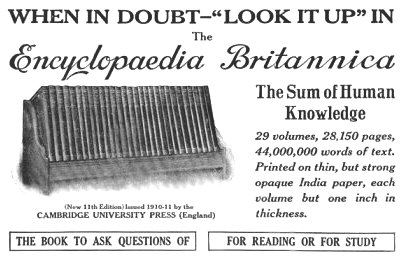
Notability is a rather dubious requirement – that is if we consider Wikipedia *The* encyclopedia, which is what I think it has become for millions of readers. The “Sum of Human Knowledge” (see ad on right) is constantly increasing, forcing paper-based encyclopedias to be selective/restrictive for obvious reasons. Wikipedia does not have such physical limits, and has an army of volunteer editors, so why be restrictive? “When in doubt – look it up” is still what I think encyclopedias are all about, and that approach is what propelled Wikipedia to the No. 1 spot leaving the Britannica in the dust.

Neologism doesn’t belong in Wikipedia”: as several commenters pointed out, the term neologism itself is a neologism:-) But let’s get real: considering the body of knowledge already covered in Wikipedia, an increasing ratio of new articles will by definition be neologism. An overly exclusionary approach by Wikipedia administrators will relegate it from being *The* encyclopedia to being just one, in fact likely still #1 of many, giving way to the Refupedias so eloquently defined by my fellow Irregular (and I might add, subject matter expert on this debate) Niel Robertson.

While I question the principles behind the notability and no-neologism rule, I understand that the debate on deleting an actual submission is not the appropriate forum to discuss the validity of Wikipedia rules.

Yet I am surprised by the sharp contrast in the two side’s approach: defenders of the article, mostly domain experts in enterprise software but Wikipedia-newbies discuss the merits of the article itself, while the deletionist side avoids such conversation strictly focusing on adherence to policy only. In fact it’s this part of the discussion that convinced me we’re not seeing a constructive debate (side note: why isn’t there a Wikipedia entry on this?), instead the most active deletionists are pre-determined to kill the article, and are shutting down reasonable arguments / citations in a rather dogmatic manner.

The trio of no original research, verifiability and reliable sources should be more or less self-explanatory, and one would think references to “Enterprise 2.0” in respected publications like MIT’s Sloan Management Review and Business Week certainly meet these requirements. Not really. Our Praetorian Deletionist discards both:

“The problem is only readers that have access to this journal can verify the information. It must be available to anyone (by heading to the library, searching online, or stopping by a book store)”

“Journals that the general public can not easily access are not valid sources. Period. That is wikipedia policy.”

Wow. Not accessible… well, I don’t see any restrictions on these subscription pages:

In fact the individual article is available for $6.50, but (don’t tell anyone!) it can also be found as a free PDF file on the web. Now, I am not claiming these publications have as wide circulation as the New York Times, Boston Globe, Washington Post, Time Magazine, Newsweek – all papers that our gatekeeper finds acceptable – but why should they? We’re not talking about architecture, medicine or gardening – for the cross-section of business and technology it’s hard to find more authoritative source than the SMR or HBR.

All other citations the “defending team” comes up with are refused, for formal reasons, without looking at content.

Business Week: “the article itself is not about the term “Enterprise 2.0”, but about “Web 2.0” “. In fact “Web 2.0 in the Enterprise” is what the entire article is about, and that is indeed Enterprise 2.0, but the Wikipedian here does not understand the content, he is just looking for a verbatim match.

ZDNetBlogs” by Dan Farber or Dion Hinchcliffe are rejected for being blogs, and self-referencing, being about the deletion process, not the original term. Once again, this is a rigid, dogmatic argument: true, the deletion debate is referenced in the articles, but it was just the trigger, the authors (recognized subject matter experts) explicitly discuss the validity of Enterprise 2.0. Ross Mayfield then cites further articles, including one by Dion Hinchliffe, ZDNet specifically referencing Enterprise 2.0: “Fortunately, the title of McAfee’s piece says the important part” – and that title is: Enterprise 2.0: The Dawn of Emergent Collaboration . Not accepted, after all it’s just a blog.

I can’t leave Wikipedia’s exclusion of blogs as reliable source without a comment. Tehcnorati is tracking over 50 million blogs, and we know it does not track everything, so who knows what the total number is: 70M? 100M? How can they all be lumped in one, “unreliable” category? As non-PC it may be, I have to side with Robert Scoble here, there is a slight difference between content-light (LiveJournal) diaries and professional blogs by industry experts. The ZDNet blogs mentioned above really shouldn’t be personal blogs, they are professional publications. And by whose standards should the HBS Faculty Blog, bearing the logo of Harvard Business School not be considered a reliable source, in fact an authority on matters of business and technology?

The concept of authority is not unknown to Wikipedia, just check the following excerpt from the guidelines on reliable sources:

“Advanced degrees give authority in the topic of the degree.”

“Use sources who have postgraduate degrees or demonstrable published expertise in the field they are discussing. The more reputable ones are affiliated with academic institutions.”

Guidelines or not, Mr. Deletionist has his own view about Harvard Prof. McAfee:

“While I respect your knowledge and status as an Associate Professor, I take a dim view of a person who coins a term also being the person that is the main editor and follower of that term’s wikipedia article.” (for the record Prof. McAfee did not edit the disputed Wikipedia article at all)

Oh, well… instead of talking about Wikipedia, let’s focus on why this whole debate is irrelevant. Because “Enterprise 2.0” is really just a label. Opponents call it “marketing buzzword”. So what? Labels, Marketing buzzwords can be quite helpful:

  • In the beginning of this post I spent 2 paragraphs detailing my point of view on Notability and Neologism, when I could ave simply referred to a “label”: I am an Inclusionalist. (I believe in editing rather than killing posts)
  • In the very early 90’s I was implementing SAP systems (yes, guilty of being a domain expert). The concept of an integrated cross-functional enterprise system was rather unusual, it took lot of “evangelism” to spread the idea. A few years later Erik Keller and team at Gartner coined the term ERP, and it is the industry definition ever since.
  • Here’s a fairly lengthy explanation of how a web application can look and feel like a desktop application. (alert: it’s a blog!). The post is from January 2005. A year later the term Ajax was coined, and now the author of this article could save half a page and just say: Ajax.

Perhaps the above examples make the point: in business and technology, marketing “labels” are typically coined to describe an already existing phenomenon. Enterprise 2.0 as a term my be relatively knew, but it’s not some theoretical concept a bored professor is trying to sell the world. It’s a disruptive change, a confluence of technological, social and business changes in how corporations conduct business using new IT tools. No Wikipedia gatekeepers can prevent this seismic shift. Let’s move on, do our work, and in less than 6 months Enterprise 2.0 will find its way back to Wikipedia.

Update (9/1): The debate is now closed, Enterprise 2.0 stays in wikipedia.

Related posts:

(Note: this is just a partial list, pros and cons from domain experts – all this representing zero value, per wikipedia policy, since they are blog posts.)

Tags: , , , , , , , , , , , , , , , , , , , , , , , ,

Zemanta Pixie
post

Women 2.0 Party

I should read the PR 2.0 blog more often.  A lot more often.  Here’s the invitation I missed:

You’re Invited – Women 2.0 Party Today  Wow!  Woman 2.0 – Peter Rip should update his Everything 2.0 list now.

Here’s a set of photos from the previous Women 2.0 Party.  But wait…  where are the women?

Guys, you’re nice and everything… but if this is what 2.0 means, I’d rather stay with Women 1.0

Update (8/28): Stowe, what’s on your mind?

Update (9/3):  Valleywag shows an improved photo

Tags: , , , ,

post

Scammers Are Getting Smart

(Updated)
Here’s an email I received this morning:

Dear xxxxxx,

Thank you for your subscription to
http: // polarstaryouth.org/scken1578.html  (link removed for my readers protection)

You have been billed as KRBILL LLC for the amount of:
3.95(USD) for 3 days (trial) then 34.95(USD) recurring every 30 days .
Your new subscription identification number is:xxxxxxx,
Your membership access information is:
Username for your subscription: xxxxxxx
Password for your subscription: xxxxxxx
E-mail: xxxxxxx
Membership website: http: // polarstaryouth.org/scken1578.html (link removed)
Thank you for choosing KRBill as the eMerchant for your subscription!
Customer Support/Cancel Your Subscription 28/08/2006 07:06


Obviously scammers are getting smart: reading you’ve just been billed, wouldn’t you instinctively click to clarify/cancel?  We’re all getting smarter about scam, but the sense of urgency can easily trigger a kneejerk reaction, forgetting all precautions, and that’s exactly what the scammer counts on. However, there’s two safety precautions I strongly recommend to everyone:

  • No card to charge: I only ever use throwaway, virtual credit card numbers on the Net, so scammers can bill all they want, they can’t charge my card
  • Protected Email address: I have specific email addresses for subscription lists and online orders,  another one for financial activity (banks, brokers), yet another for the blog…etc.  I don’t ever use online my “real” email addresses that I want to protect. So when scam arrives to the protected email, I can rest assured they don’t have any of my data, the email is harmless junk.

Any other good ideas?  Please leave them in a comment below.

Update (8/28):  Polar Youth appears to be a non-profit, not selling anything. However, the full URL (I did not click it, but retyped it) leads to a page where one can supposedly by a software product, and the licence terms refer to Intuit.  Since it’s obviously forgery, perhaps someone from Intuit will chime in here.

Update (9/1):  Wow… apparently this scam was first insignificant enough that only I posted about it, thus getting the #1 postition on Google for the search term “Krbill”… than it got widespread enough that a lot of people are searching for it… I am getting a lot of hits.  I also may have become the target of the scammers revenge: the appear to phish my email as sender.  I received emails asking for explanation, even one asking for a refund of any money charged to them.  Rest assured: the scammers could not get your money, unless you provided them with data.

As a commenter points out below, the websites the scam email leads to contain hidden iframe that attempts to download malware on your computer.

Tags: , , , , ,

post

Friday Quiz: What do Astronomers and Wikipedians Have In Common?

Hints here and here.

Tags: , , ,