post

TieCon 2006: John Doerr, VC, Enviromentalist, GreenTech Evangelist

(Updated)
I’m at TieCon 2006 at the Santa Clara Convention Center.  Trying to park was a nightmare: 15 minutes circling in the parking structure.   Last time I was here for Software 2006, I parked right next to the stairs. Finally got in, sitting in the back of the conference room (power source!), flip my laptop on, and Voila!  – free wi-fi available… as it should be (at Software 2006 it cost $26/day)

Michael Malone,  introducing John Doerr just made the same comment – he parked in Great America’s overflow parking …. 3,000+ participants. Entrepreneurial spirit is definitely back.
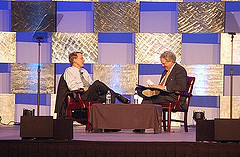
Raw notes from the discussion with John Doerr of Kleiner Perkins Caufield and Byers, a Silicon Valley VC Legend:

If you’re thinking of coming to KP just for money, it’s expensive: don’t come. Come for the networking resources, experience. 

This being TiE,  a few India-pecific questions. Response: Kleiner backed 100 companies over the past 4 years and half of those have Indian leadership. They are passionate, have a sense of wanting to give back to India and the world.  KP is also active in in India, which happens to produce the largest pool of engineering pool in he world, English is spoken and it’s a democracy. KP made two recent investments in India.

New subject:  Technology –  what’s coming next?   John Doerr:  Biology.  This is what he really wants to talk about, now he gets passionate.  He talks about soon-to-debut   “Inconvenient Truth”   and shows a few powerful slides about Greenland shrinking, due to ice melt.  If Greenland melted all, the oceans would  rise by 20 feet. Just how much is that? – we get a feel when he shows a few slides of the Bay Area – oops, there goes the convention center we’re in…

So what can we do about it: need to reduce carbon emission. Opportunity for engineers, innovators, politicians: get efficient, produce growth requiring less energy, less pollution.

Kleiner Perkins has invested in 7 stealth GreenTech companies in the past 5 years. – $57M total invested in those.  Huge potential business, ROI eventually may be bigger than “traditional” tech. areas, but wait for payback longer.

Tom “World is Flat”  Friedman’s next book, Green is the New Red-White-blue:  the current biggest enemy facing this country is not Islamism, Communism, or other such ideologies, but Petrolism.  We need petrol tax to encourage getting energy efficient.  It takes guts, not for the “girlie man”.  (Timely quote from the Gubernator due to appear on a panel this afternoon.)

We’ve had no major innovation in energy for the past 30 years.  China has higher automotive emission standards than the USA.  If India and China develops the way the US has, we’re choking the world. We need to innovate.

Michael Malone: “you’re working with your heart, not your mind”. John Doerr: no, this will be the largest economic opportunity in the world.

On to the issue of the Pandemic Fly: Something of this magnitude happens 2-3 times in a century.  Shows some slides of the devastation of the Spanish Flu.  What can entrepreneurs do?  Improve surveillance and diagnostics. KP backed startups working on inexpensive diagnostic devices, and vaccine expected to be 10 times more effective than Tamiflu.  He is calling for backing entrepreneurs in this area.  Distribution, pricing: give it away free or cheap in the developing world, sell it in the developed world..

On Social Entrereneurship:  double bottom line. Build a sustainable operation and eliminate poverty.  John Doerr has some more personal involvement in this area,  not through Kleiner.

Politics: Silicon Valley traditionally was doing best by staying out of politics.  John sees politics playing a bigger role. Advocate for policies that reduce the climate crisis and increase energy innovation.”   Let’s have a President who will make “green ” a priority.

Social Entrepreneurs build should build scalable and sustainable businesses, but they don’t have to be profitable, just self-sustaining.  Do you want to built an inconsequential Enterprise Software company or do something big?   (This reminds me of Steve Jobs famous challenge to John Sculley: “Do you want to spend the rest of your life selling sugared water, or do you want to change the world?”)

In conclusion, John Doerr sums up what he is passionate about: “I want to revolutionize the energy industry, make investments in : fuel cell, solar, bio-fuels.

John’s call for action to the audience: If you’d like a copy of these slides, email me the titles of your  three favorite books.

References:

Tags: , , , , , , , , , , , , , ,

post

Missing the Old TechCrunch

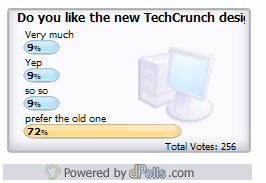
This is obviously a matter of taste, but I preferred the old TechCrunch look, Frederico Oliveira’s design: cleaner, easier on the eye.  I find the  new, greener pastures a bit harsh, too vibrant.   Apparently so do the overwhelming majority of readers, based on a vote count of 256, 72% prefer the old site.   This is a static pic here, but if you click through, you can vote yourself, which then allows you to see the dynamic vote-count.  The poll is run by Ouriel Ohayon, the editor of the French TechCrunch which still appears to follow the old design – and so does Mike Arrington’s sidekick blog, CrunchNotes.

I understand the need for more advertising space though…

Update (5/13):  This stirred up quite a blog-storm.  Here’s an interesting comment: “Now, Techcrunch is all web 2.0, which is supposed to be about users, conversations and listening amongst other things. So given that Poll you link to above, I wonder: WIll Techcrunch listen to it’s audience?

Well, this will certainly be interesting … will Mike follow the Gold standard, or … ?

Tags: , , , , , ,

post

Jack Bauer’s IT Adventure

No guns, explosives … Jack, you’re losing your edge

Tags: , ,

post

Innovative Software Business Models

Joseph Weisenthal at The Stalwart felt it was time to dust off Shai Agassi’s infamous half a year old speech and warm up the Open Source as IP Socialism debate again. (hat tip: Jeff Nolan) Why now is beyond me, but in a way it’s perfect timing: draws attention to the Who Pays For Software? New and Old Business Models event tomorrow, where Open Source, SaaS and VC Panelists will discuss the old and new business models.

Talk about Business Models, I haven’t had a chance to write about Intalio’s innovative business model, which I heard about at the World is Flat breakfast organized by Ismael Ghalimi, Intalio CEO and IT Redux blogger.

As Marten Mickos pointed out: “Open Source is not a business model, it’s a software production model and philosophy”. How do you turn it into a business is the million-dollar question now: there is no gold standard, creative entrepreneurs are experimenting with their own models.

Intalio recently moved 80% or so of it’s offering into Open Source. The fully featured product is avaialable free as long as it is run on an Open Source Database, however, customers have to pay an Enterprise Licence if they intend to use it on a commercial DB. Services and Training are chargeable – so far that’s the “traditional” Open Source model, if there is such a thing…

However, Intalio started an innovative experience outsourcing their product management to none other but their customers. They publish the future product development roadmap, along with the estimated timeline and cost of features, enhancements. Customers then can “bid” as to how much they are willing to pay to rep-prioritize the plan and get their requested features developed sooner. To move an item up on the schedule the entire cost has to be covered and at least two customers have to request it. As the model scales up, the requisite minimum “vote” may move from two to a higher number of customers – the more the better, the closer they are to a standard core product. 50% of what customers pay will be made available to them as discount towards future Enterprise Licence purchases.

So let’s tally it up. If the model scales up, Intalio expects most of it’s development paid for by customers – albeit at cost level. But when you start from zero development cost, zero sales cost (there is no sales organization, it’s all a download-try-buy pull process), add revenue from training and services, provide incentives for customers to purchase licences (the 50%) – I’d say it looks pretty good to me. Let’s review the model in half a year or so…

Update (7/11/06): More details from Ismael on Intalio’s business model.

Update (3/18/07): A year later Ismael declares the model a success.

Tags: , , , , , , , , ,

post

Who Pays For Software? New and Old Business Models

Philippe attended an event titled Demystifying Open Source – How an Open Source Strategy Can Make and Save Money for Your Business.  He sums up statements by one of SQLFusion’s customer; the CTO of Del-Jen ( a Fluor company):

Over a period of 4 years the cost of open source software did go down. The more they use it the less it cost.
On the other end the cost of commercial software increased constantly during the same period. The cost includes licensing and consultin
g.”

The product Fluor is using is Open Source Fusion Enterprise;  The small-business version, Open Source Fusion on-demand has opened for beta a few weeks ago.

Tomorrow I’ll be attending another event where I suspect we’ll hear a lot about Open Source: Who pays for software: new and old software business models – What’s next?

The panelists:
Josh Stein, Director, Draper Fischer Jurventson
Brian Bhelendorf, Founder and CTO of CollabNet.
Philippe Courtot, Chairman and CEO, Qualys.
Scott Dietzen, Ph.D., President and Chief Technology Officer, Zimbra
Marten Mickos, CEO MySQL.
Bernard Pesh, CTO of Salesforce.com.

This promises to be a hot event, pre-registration is now closed, but ad-hoc attendance appears to be open. Zbutton

Tags: , , , , , , , , , , ,

post

SMB / SME Have Become Obsolete Acronyms

SMB / SME describes Small – Midsize Businesses (Enterprises), but in terms of describing a market segment, especially in the software industry it has become obsolete. Why?

It used to collectively refer to companies too small to be attractive for the major Enterprise Software providers – and of course the same held true vice versa: it described a group of businesses that could not afford “enterprise software”. Well, that’s changed with Oracle, SAP now catering for the lower- mid-market, and a growing number of innovative new software solutions affordable even by the really small businesses. Hence the problem with the SMB / SME acronyms: they were sufficient to describe the “crowd to be ignored”, now that the software industry can actually address the needs of this segment, it’s too heterogeneous to be lumped together. To demonstrate the point, here are two articles talking about sofware in the SMB market:

SaaS Players Jostle For Position (internetnews.com) uses the term SMB, cites a VC and software vendor, but clearly the focus is on “small- and medium-sized companies of several hundred employees and 20 or more sales reps

In Gartner, SAP and small business – an oxymoron? Dennis points us to Small Business Vision – a Gartner Event. As he says: “SAP also has a definition of SMB which starts at revs of $250 million. (last time I looked) Which kind of says it.”

There is very little a $200M business and a 10-person startup have in common – their IT needs will definitely be different. Most analyst who talk about SMB really mean midsize businesses. That’s an important market, but let’s not forget the huge untapped opportunity the “long tail” presents; i.e. the millions of very small businesses that can now directly be reached, sold to, serviced inexpensively over the Net – classic SaaS style. Essentially what we are seeing is that the SMB / SME market really isn’t one segment at all, but at least two … perhaps three:

  • SAP, Oracle may consider a $100-200M million business “small”, but it really is midsized, the “M” in SME, with a few hundred employees and a dedicated IT department, that will likely need help with software implementation, but will cope with the ongoing maintenance themselves. SaaS is a wise choice for these businesses, but certainly not the only one.
  • One could define the “S” part, i.e. small businesses in terms of revenue or headcount, but from a software point of view a more important criteria is that they typically do not have permanent IT staff on payroll. This by definition makes any software products that are implemented and ran at the customer’s premises a poor choice – a potential maintenance nightmare. There is simply no better option for this group than SaaS – Software as a Service.
  • The third category in my mind is the very-very small business, possibly with 1-5 employees, who are likely all do-it-all types, focus on their core product / service, and are likely to struggle not only with IT, but some of the standard processes of running a business. This category needs more help than just technology, and vendors like WinWeb are experimenting with a unique combination of hosted software as well as “Live” services, i.e. expert advisors in various aspects of business. (Update: see Stefan’s new post on Live Services)

I’m hearing a new term more and more: VSB – for Very Small Business, describing either the third group above, or a combination of the second and third.

(Key ideas in this post were first published at The Small Business Blog where I am a guest blogger)

Update: 3 days after this post, Wikipedia now has an entry for VSB.

Update (8/14/2006): Vinnie‘s guest blogger, Jyoti Banerjee approaches the issue from the opposite direction, the “M” in SME / SMB, but comes to the same conclusion, i.e. they should not be lumped together with small- and micro-businesses.

Update (10/23/07): Further SMB segmentation by Gadi Shamia.

Tags: , , , , , , , , , ,

post

Kartoo Presents Search Results on a Map

I’ve found Kartoo following the trail from the visitors’ log.

post

Yahoo News Stroking My Ego

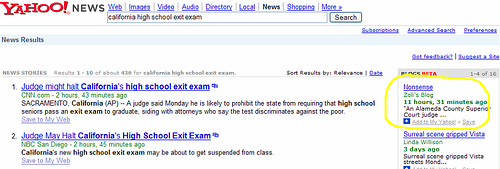
Wow, I am topping Yahoo News again – my post about the California High School Exit Exam is listed right next to CNN.

I guess that’s my (second) five minutes of fame …  I like this beta.

Tags: , , , ,

post

Nonsense

“An Alameda County Superior Court judge issued a tentative ruling today prohibiting the state from carrying out its plan to deny diplomas to tens of thousands of high school seniors in the Class of 2006 who have been unable to pass the exit exam.” (via the SoCal Law Blog)

Nonsense. 

Update (5/10):  I want my PhD issued by Stanford, Harvard, MIT and Wharton.  I want it ALL and I want it NOW – or I will file a discrimination lawsuit.

Update (8/11):  Appeals court refuses diplomas for 20,000 who failed exit exam (SFGate, hat tip: Jeff Nolan). Justice Ruvolo:  “A high school diploma is not an education, any more than a birth certificate is a baby.’’

Related posts:

Tags: , , , , , , ,

post

Vonage – OpenIPO?

(Updated)
I had already called the Vonage IPO a dud prior to receiving this email:

Because much of our success is attributable to our customers, we have asked the underwriters of the IPO to reserve shares of common stock for sale to certain Vonage customers at the IPO price in a Directed Share Program.
You may be eligible to participate in the Directed Share Program if you meet certain eligibility requirements, including having been a Vonage customer from December 15, 2005 through February 1, 2006.”

So Vonage is offering it’s IPO shares to all their customers.   I can’t help but see the similarity to WR. Hambrecht’s OpenIPO in the bubble years: little guys like me would never get an allocation in any of the juicy IPO’s, but we got all the duds the brokerage was trying to dump.   D