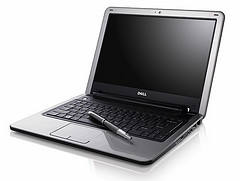
The proliferation of affordable netbooks is good for everyone – consumers, that is.  Computer manufacturers loath it (high volume, low margin business) and so does Microsoft: they can’t exactly sell $100+ worth of software on a $200 machine.  So they come up with all sorts of evil plans. smile_devil

Read more…

Tags: , , , , , , , , , , , , , ,

Hardly a day goes by without another new Netbook announcement, at lower and lower prices.  The first baby eee PC by ASUS was toy-like ( I returned it after a day), but the current crop are quite usable mobile computing devices. 

These new Netbooks are flying off the shelf, so much so that sometimes you wonder if manufacturers rush to re-label their notebooks to netbooks, just to ride the wave.  Whereas the first model had a puny 7” screen, the current standard is a minimum of 8.9, but 10” is becoming widely available, and when Dell recently announced their Inspiron Mini 12, ZDNet’s Larry Dignan rightfully noted that the netbook-notebook-laptop lines have just become blurry.

Dell’s divider line may very well be at the 12” screen size, considering anything beyond that a notebook.  ASUS CEO Jerry Shen clearly draws the line at 10” – a definition that fits his own eee PC line.  I think all these size-based definitions are meaningless. Size truly matters, but for another reason: when you pick a travel n*tbook,  you clearly need something small and lightweight, yet with a decent keyboard and screen.  But that’s not what differentiates Netbooks from any other computer.

The real divider is how you use it.  A Netbook is a light mobile computing device that allows you to process information, access the Internet, and that does not store a bundle of bloated programs or data

When computers first became personal, most of us only got one at the workplace, then years later the family PC appeared– one expensive computer shared by the entire family.  Now we often have individual PC’s for just about anyone at home, including the kids, and are moving to a new pattern, where individuals will have a number of purpose-oriented computing devices, be it a desktop, workhorse laptop, netbook or smartphone.  The fundamental change is that we’re not really working on the computer itself, but on the Net: the computer (keyboard, screen) is just our way to access the net. As Coding Horror’s Jeff Atwood says in The Web Browser is the New Laptop :

After spending some time with a netbook, I realized that calling them "small laptops" is a mistake. Netbooks are an entirely different breed of animal. They are cheap, portable web browsers.

We’re getting to the point where for most productivity task the computer’s performance or even the operating system won’t matter anymore: all we need is a decent screen and keyboard to get online. 

But computer manufacturers while jumping on this hot new trend, seem to be confused.  Minor flavors aside they typically offer two major configurations:

  • The uber-geek netbook:
    • Linux
    • Solid-state drive (SSD)
  • For the rest of the world:
    • Windows XP
    • Traditional hard drive

That’s not a very smart combination, if you ask me.  Statistics show the return rate of Linux vs. Windows based netbooks is 4 to 1. Buyers of the cute little netbooks are happy first, then they become frustrated that they can’t instantly do things they are used to – and a learning curve with a $400  $200 device is unacceptable.  Let’s face it, Linux is not friendly enough for most non-geeks – including yours truly.  But why can I not have a netbook with XP and SSD?

Typical netbook SSD’s are still in the 8-16GB range, while harddisks are up to 160GB.  That’s a trap that vendor themselves fall into: my sexy little netbook (an Acer Aspire One) came loaded with crapware, including trial versions of MS Office, MS Works, Intervideo WinDVD (on a DVD-less computer!) and who knows what else.  Once the pattern is established, and you have large storage, you will start installing your own programs and data, too, the temptation is just too hard to resist.  You no longer have a netbook, it just became a noteboook.

The New York Times ran an article this week: In Age of Impatience, Cutting Computer Start Time, discussing the problem of slow boot times.  Anyone who ever had a Windows computer knows this tends to get worse over time.  My own Vista desktop had a sub-minute startup time a year ago when new, not it takes 3-4 minute to boot it.  The two older XP-based laptops take 6-7 minutes to reboot.  This well-known Windows disease can only be cured by refreshing your system from time to time. It’s an ugly process, requires wiping out your harddisk’s content, re-installing Windows, then your programs and data.  PC manufacturers don’t exactly help by providing “restore disks” instead of proper OS CD’s: why would you start with a pre- SP1 copy of WinXP and reinstall a bunch of years-old obsolete crapware   when the objective was to cleanup your system in the first place?
If you want to avoid the pain, keep your netbook free of applications and data: use it as a NETbook, and it will stay nimble and fast (sort of).

Talk about fast, there’s a neat solution to reduce boot-up time: Splashtop, a quick-load platform by startup company DeviceVM can put you online within seconds, without loading the main operating system. Chances are you’d be using it 80% of the time, relegating full Windows to an as-needed basis.  DeviceVM charges manufacturers about $1 per system, so why is it that it’s often found in high-end notebooks, but not in the netbooks by the same manufacturer?   Splashtop should be a must on any netbook.

 Finally, a word on connectivity and prices:  Wifi gets you online almost, but not all the time, so obviously a 3G connection is a useful addition to your netbook.  But you will pay for 3G data usage, so why don’t carriers subsidize your netbook purchase, like they do with cell phones?   The day will come, as the WSJ reports, HP may be one of the first to introduce such a model:  H-P Mulls Service Bundles for Netbooks. When that happens, your notebook will not be too different from a smartphone, just with a larger keyboard and display.


(Cross-posted from CloudAve.)


Related articles by Zemanta

Tags: , , , , , , , , , , , , , , , , ,

So the next OS from Microsoft will be Windows Seven (where’s Windows 6?) – does anyone still care?

I simply don’t get it: Vista is barely out, nobody seems to like it, CIO’s refuse to upgrade, analyst firms tell them to wait, individual users who tried it switch back to XP, others time their new PC purchase so they can still get an XP machine – generally speaking Vista was as poorly received as the ill-fated Windows ME.

Apple is gaining market share, the major computer manufacturers are offering Linux PC’s, the Web OS concept is getting popular, applications are already on the Web – can anyone clearly see the shape of personal computing in 2012? (Yes, I know MS plans for 2010, I’m just adding the customary delay.) Will it still matter what OS we use to get on the Internet? How can Microsoft be so out of touch?

Considering the resistance to Vista ( see this Computerworld article on making XP last for 7 years) why would the world want to upgrade switch to yet-another Windows OS in five years?

Of course I’m not saying nobody cares. This hypnotized crowd certainly does. smile_yawn

Update (7/23): ZDNet’s David Berlind is asking the same question.

Update (7/25): Why ‘Seven’ and Not SP1?

Update (8/9): a very good analysis by eWeek: Broken Windows

Tags: , , , , , , , , , , , , , ,