GOutlook. Gmail Back to Earth… in Search of Revenue.
Personal Productivity September 29th, 2010
I’ve been long-time Gmail fan, having used it from the very early days, for almost 5 years now. The key reasons why I switched and have stuck with the service ever since were the productivity boosters, first of all:
- Threaded conversations
- Labels
- Search
Google did to email what all new product teams should: throw away all known concepts, start from fresh, figure our what the system should really do, instead of delivering a customary system with minor improvements. Instant success. Instant Customers. No, correct that: instant users. There is a difference. Apparently not everyone likes “radically new”.

Tags: CloudAve, email, folders, gmail, Google, labels, Microsoft Outlook, productivity, search, zoho
Universal, Actionable Search: Zoho’s Improved Answer to “Where’s My Stuff?”
Personal Productivity, SaaS June 1st, 2010
- is the Google mantra, meaning we should stop wasting time filing away information in folders, sorting, labeling it for later retrieval, when it’s so much easier to search / find it.
That is, if you know where to search. Did you discuss that project in email? Or was it a Document? A Presentation? A Spreadsheet? A Wiki? Was there a meeting on it that’s in your Calendar?
We’ve finally resolved the issue of universal search on the desktop, but not on the Web. Google’s productivity tools all have their own search facilities (I love Gmail search) but you have to execute search on an app by app basis. Even my Android-phone fares better, where I can search within a particular app or all my data.
Surprisingly, Zoho came out with Universal Search before the King of Search (although it would be naive to believe Google won’t catch up…) The Universal, Actionable Search solution announced today is just that:
- Universal: working across several Zoho applications, e.g. Mail, Docs, Writer, Sheet, Show, Notebook, Discussions, Accounts
- Actionable: depending on the context you can edit a document, respond to / forward an email, IM a contact..etc on a single click, right from the search results, without having to launch the individual application.
A nice step towards contextual integration we’ve just discussed recently.
For now Search is either accessible via search.zoho.com or by using the search box in Zoho Business – eventually all Zoho Apps will get the Universal Search box. (I have no information on how it will be implemented, but once again, context comes first: I’d expect the default to be within the specific app, other apps or “all” selectable, whereas in Business, which is Zoho’s business portal the “all” setting is more logical)
Related articles by Zemanta
(Disclosure: Zoho is CloudAve’s exclusive Sponsor)
Tags: actionable search, CloudAve, contextual integration, Google, SaaS, search, universal search, web apps, zoho
Why Bing is Gaining on Google
Humor July 10th, 2009
Bing is gaining on Google. Do you know why? Check these Google image search results for the keyword Bing. My friend Chris Yeh could come up with all sorts of theories on why she is winning, but I’ll skip the details.
On a serious note (and it’s not even tomorrow) here’s an easy way to experiment yourself: either use Bing vs. Google online, or better yet, add it as a search provider to your browser and observe the results for a few days.
Related articles by Zemanta
- Bing To Google: Try Updating Your Index Once In A While (techcrunch.com)

Yotify – an Almost Impressive Personal Alert service
Personal Productivity, Startups September 24th, 2008
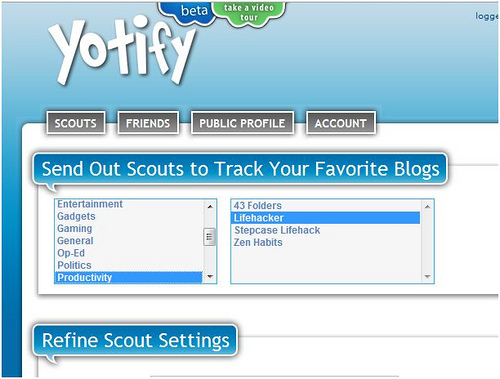
Reading that TechCrunch calls Yotify “Google Alerts on Steroids” I had great expectations… that did not last long. For now, it’s a no-go… read my quick review on CloudAve.
Related articles by Zemanta
- Yotify Launches Its "Google Alerts On Steroids"
- Concierge-Style Search Service Yotify Launches
- Stop Searching The Web – Let Yotify Do It For You
- Yotify Can’t Really Notify – Yet
Tags: concierge, google alerts, personal search, productivity, search, Startups, yotify
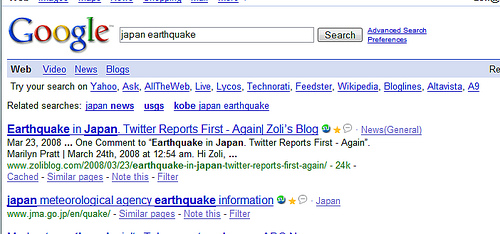
I often find out what’s happening in the world just be looking at the keyword activity in my blog referral log. Like today, when I received readers looking for news on the earthquake in Japan. This is actually sad, I feel bad for people looking for real info and getting “hijacked” – I am clearly not an earthquake expert, not even an authority on the subject. All I did was point out how Twitter had been the first to report on several quakes in China and Japan, long before the major news-wires, and miraculously (and unfortunately) my post became the #1 hit for the Japan earthquake search on Google for a while, even preceding Japan’s Meteorogical Agency, which should be the ultimate source for such information.

This isn’t anything new, I’ve seen some of my posts get into top Google positions before – but it’s more understandable when I write about a more obscure subject, or a startup nobody else covers… like Brainkeeper, where my post was #1 for months, preceding the company’s own site. Being #2 for the fairly generic search on saas very small business is a bit more surprising, and #1 for Microsoft Outlook Sluggish is certainly rather unexpected. Yahoo, for a change, lists my fairly old post as #1 for the very generic search term Startup Executives, and how on Earth did I get to dominate the igoogle for google apps search? 

Recently I’ve noticed it almost doesn’t matter what I write about, I can get a premium position for certain relevant keywords. As much as I am enjoying it (hey, who doesn’t like Google Juice), there’s something fundamentally wrong with this system. I think blogs are somewhat overrated, and perhaps individual posts should be weighted on their own merits, not the Google Juice of the main blog itself.
But there’s another conclusion we should draw here. Content is really king, to the extent that it can compete with advertising. Businesses should take notice: you can pay for AdWords, or get to the top by developing your own content – and organic hits are worth more than paid ads. 
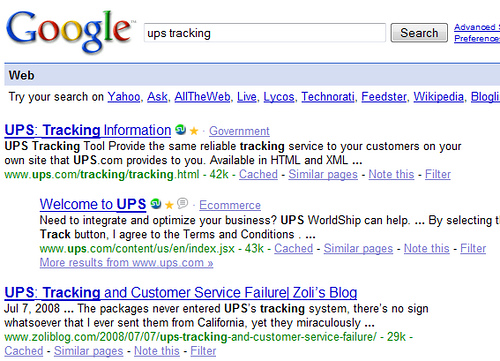
There’s another side of the coin here: if you don’t develop your own content, someone else will – and you may not be happy with the results. I’m not sure UPS enjoys seeing my post immediately under their site for the google search UPS Tracking…

So once again: the old adage “Content is King” has got a new meaning. I’ve been contemplating this for a while, and am getting ready to announce a new initiative in the next few weeks.
Tags: advertising, adword, Blogging, content, Google, google juice, marketing, pagerank, search, SEM
Gmail Search is Slowing and Google Knows…
Personal Productivity, SaaS January 6th, 2008
Perhaps the best thing Gmail has going for it is the power of search: the ability to instantly find everything. Except that instant is getting ..well longer and longer. And make no mistake, Google knows it, to the point that there is now a message recognizing the fact:

The Still working message comes up when you are waiting for search, stuck to the point that you can’t move away, stop the search …etc: your options are either wait it out, or close the browser/window. A Windows-like experience? 
Related posts: Simplified Guide to Importing All Your Archive Email Into Gmail
Tags: gmail, gmail search, Google, search
Koral Acquired by Salesforce.com
Business, Collaboration, Personal Productivity, SaaS, Startups, Technology April 9th, 2007
Wow, this was fast. I met Koral CEO Mark Suster some time in November, when he gave me a demo of his then pre-beta Content Collaboration system. I instantly liked it, largely for it’s simplicity – hence the title of my review: Koral – Collaborative Content Management without the Hassle of “Management”.
Apparently I was not the only one who liked the product
. Koral is no more. Salesforce.com has acquired it, launching its new service … hm, SalesforceContent, or Apex Content, or Salesforce ContentExchange – apparently there is a bit confusion over the name, but we’ll know it tomorrow for sure. The logo is from the (former) Koral site:
Update: Clarification from CEO Mark Suster:
“The overall initiative is called Salesforce Content. That consists of the Apex Content platform where developers will be able to build their own content based applications and Salesforce ContentExchange, which is a Web 2.0 application for managing corporate content that sits on top of this platform.
Basically, we took an integrated product, Koral, and split it out into a platform piece for developers and an application piece ready to sell to customers.”
TechCrunch, Read/WriteWeb and ZDNet has all the details. Congratulations, Mark, Tim and the rest of the team!
Tags: Collaboration, content collaboration, content discovery, content management, document management, ecm, koral, SaaS, salesforce.com, search


![Reblog this post [with Zemanta]](http://www.zoliblog.com/wordpress/wp-content/uploads/HLIC/54e6a3db43b098ecbf5db09e027cb1c1.png)
Zoli Erdos