
I guess this is it: I am officially old. Otherwise I’m sure I would understand WTF this is all about.

Photo Credit: Laughing Squid.
Connecting the dots ...

“Last month, Karzai’s Cabinet approved a proposal to re-establish the agency also known as the Department for the Prevention of Vice and Promotion of Virtue, whose police under the Taliban beat and imprisoned Afghans for violating Shariah law. For many, the revival of religious cops raises painful memories of ruffians zipping around Kabul in Datsun pickups mainly in search of women and girls who refused to wear the head-to-toe burqa, donned high heels, wore nail polish or walked down city streets without a male relative. Men were cited for sporting short beards, drinking alcohol, working during prayer time, playing chess or listening to nonreligious music.”
(full article in SFGate)
Tags: Politics, Democracy, Afghanistan, Sharia+Law, oppression,
Recently I joined my fellow Irregulars (a work-group of bloggers, analysts, journalists who write about Enterprise Software) in jointly publishing an article on Sandhill: Software’s Sky is Not Falling.
All articles get edited, and that’s even more so with multi-author ones; therefore I thought I would post my original, pre-edit piece below.
With almost predictable regularity we’re seeing software obituaries popping up just about every month: the only variation in the theme is what’s being declared dead: sometimes it’s Enterprise Software, sometimes it’s email. Just like I’ve already stated I did not believe email was dead, I strongly disagree it’s time to mourn Enterprise Software.
Since my fellow Irregulars mostly addressed the Open Source angle in Guy Smith’s post, Is Enterprise Software Doomed? I’ll reflect on the SaaS part of his piece.
“SaaS is the bastard child of the traditional proprietary software vendor and the Open Source marketing paradigm.”
SaaS is NOT an offspring of Open Source, although they often get lumped together, especially in buzzword-heavy startup pitches; however, they are quite different animals.
With a great deal of simplification the single most important difference is in the deployment model, SaaS by definition being on-demand, while most Open Source products are on-premise, traditionally installed systems.
Guy sees the natural evolution of Open Source Enterprise Software vendors “retrofitting” their products to SaaS offerings, but in reality most SaaS offerings are commercial, and most Open Source is on-premise, these two being on decidedly different paths.
The common trait, as Guy correctly points out is the change in the sales & marketing process: PR, buzz, online sales cycle process management, free trials, inbound sales, customer-initiated pull process vs. sales push. Yet Guy sees this as a necessity forced by economics: “the reduction in unit revenue will force all Open Source (including Dual Source) vendors to change their marketing and sales cycle “ when in reality these are actively pursued changes that both Open Source and SaaS companies embrace. Without denying the importance of the underlying technology, the most important change SaaS facilitates is this very business model change, which opens up entirely new, unpenetrated business segments for Enterprise Software: small and medium businesses (not just the M but the S in SMB). In fact customer size is another differentiation factor, at least for now, SaaS penetrating the SMB segment, while Open Source is ideal for mid-size companies, that actually have the in-house IT-expertise to play around with OS.
So is it as simple as:
Not really, that would be oversimplification. But while it’s easy to declare that for small businesses without their own IT resources there is no better option than SaaS, there is no clear “winner” for large corporations. There shouldn’t be. This is not religion; it should be business decisions that these organizations have to make individually. Analysts fighting the SaaS vs. On-premise war often forget that software exist to resolve business problems. As Charles so eloquently points out, it’s the complexity of these business processes, the need for customization, the number of user seats..etc that matters, and as we move up on this scale, increasingly “traditional” Enterprise Software is the answer. I happen to believe that eventually SaaS will grow up to meet those requirements, but am not going to guess how many years it will take. In the meantime the SaaS-fans (admittedly I am one) can claim that SaaS is the future – but that does not mean Enterprise Software is dead.
If I were to launch a software startup, it would be SaaS. Dave Duffield and his PeopleSoft team have the luxury of starting from scratch launching Workday, a pure SaaS company – since they were forced to walk from PeopleSoft and it’s customer base. But SAP and Oracle, (btw, Guy, since when do we determine market leadership by the amount spent on acquisitions?) together “own” the large corporate space; how could they expect their customers to throw away their investment in traditional software?
On-demand “purists” (the religious types) criticize SAP for their half-hearted hybrid approach to SaaS – but why would they do anything else? After all, SaaS is still only 10% of all enterprise software sold. Even if we believe “the future is SaaS” (which is of course unproven, but I happen to believe in it), there is a lot of mileage left in the “old” Enterprise model, and market leaders like SAP have certainly no reason to turn their backs to their huge and profitable customer base.
Here are the other “Irregulars” un-edited contributions:
Tags: enterprise+sofware, irregulars, mysql, on-demand, open+source, oracle, os, saas, sandhill, sap, software+marketing, software+sales, sugarcrm, smb, sme, small+business
IBDNetwork’s Under the Radar event at SAP Labs was a lively evening with full house, good discussion and four exciting companies. Prior to the presentations moderator Mike Arrington (TechCrunch) and the panel discussed pro’s and con’s of Office 2.0.
Part of the discussion was whether “Office 2.0” is just an attempt to replicate existing functions on the Web.
Peter Rip’s take was that such replication is pointless: the web-based apps cannot come close to the incumbent (MS Office) in functionality and they stand no chance to unseat it in the corporate world. The real promise of Office 2.0 in Peter’s view is creating processes-mashups, supporting business in entirely new ways.
Ismael Ghalimi’s response was that partial “replication” is OK, in reality the MS Office products are way too complex, 90% of users probably only use 10% of the functionality. The added value is the ease of collaboration, and also easier integration, as it would be demonstrated by Zoho in a few minutes. I tend to agree with Ismael, as I stated before.
The Panel: Peter Rip, Sam Schillace, Etay Gafni, and Ismael Ghalimi

(photo credit: Dan Farber, ZDNet)
After the initial discussion the four invited companies each had 5 minutes for a presentation/demo, followed by another 5 minutes of Q/A. Although the theme of the evening was Office 2.0, 2 out of 4 presenters were not strictly speaking “office” companies – the Web 2.0 moniker would better fit them: Wetpaint and Collectivex. They also have something in common: a strong focus on groups, communities – but they take rather different approaches with CollectiveX being rather structured, whereas Wetpaint is an open book that the users get to write.

Wetpaint was presented by Ben Elowitz, Founder and CEO. Technically Wetpaint is a wiki, but the best part is that one really does not have to know wikis, just happily type away and create attractive pages without the usual learning curve. More than that: these pages can be shared, other users can contribute, entire communities can grow and thrive.
It’s an ad-supported free web-based service that combines the best of wikis, blogs, and forum software.
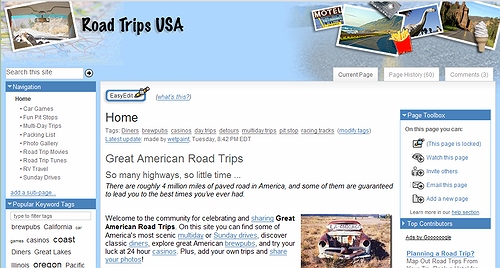
All panelists were impressed with the simplicity and elegance of the UI, but someone (don’t remember if panel or audience) commented this is just one of many similar products available.
I beg to differ. Yes, in a room of 60-80 techies we can all use (?) any other wiki easily. Not so in “real life”. I’ve set up wikis for companies, ad-hoc workgroups and events for the general public – there’s a whole world of difference. In a company you have a common purpose, set objectives, can provide training – not so in the consumer/ community space. Take a look at the Wetpaint site we set up for the Techdirt Greenhouse (un)conference, or Road Trips USA (pic link above) on the fun side.
I challenge anyone to find another “wiki” with comparable features yet is so easy that anyone who can type and click (i.e. use a simple editor) will be able to contribute without any learning.
Update (8/18): Robert Scoble hits the nail on the head: it’s all about the Blink Test. Wetpaint passes it. Other wikis don’t.

Collectivex Founder and CEO Clarence Wooten described his service as LinkedIn meets Yahoo Groups. Mike Arrington’s definition (not as moderator, but earlier on TechCrunch): “CollectiveX is what LinkedIn should have been.” It’s social networking based on groups, rather than individuals, facilitating communication, providing file sharing, messaging, calendaring and exchange of leads/contacts. Revenue model: free base, subscription for a few premium features.
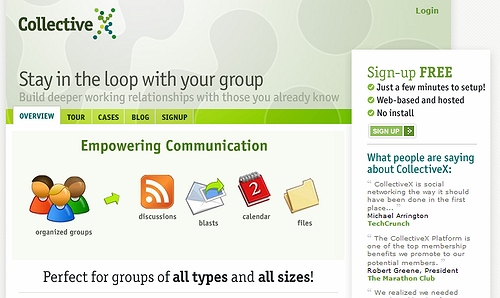
I admit I suffer from Social Network burnout. I do find some of them useful, especially LinkedIn, and I can think of a few groups I am a member of where we could use CollectiveX – I am simply tired of creating zillion version of my profile. I’d like a “Profile Central” where all these new services could pick up my data from. Am I dreaming? Wasn’t AlwaysOn/GoingOn supposed to somehow resolve the profile portability problem?
Of course this is just my ranting, although the audience questions pointed in the same direction, albeit indirectly: nice functionality, but isn’t incumbent LinkedIn too entrenched for new social networks to challenge its position?

Echosign Founder and CEO Jason Lemkin’s task was perhaps more difficult, perhaps easier: unlike the other three, his service could not be identified with a few words, he had to explain a new process flow. On the other hand he is addressing an ugly enough problem that he captured everyone’s attention: No matter how well computerized we are, when it comes to signing contracts, we’re back to the world of paper, faxes, lost documents. Echosign is a web-based service that takes care of the entire process flow( see slide below) : getting documents signed (electronically or hand-signature by fax), filed and distributed as pdf, routed, approved, managed, archived.
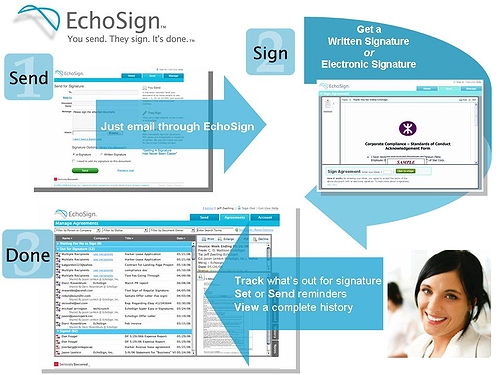
While technically this is SaaS, I guess Software Enabled Service is a better description than Software as a Service:-) EchoSign addresses a painful enough problem with a simple and elegant solution that it won the Panel’s Award. Congratulations to Jason and team!

Zoho Founder and CEO Sridhar Vembu did not bring us just one product but an entire productivity Suite. How do you demo 4 products in 5 minutes? (Not that he only has four, at my last count the company has 10 Zoho-branded products). The solution: you don’t. Instead of focusing on individual products, you demonstrate the power and ease of integration between them.
Sridhar pulled up a sample spreadsheet of sales figures and a chart; he changed some numbers in Zoho Sheet and of course the chart changed, too. Next with a few clicks he dropped data in a window and voila! – a Zoho Creator application just got created. We then saw the data entry form show up on a slide – part of Zoho Show. The same form, or other data views can also be embedded in Zoho Writer documents, or even in an email. As Sridhar kept on switching screens, one could almost get lost, but he got his point through: whichever application he changed the data in, it would show up real-time in the other application. I don’t have his presentation, but can present a similar scenario I used on my blog earlier. First I collected votes in a blog post using a Zoho Polls entry form –here are the results. Useful chart, not as impressive as the spreadsheet’s charting capability though, so I dropped the results in Zoho Sheet, which generated the pie chart below:

The chart has it’s own URL, it’s easy to embed in a blog (this post), document or presentation, and so does the entire spreadsheet itself.
Clearly the format of the Zoho presentation was a compromise, focusing on integration, but I think it paid off, the audience clearly got the picture that instead of randomly selected applications Zoho has a complete office/productivity Suite to offer. The tradeoff of course was not seeing detailed functionality – which is probably why panelist Peter Rip commented that the creation of these documents did not appear to be a collaborative process. As I have played with the Zoho Suite before, I know it is indeed very collaborative and the Zoho folks might want to call Peter and offer him a more detailed demo. The audience was very interested, in fact after the official event Zoho set up a demo station outside where they continued answering questions for a good half an hour or so. Some of those inquiries were about the ability to buy and implement the Suite behind a corporate firewall – something that Zoho is not ready for at this stage, but the interest level certainly bodes well for a future corporate business model. The immediate reward to Zoho came in the form of votes: Zoho won the Audience’s Choice for Best Product Award.
Congratulations to Sridhar and his team!
Last, but not least, thanks to IBDNetwork for organizing another successful event.
This was just the beginning: Office 2.0 enthusiast, or just about anybody interested, come join as at the Office 2.0 Conference in San Francisco, October 12-13.

Tags: Office+2.0, WebOffice, IBDNetwork, Under+the+Radar, TechCrunch, MS+Office, Microsoft+Office, Microsoft, Productivity+tools, Wetpaint, wiki, wikis, collaboration, online+communities, blogs, blogging, Techdirt+Greenhouse, CollectiveX, social+networking, LinkedIn, AlwaysOn, GoingOn, Echosign, digital+signature, document+management, SaaS, Zoho, Zoho+Suite, Zoho+Writer, Zoho+Sheet, Zoho+Show, Zoho+Creator, Zoho+Polls, Office+2.0+Conference, office2ocon
for this masterpiece (of a title):
Vinnie updated the Why did the chicken cross the road? classic.

The Golden State has outlawed big SUVs on many of its roads but doesn’t seem to know it.
Cities throughout California-the nation’s largest car market-prohibit the heaviest SUVs on many of their residential roads. The problem is, they don’t seem to know they’ve done it.
The Slate article is 2 years old, but showed up on reddit today – what a shock!
The TechCrunch party at August Capital will likely be the most lavish one – just look at the impressive list of party sponsors (see logos at the bottom). There are 760 names on the attendance list, and yours truly holds the last position on the wiki – hey, I am a rock-solid Z-lister forever:-)
Mike Arrington put up the last two tickets for bidding on eBay, and he will donate all proceeds to the Entrepreneurs Foundation, a Bay Area non-profit organization.
And now the big news: there may potentially be one more ticket to win – right here. How high do you think bidding will go? Fill out the form below, and you can be the winner. (I’ve just realized that the script may not come through in a feed, so please click back to my post to access the form). The guess closest to winning bid amount will be awarded by:
 )
)Note: I will be closing the poll at 10am on the day of the party, The eBay bid will close at 4:15pm. Winner will be published and notified by email as soon as payment is verified. (i.e. the bid has to be real). Update: The poll is now closed. The winner of the free
ticket is David Gobaud from Stanford, who guessed $537, and the winning
eBay bid was $501. Congrat’s and see you there! 
Proof that this is for real:

Tags: Charity, Entrepreneurs Foundation, TechCrunch, TechCrunch Party, eBay, zoho, zoho creator, techcrunch7
Mike Arrington’s TechCrunch Parties have become “THE EVENTS TO ATTEND” in the Valley – in fact not just in the Valley: last time around I remember participants driving up all the way from San Diego, and this time people will fly in just to be there. The last party as well as the next one this Friday both sold out within hours after the announcement, and a lot of readers felt frustrated:
I don’t envy Mike in this situation. It’s his party, his house (well, at least for the previous events), it would be perfectly OK for him to have an invitation-only party. Yet he obviously wants to see new faces, so he opens it up to anyone, but then of course he can’t please all… This time around, for the seventh TechCrunch Party hosted by August Capital there was more than the usual rush: the registration wiki has become constantly locked up and Mike was forced to move RSVPs to comments on his blog, closing the wiki.
Mike received ample feedback on why the wiki was not the right platform to handle hundreds of almost simultaneous registrations, and several entrepreneurs seized the opportunity to announce new offerings. Central Desktop announced a free public event wiki, and since it’s a hybrid not-just-a-wiki solution, Founder and CEO Isaac Garcia claims they do not have lockup issues (they use a form with a database in the background). Zoho Creator would have been another elegant solution.
However, what almost no-one talks about is that this was not simply a technical glitch. Having been lucky enough (?) to wake up 4am the day the wiki opened I managed to register myself at exactly position #100 in the wiki, then observe the wiki-war that soon ensued. The major “sins” I witnessed were:
One can perhaps justify registering others, although I don’t know where the reasonable limit is ( I only signed up myself), but deleting others is the absolute cardinal sin. Apparently fair play is a strange concept to some.
This raises another issue though: are these people not aware that wikis provide a perfect audit trail and what they did can easily become public? Or do they simply not care? Is getting in on the TechCrunch party worth being displayed on a virtual “hall of shame”?
This particular incident aside, I think the major learning here is the overall lack of awareness of a typical wiki’s capabilities and how to “behave” while using it. I know many who’d like the collaborative capabilities but are afraid of “chaos” and the potential lack of civility… in short a major ‘wiki war’ if they open up editing to anyone. Most wiki platforms offer technical controls to limit chaos: even consumer /community focused WetPaint introduced several security schemes in their latest updates, and enterprise wikis like Socialtext and Atlassian’s Confluence have for long had elaborate security schemes – heck, that’s why they are “enterprise”.
Just as important as the permissioning is the role of social- behavioral norms, which clearly are more common and more forceful in a corporate environment, where all wiki “contributors” work for the same company. “Ross Mayfield said that in four years of building wikis for corporations Socialtext has seen precisely 0 trolls and 0 instances of vandalism.” He also maintains a Best Practices wiki (hey, it’s the new skin!). Now, remember, it’s a wiki – you can contribute, not just read.
As for the TechCrunch Party, the guest list is currently at 738(!) and here’s a preview of who’s coming, courtesy of CustomCD.us. (who may have intended to keep this a surprise, but I found it anyway….)
Update (7/28/2007): Here’s another case of wiki “who done it”.
 Potus paid an impromptu visit at CTU headquarters today where Agent Jack Bauer had a plan ready to kidnap him and ship him off to a secret location in Africa. Unfortunately the King of the receiving country changed his mind in the last minute, therefore the plan was canceled and Potus proceeded to head a CTU Briefing.

Publisher / Editor of CloudAve and Enterprise Irregulars.
I do most of my business blogging there, with occasional asides here. More...
Recent Comments