Will Google Enter the Business Applications Market?

Enterprise Software, Personal Productivity, SMB / SME, SaaS December 13th, 2007

Google’s next killer app will be an accounting system, speculates Read/WriteWeb. While I am doubtful, I enthusiastically agree, it could be the next killer app; in fact don’t stop there, why not add CRM, Procurement, Inventory, HR?

The though of Google moving into business process / transactional system is not entirely new: early this year Nick Carr speculated that Google should buy Intuit, soon to be followed by Phil Wainewright and others: Perhaps Google will buy Salesforce.com after all. My take was that it made sense for Google to enter this space, but it did not need to buy an overpriced heavyweight, rather acquire a small company with a good all-in-one product:

Yet unlikely as it sounds the deal would make perfect sense. Google clearly aspires to be a significant player in the enterprise space, and the SMB market is a good stepping stone, in fact more than that, a lucrative market in itself. Bits and pieces in Google’s growing arsenal: Apps for Your Domain, JotSpot, Docs and Sheets …recently there was some speculation that Google might jump into another acquisition (ThinkFree? Zoho?) to be able to offer a more tightly integrated Office. Well, why stop at “Office”, why not go for a complete business solution, offering both the business/transactional system as well as an online office, complemented by a wiki? Such an offering combined with Google’s robust infrastructure could very well be the killer package for the SMB space catapulting Google to the position of dominant small business system provider.

This is probably a good time to disclose that I am an Advisor to a Google competitor, Zoho, yet I am cheering for Google to enter this market. More than a year ago I wrote a highly speculative piece: From Office Suite to Business Suite:

How about transactional business systems? Zoho has a CRM solution - big deal, one might say, the market is saturated with CRM solutions. However, what Zoho has here goes way beyond the scope of traditional CRM: they support Sales Order Management, Procurement, Inventory Management, Invoicing - to this ex-ERP guy it appears Zoho has the makings of a CRM+ERP solution, under the disguise of the CRM label.

Think about it. All they need is the addition Accounting, and Zoho can come up with an unparalleled Small Business Suite, which includes the productivity suite (what we now consider the Office Suite) and all process-driven, transactional systems: something like NetSuite + Microsoft, targeted at SMB’s.

The difficulty for Zoho and other smaller players will be on the Marketing / Sales side. Many of us, SaaS-pundits believe the major shift SaaS brings about isn’t just in delivery/support, but in the way we can reach the “long tail of the market” cost-efficiently, via the Internet. The web-customer is informed, comes to you site, tries the products then buys - or leaves. There’s no room (or budget) for extended sales cycle, site visits, customer lunches, the typical dog-and-pony show. This pull-model seems to be working for smaller services, like Charlie Wood’s Spanning Sync:

So far the model looks to be working. We have yet to spend our first advertising dollar and yet we’re on track to have 10,000 paying subscribers by Thanksgiving.

It may also work for lightweight Enterprise Software:

It’s about customers wanting easy to use, practical, easy to install (or hosted) software that is far less expensive and that does not entail an arduous, painful purchasing process. It’s should be simple, straightforward and easy to buy.

The company, whose President I’ve just quoted, Atlassian, is the market leader in their space, listing the top Fortune 500 as their customers, yet they still have no sales force whatsoever.

However, when it comes to business process software, we’re just too damn conditioned to expect cajoling, hand-holding… the pull-model does not quite seem to work. Salesforce.com, the “granddaddy” of SaaS has a very traditional enterprise sales army, and even NetSuite, targeting the SMB market came to similar conclusions. Says CEO Zach Nelson:

NetSuite, which also offers free trials, takes, on average, 60 days to close a deal and might run three to five demonstrations of the program before customers are convinced.

European All-in-One SaaS provider 24SevenOffice, which caters for the VSB (Very Small Business) market also sees a hybrid model: automated web-sales for 1-5 employee businesses, but above that they often get involved in some pre-sales consulting, hand-holding. Of course I can quote the opposite: WinWeb’s service is bought, not sold, and so is Zoho CRM. But this model is far from universal.

What happens if Google enters this market? If anyone, they have the clout to create/expand market, change customer behavior. Critics of Google’s Enterprise plans cite their poor support level, and call on them to essentially change their DNA, or fail in the Enterprise market. Well, I say, Google, don’t try to change, take advantage of who you are, and cater for the right market. As consumers we all (?) use Google services - they are great, when they work, **** when they don’t. Service is non-existent - but we’re used to it. Google is a faceless algorithm, not people, and we know that - adjusted our expectations.

Whether it’s Search, Gmail, Docs, Spreadsheets, Wiki, Accounting, CRM, when it comes from Google, we’re conditioned to try-and-buy, without any babysitting. Small businesses don’t subscribe to Gartner, don’t hire Accenture for a feasibility study: their buying decision is very much a consumer-style process. Read a few reviews (ZDNet, not Gartner), test, decide and buy.

The way we’ll all consume software as a service some day.

Update: As an aside, the Read/WriteWeb article that inspired this post demonstrates the “enterprise software sexiness” issue, which was started by Robert Scoble and became a Firestorm, per Nick Carr. I really think it’s a very thoughtful post, which, quite unusually for Read/WriteWeb sat alone at the bottom of TechMeme, then dropped off quickly. Now, has this not been about Accounting (yeah, I know, boring) software by Google, but, say adding colors to Gmail labels, in the next half an hour all the usual suspects would have piled on, and this would have taken up the top half of TechMeme. smile_sarcastic

Tags: , , , , , , , , , , , , , , , , , , , , ,

24SevenOffice Acquisition Rumors

ERP / CRM, SMB / SME, SaaS January 19th, 2007

24SevenOffice, the European SaaS provider of an integrated, All-In-One system for small businesses may be in acquisition talks with a major US vendor. The news went almost unnoticed, partly because it leaked just before Christmas, partly because the company is largely unknown outside a few European countries - not for long if a deal comes through.

I covered 24SevenOffice, a very promising SaaS provider for the SMB (SME) market several times. Their system is modular but integrated with a breath of functionality I simply haven’t seen elsewhere: Accounting, CRM (Contacts, Lead Mgt, SFA), ERP (Supply Chain, Orders, Products, Inventory), Communication, Group Scheduling, HR, Project Management, Publishing, Intranet. Essentially a NetSuite+Communication and Collaboration.

About the only thing I did not like was the lack of availability for US customers - this might change soon. The news release and blog post mentions three names: Salesforce.com, WebEx and Google, but adds a somewhat cloudy remark: “the companies here are only examples of what the rumors have outlined.” It does not explicitly confirm one of these specific companies as the potential buyer. I should also add that while I had in the past been in touch with Management, at this time I have no information whatsoever from the company, so the ideas below are purely my speculation.

Salesforce.com as suitor: A well-integrated All-In-One product would come handy to Salesforce.com which could dramatically expand their customer base this way. However, they’ve gone a long way in the other direction, trying to become a platform and extending their reach via the ecosystem built around the AppExchange. Acquiring 24SevenOffice would be a huge about-face for Marc Benioff, and essentially would mean admitting that archrival Zach Nelson of NetSuite was right all this time about the superiority of the integrated All-In-One approach.

WebEx: Their original market, the web conferencing space is being commoditized, they clearly are looking for more lucrative markets, as evidenced by the recently launched WebEx Connect (their “AppExchange”). I haven’t heard about much activity since the announcement - certainly owning a product like 24SevenOffice (btw., it really should be called 24SevenBusiness) would allow WebEx a powerful entry into the SMB applications market.

Google: No way, you might say. Google and business process / transaction oriented software are lightyears apart - at least today.

Yet unlikely as it sounds the deal would make perfect sense. Google clearly aspires to be a significant player in the enterprise space, and the SMB market is a good stepping stone, in fact more than that, a lucrative market in itself. Bits and pieces in Google’s growing arsenal: Apps for Your Domain, JotSpot, Docs and Sheets …recently there was some speculation that Google might jump into another acquisition (Thinkfree? Zoho?) to be able to offer a more tightly integrated Office. Well, why stop at “Office”, why not go for a complete business solution, offering both the business/transactional system as well as an online office, complemented by a wiki? Such an offering combined with Google’s robust infrastructure could very well be the killer package for the SMB space catapulting Google to the position of dominant small business system provider. Who’d benefit from such a deal? Google, millions of small businesses, and of course 24SevenOffice.

I admit I would feel somewhat sorry for 24SevenOfice though, as I clearly think they could have a shot of becoming a billion-dollar business on their own - the next NetSuite. Either way, if they make it to the US market this year, they’ll likely see explosive growth. When they are a well -known brand, remember, you discovered them here.thumbs_up

Tags: , , , , , , , , , , , , , , , ,

Betting on the NetSuite IPO

Business, ERP / CRM, Enterprise Software, SMB / SME, SaaS, Software, Technology December 6th, 2006

(Updated)

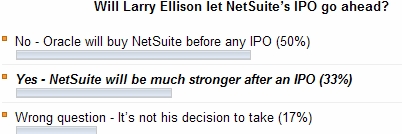
Phil Wainewright at ZDNet is running a poll on whether NetSuite will have a chance to go ahead with the long-awaited IPO or it will get folded back into the Empire.

I’m somewhat surprised by the above results, but since this is an early snapshot, please check the live poll for the current vote count.

Surprise or not, acquisition by Oracle is a realistic scenario, considering Larry Ellison’s close to 60% stake in NetSuite. This is certainly fellow Enterprise Irregular Jason Wood’s take.

I tend to believe that NetSuite is better off being an independent business; there are just too many differences for a merger to work well, and I don’t mean only technical, product-related differences. NetSuite is still largely a small business (SMB) player, and that’s a market that requires an entirely different Sales and Marketing approach, amongst others, and Oracle with it’s current “legacy” salesforce just can’t reach this market profitably. If your products are different, your target market is different, your organization, corporate culture are different, where’s the synergy? Big behemoth Oracle would kill NetSuite - Larry is better off with a portfolio approach, cashing in a 10-digit returnsmile_tongue

Talk about the SMB market - there really is no such thing. “SMB” was sufficient to describe the market to avoid, but now that the software industry is getting ready to actually address the needs of this segment, it’s too heterogeneous to be lumped together.A $100M business is just as different from a ten-person startup as it is from a Fortune 1000 company. When analysts talk about SMB, they really have the mid-market in mind; when SAP is announcing new SMB initiatives, it targets $100-$200M companies.

The forgotten “long tail” represents a huge untapped opportunity: millions of (very) small businesses that can now directly be reached, sold to, serviced inexpensively over the Net - classic SaaS style. Different markets require different organizations - NetSuite serves this segment much better than Oracle (or SAP, for that matter) ever could. In fact SAP would be wise to copy this chapter from Ellison’s book: it should get it’s own “NetSuite” by investing in (not acquiring) an up-and-coming small-business focused All-in-One SaaS provider, like European 24SevenOffice. The next NetSuite.

Update (12/11): NetSuite Gets Ready For Its Close-Up by BusinessWeek.
Update (12/19): TechCrunch is running a story titled NetSuite’s Going Public, Looking for $1 Billion Valuation. I don’t know if it’s based on new information or …. (?)


Tags: , , , , , , , , , , , , , , , , ,

SaaS vs. Open Source for SMB’s? A No-Brainer.

ERP / CRM, Enterprise Software, Open Source, SMB / SME, SaaS, Software, Startups March 5th, 2006

(Update)
I have to take issue with Paul Gillin’s approach as he discusses whether SMB’s are better off with SaaS or Open Source Applications. If we equate Open Source to downloadable, on-premise installed software, I have no doubt, and have stated it before that the only good answer is SaaS. But, hold on, a few minutes later we’ll see these two options may not be mutually exclusive for long.

Paul analyzes several criteria:

  • cost
  • speed of deployment
  • customization
  • reliability
  • data ownership
  • vendor viability

These are all issues well-discussed on the web, and although Paul does not explicitly say, my reading is that he also leans towards the SaaS conclusion. The problem is that this criteria-by-criteria approach works well with a typical (mid-size) company where some level of IT expertise is present. Small Business America is very different from the web-savy geeky software startups; the majority are more traditional businesses with no CIO, IT department, in fact often without any IT support whatsoever. While the two main obstacles SMB’s face with any on-premise implementation are cost and (lack of) IT expertise, you can’t just translate the latter into cost – i.e. the cost of hiring full-time IT support. The opportunity cost of Management venturing into IT hiring and project decisions instead of focusing on their primary business makes this an impractical approach, leaving us with only one choice: SaaS.

Another issue not discussed in the article is integration. Open Source or SaaS, getting several packages work together requires IT and business process expertise, which typically means hiring expensive consultants. Therefore, I would go one step further: not only SaaS is the best choice for most SMB’s but they should seek to minimize the number of providers, i.e. the best choice is to use integrated All-In-One solutions.

The current undisputed leader in this field is NetSuite, but as they follow Salesforce.com’s footsteps and move upstream chasing midsize businesses, they leave an opening for up-and-coming challenger 24SevenOffice, which focuses solely on SMB’s, and covers a wider range of business functionality than the incumbent.

This is the situation today. Now, let’s revisit the original question: SaaS or Open Source? A tiny startup named SQLFusion is working on making that question obsolete. The dilemma with Open Source: a lot of good applications are available, but they are written by geeks for geeks… you really have to be quite knowledgeable to download and implement them. Example: at one of the startups I am advising I use SugarCRM over the internet. Starting to use it was a no-brainer, but when I looked at the prerequisites and the process of installing it myself, my head started spinning. No way, this is not for me! Open Source Fusion, which I hear is within days of opening for a limited beta will bridge the gap between availability and usability of Open Source Programs, by offering such apps to be used over the Internet. In true On-Demand fashion, maintenance, upgrades all happen in the background, one can start using the programs without implementing them. So it will no longer be SaaS or Open Source, but SaaS and Open Source.

The first incarnation of Open Source Fusion will provide access to individual applications, still leaving the integration dilemma for SMB’s, but the technology under the hood enables the company to later offer an integration layer between the key applications it serves up.

So the future is Open Source Software as a Service. Hm, here’s an ugly acronym: OSSaaS (?)

Update (3/6). Releated posts:

Update (5/23): Stefan over at The Small Business Blog discusses the issue; his company, WinWeb is expected to offer Open Source apps as a service soon.


Tags: , , , , , , , , , , , , ,