Archives for 2007

post

The Best Quote from Web 2.0 Expo

And the Best Quote Award (so far) goes to…. drumroll…

      …. Phil Wainewright for summing  up the wi-fi fiasco at Web 2.0:

“I was planning to live-blog the debate, but in a marketing masterstroke by WiFi sponsor Adobe to bolster interest in its Apollo smart client technology, the coverage was so poor I was obliged to take notes offline.” smile_teeth

Hilarious.  Btw, don’t expect longer posts from me for lack of power and wireless.

 

post

Freshbooks Launches Benchmarking Service: SaaS Will Never Be the Same

Way back at the Office 2.0 conference FreshBooks CEO Mike McDerment dropped a bomb in the last 20 seconds in his presentation: being software as as service, they can aggregate customers’ data, categorize it by industry, size ..etc, and once they do that, why not turn it into a service, providing customers with their own performance metrics as well as benchmarking them against their peers.
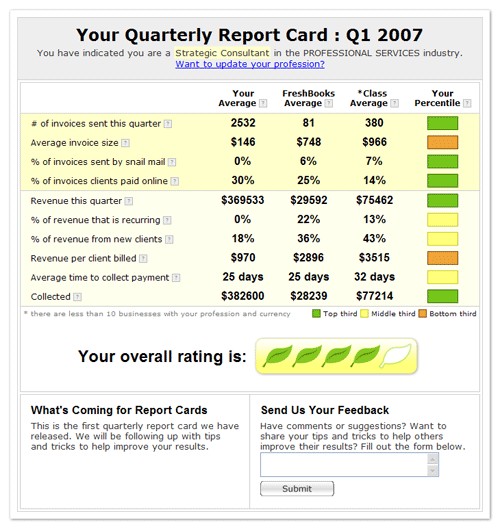
A few months later, the Small Business Report Card service will launch tomorrow at the Web 2.0 Expo as well as online. The service will be free to all Freshbooks customers, who will:

  • all receive their own performance metrics, and
  • if they select their peer group based on (currently) 80 types of business / professions, geography and several other business criteria, they will also receive their relative position, “score-card” within that group.

The sample below is a mock-up of the actual Report Card, but is shows the initial metrics reported. Clearly, as they further enhance the program, there will be more and more criteria, and FreshBooks customers will have a say in what performance metrics they find valuable.

Remember, FreshBooks’ customers are mostly small businesses who don’t have an army of MBA-types crunch the numbers and look for business (in)efficiencies. In fact it’s probably fair to say some would not even know how to interpret the numbers, until they are put in prospective – hence the value of relative benchmarking.

But why will SaaS never be the same? This isn’t just about FreshBooks and its customers.

It’s *the* hidden business model enabled by SaaS. An opportunity not talked about, but so obvious it has to be on the back of all SaaS CEO’s mind. Benchmarking is a huge business, practiced by research firms like Forrester, Hoovers, Dunn and Bradstreet, as well as by specialized shops like the Hackett group – none of which are affordable to small businesses. More importantly, all previous benchmarking efforts were hampered by the quality of source data, which, with systems behind firewalls was at least questionable. SaaS providers will have access to the most authentic data ever, aggregation if which leads to the most reliable industry metrics and benchmarking.

Being pioneers always carries a risk, and clearly, Freshbooks will have to keep an eye on their customers feedback. There may be a backlash due to data privacy/ownership concerns; some customers will not opt in, they may even lose some customers entirely. But I believe the majority will see the light and benefit from the service. If Mike’s blog post on the subject is any indication, the feedback there was overwhelmingly positive, with 13 comments for, 3 against.

I suspect a year or two from now benchmarking based on aggregate customer data will be standard industry practice, and little (?) FreshBooks will be looked upon as the pioneers who opened up the floodgate of opportunities.

Last, but not least a word on the creative launch – or a lesson on how to launch from a conference you don’t officially participate atsmile_wink:

Yugma is a web-conferencing company and an exhibitor at Web 2.0 Expo. What better way to demo a web-conferencing product than by showing real-live use… without Yugma having to move a finger to create content. They created Stage 2, a platform for companies to showcase their products remotely at the Yugma booth and simultaneously to the World through a Net broadcast. Both the presenters and Yugma win – congrat’s, and my personal Creativity Award to Yugma thumbs_up

Update (4/19): read Jeff Nolan’s comments.

Update (10/8/2008):  Congrat’s to Freshbooks for getting on  Fox Business.

post

Surprises @ Web 2.0 Expo

thumbs_up Surprise #1: It’s early Sunday morning, and there’s a huge crowd! Wow!   ExpoCal only showed a few dozen names for the Sunday sessions, so I figured this was just for the crazy-enthusiasts, the real crowd hits tomorrow.  It’s great to see so many participants. 

thumbs_down Surprise #2:  Registration is a disaster. A Case Study in how the best technology becomes worthless without the right process.  I’m guided in the pre-registered line, it goes quite fast, then in the data entry area I enter my name and click “print” to initiate printing my badge.  So far, so good: next step is another (not-too-long) line to actually pick up the badge. 

The line is somewhat pointless though, you have to wait till they call out your name. After 15 minutes or so, I do step up, and ask, only to find out, that if I checked in on any but the first three rows of computers, it goes to another bank of printers, at the other end of the check-in area, where all the crowd for on-site registration is. Great!  Nobody has told this before.

Over to the other line, nobody seems to have my badge, am told to wait till my name is called. I’m sure I was called earlier, someone must have picked it up, it’s been over 20 minutes now. After a while, I have a crazy idea: walk up to a computer again, let’s see if I can re-print my badge.  I shouldn’t be able to … but wow! it works!  Here we go: send to print again, and voila! I am called and have the badge in hands in 5 minutes.

Now I only have to walk back to the area where I started to pick up conference material .. then up to the workshop floor.  Dear organizers, despite Surprise #1 above, this is still just the rehearsal, tomorrow the real crowd arrives, you better fix this chaotic process.

Update: It’s Monday, the first full day, and I’m glad to see the problem fixed: there are clear signs that match the computer rows to the printers, registration is easy, no crowd to be found.

thumbs_down Surprise #3:  Web 2.0 needs connectivity, we all know that.  Wireless works, albeit sloooowly.  But…but: we need, power, too. I know, it’s my fault, should have carried extra batteries.. and there’s never enough power outlet for all attendees. But I haven’t been to any conference where’s not a single power outlet in the entire room. I’m sitting outside, next to a watercooler (which runs on power, so it led me to a spare outlet), trying to recharge my hungry laptop.  I’m afraid starting tomorrow, there will be tough competition for these spots.

That’s it for now, joining Ismael’s session.

Update, Monday: power still non-existent, wi-fi dying. It’s useless, and I’m sitting in the Mindtouch wiki session, where Ken  Lui just gave up trying to demo anything, due to poor connection.   Web 2.0 Expo with Web 0.5 connection:-(


post

Microsoft Patches Outlook, Creates PR Nightmare

Computerworld reports that Microsoft issued a patch to deal with Outlook 2007’s sluggishness, this time for real.

I can’t say that this will 100 percent solve the latency issues, but users should see a big improvement,” – says Jessica Arnold, Outlook’s program manager.

 Why won’t it solve the latency problems?  Because they were largely introduced by design changes to accomodate:

  • RSS handling – a new feature.
  • Indexing – fixing what hasn’t worked for years, i.e. finding email.

So, is Microsoft saying it’s the improvements that brought Outlook down to its knees? Ouchsmile_sad

Arnold said that while Microsoft had started hearing about problems even before Outlook’s release to businesses last November, “until we had enough users, the data wasn’t clear.”

Oh, I’ve got it now.  This is Microsoft’s way of becoming Web 2.0 complient: “Release early, release often” – don’t test, I might add.  Sorry Microsoft, this works for startups with early-adopter techno-enthusiast users, not for the corporate world’s #1 communication platform. And where’s the “Beta” moniker, anyway?

“Outlook wasn’t designed to be a file dump, it was meant to be a communications tool,”  – says Arnold, recommending users archive their email often, reducing the size of their .PST file.

Yeah, right. For years I bought into that, and was a religious auto-archiver.  There’s only one problem with that concept: we’re not storing old email for the sake of having it: it’s for the occasional need to actually find old information.  Have you tried to open an archive.pst file?  Since the contents are not kept up-to-date in your index, you can launch “find”, than take a coffee-beak.  Better yet, go for lunch.plate

Archiving, limiting storage was indeed the only solution for a long while.  But now there is a better one.  Ever since I’ve dumped Outlook, moved ALL my archives to Gmail, my PC is fast (desktop index, online backup, virus checker all have less to do) I have an efficient, fast email system, and can retrieve any email sent/received in the past ten years in a second.  That’s the real solution to Outlook’s performance problems.

I’ll take it one step further: for doc, spreadsheet, presentation needs I use the Zoho Suite.  Signing documents: EchoSign.  Incidentally, I am typing this on an offline editor, while sitting on BART, on my way to the first Web 2.0 Expo session: Ismael Ghalimi presenting how he runs his business entirely on Web-based services.

Update (4/16): Built For vs. Used For by Jeff Nolan.

post

The Long Swim to SAPPHIRE

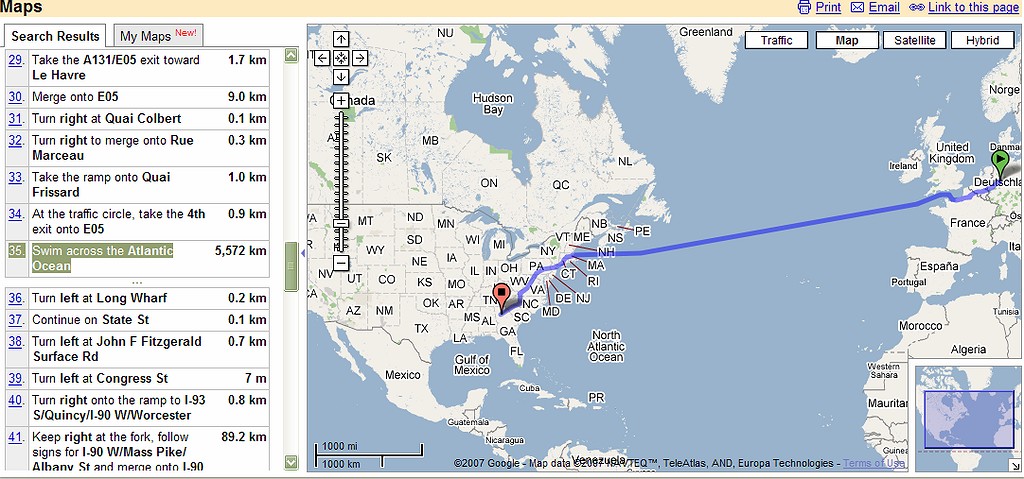
SAP’s Craig Cmehil is excited to come to Atlanta as part of the Bloggers’ Corner at SAP’s annual mega-event, SAPPHIRE. He even included the map of the Congress Center area. Nice … but Craig, you should look at another map – the one that tells you how to get there. Pay special attention to step# 35. I hope you start training soon.smile_shades

, , , , , ,

post

When Funding Spoils Startups

I ‘m reading about two startups this morning and I can’t help but draw a comparison.

TechCrunch features the two-way storage widget released by Box.net. I consider Box.net is a cool company, with an interesting product, even though they are in a crowded market.

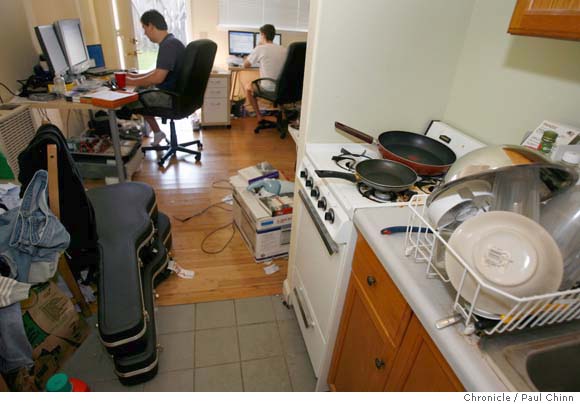
Their story is that of the classic, frugal live-in startup model: few friends get together, build the product and business day and night, live frugally but have fun in the process. (The photo to the right is from the SF Chronicle that featured several startups living the frat-house culture).

I suspect Box.net may now have real offices, having received funding from DFJ, but somehow I don’t see them spending that $1.5M on luxuries. Certainly no reserved parking smile_wink

The other story is from Wired, about Socializr. The photo on the left shows their entire team. At first glance, a “typical” startup team – except their job titles. Toni Graham’s, in particular: Executive Assistant. No, it’s not a joke.

I had the honor (?) of discovering Socializr while they were still in stealth mode, based on a job listing for the Exec Assistant position. For a while I thought it was just a prank, but later on I confirmed they were indeed real, raising funds and actually hired Toni. While I still don’t know why a 3-person startup needs an Executive Assistant, at least I’m glad the search was thorough, and she has all the right qualifications: pretty, blonde, sings, in fact trained in opera!

I can’t really figure out what to think of this. I recall visiting some of the later stage startups, like Socialtext, JotSpot (prior to acquisition) already in decent offices,with larger teams, still no Exec Assistant to be found. What are they doing wrong? Or Atlassian, with revenues in the $16-18M range, hiring a VP Marketing for the first time, yet when you visit their San Francisco office, the President (or whoever) opens the door – no Assistant there, either.

You see, I am biased. Yes, it’s all about the product and meeting real market demand, but I admit I prefer following companies that are “likeable” in many other ways. My bias tells me when a startup’s first hire is an Executive Assistant, there is something wrong with priorities, and I don’t expect much. But of course, what do I know – and it certainly helps if your investors are your friends. smile_omg

Related post: Socializr, the “un-startup” on VC Ratings.

UpdateSocializr Lays Off Staff, On DeadPool Watch

post

FireFox Not Your Default Browser – After Windows Update… Again?

Another dose of Windows updates, exactly a week after the previous set, thank you Microsoft, I’m having funsmile_baringteeth

  • Security Update for Windows XP (KB931784)
  • Security Update for Windows XP (KB931261) 
  • Update for Outlook 2003 Junk Email Filter (KB932330) 
  • Security Update for Windows XP (KB930178) 
  • Security Update for Windows XP (KB932168)

Dear Microsoft, could you please kill he annoying pop-up that wants me to reboot every 15 minutes or so?  When you take weeks to fix bugs, the World will not come to an abrupt end if those updates take effect a few hours later.  I *own* this PC and it’s my time, when I already told it I would reboot later, stop bugging me!

OK, so I give up, rebooting now… back .. starting FireFox, the “usual” message: 

“FireFox is NOT your default browser … etc.”

Wait, I’m not falling for it.  After last time, both Microsoft and Mozilla contacted me, and together they determined that Microsoft did NOT hijack the browser, FireFox was indeed still the default browser, the problem was in a check that FireFox should not perform. 

While I can’t know what’s going on now, I suspect the ball may be in Mozilla’s court – time to reopen that bug report.


post

Webmail: PC Magazine Confuses Productivity with Popularity

PC Magazine compares the 3 major Webmail providers: AOL, Microsoft, and Yahoo!, and makes the summary call of declaring Gmail “left behind” – without reviewing Gmail.  How funny.

They key criticism is that – unlike the other three -, Gmail does not have the look-and-feel of Microsoft’s “killer” Outlook. Wow. That’s quite a statement.  I fail to see Outlook a killer product, it simply is a the dominant product on the market, and will remain so for quite a while simply due to Microsoft’s weight.  By the way, I recall the time when Lotus 1-2-3 was a market leader. Or Wordstar.  Or dBase II.

While not giving Gmail a dedicated review section, PC Mag refers to it as part of the discussion on Yahoo Mail:

Gmail, beta for life (or at least three years so far, is beloved by millions (including me), and still has cachet though it lacks AJAX features, isn’t easy to use, and doesn’t have a sensible sorting ability”

I agree and disagree. Yes, Gmail is not easy to use if you’ve just come from the world of Outlook, Yahoo..etc. No, Gmail is easy to use once you “get it” – in fact at that point you will start seeing just how hard-to-use the other products are.  

Sorting, for example is the “poor-emailer’s” tool for finding information.  You can spend looong minutes sorting, scrolling up-and-down, trying to piecemeal together a conversation thread from your Inbox, Sent Mail and various other folders.  Or you can just pull the entire thread up by smart use of labels and keyword search.  (of course in Outlook I would only attempt a search when it’s time for a coffee-break).

PC Mag talks a lot about drag-and-drop and other bells and whistles – I agree, these are nice, but when it comes to productivity, there are 3 fundamental reasons Gmail beats all:

  • Threaded Conversations: in business conversations last weeks, include dozens of emails, and are basically a pain to put together before you respond to someone.  Gmail handles it automagically, and as a side-effect, it presents a lot more information on it’s list screen – since the dozen individual emails are now compressed into one line.  (Oh, and don’t forget the nifty feature of picking up the first line of the email body, instead of dumbly repeating the subject line)
  • Labels.  Folders are a crime. How often do you feel the need to file an email to several folders, yet you can’t.  Logical grouping and physical storage of email have nothing to do with each other, need to be de-coupled, and that’s exactly what Gmail does.  You can assign multiple labels to any email, pull of conversation based on labels, and your labels can still give you a sense of ‘folders’ by having them listed on the left pane.
  • Search. Find. That simple.   I can pull up email on any subject from 1999 before you even start thinking of which folder to look into, how to sort, scroll in Outlook.


Does this make Gmail a better product?  Certainly, for me.  Perhaps not for you. 

Not everyone needs productivity.  Not everyone wants to go through a paradigm change.  AOL, YAHOO, Hotmail are the absolute market leaders,and they should do whatever it takes to keep their customers.  Their mainstream users are corporate employees who use Outlook in the Office, whether they like it or not is irrelevant, they are used to it. When they go home, they may not email a lot. Some will check their emails daily, once a week, or less. They want a personal email that resembles to what they already know.  Familiarity is more important than productivity.

Gmail is for the frequent users and increasingly for people who use it to conduct their business: in other words, the productivity-freaks like yours truly.  Or Web Worker Daily’s Anne Zelenka, who rightly states:   GMAIL: NOT BEHIND, JUST GOING IN A DIFFERENT DIRECTION.


Update: If you’re thinking of migrating to Gmail but can’t figure out how to deal with years of email history, check out my guide: How to Import All Your Archive Email Into Gmail.

Update: Webware reports on a prize fight between Yahoo Mail and Gmail.


post

E&Y Happy Day

Oh, Rod, how could you leave such happy days behind? smile_secret


post

Koral Acquired by Salesforce.com

Wow, this was fast. I met Koral CEO Mark Suster some time in November, when he gave me a demo of his then pre-beta Content Collaboration system. I instantly liked it, largely for it’s simplicity – hence the title of my review: Koral – Collaborative Content Management without the Hassle of “Management”.

Apparently I was not the only one who liked the productsmile_regular. Koral is no more. Salesforce.com has acquired it, launching its new service … hm, SalesforceContent, or Apex Content, or Salesforce ContentExchange – apparently there is a bit confusion over the name, but we’ll know it tomorrow for sure. The logo is from the (former) Koral site:

Update: Clarification from CEO Mark Suster:

“The overall initiative is called Salesforce Content. That consists of the Apex Content platform where developers will be able to build their own content based applications and Salesforce ContentExchange, which is a Web 2.0 application for managing corporate content that sits on top of this platform.
Basically, we took an integrated product, Koral, and split it out into a platform piece for developers and an application piece ready to sell to customers.

TechCrunch, Read/WriteWeb and ZDNet has all the details. Congratulations, Mark, Tim and the rest of the team!