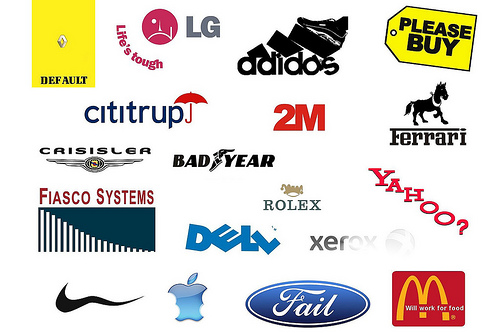

From Flickr, originally published by Business Pundit, and re-discovered by Jeff Nolan.  (Oh, yeah, I did my not-so-artistic-but-realistic rendering of the Apple logo a year ago.)

Update:  Will some of these Web 2.0 logos change in 2009?

Tags: , , , , ,

If Robert Scoble thinks he found examples of poor startup marketing (Startups: your web site sucks) he ain’t seen nothingsmile_eyeroll.  How about picking a name that almost actively drives visitors away?

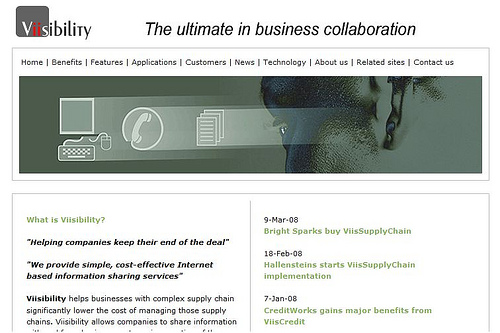
A few months ago Ben Kepes drew my attention to Viisibility, and I promptly called out their really poor naming:  how can they call their supply chain company Viisibility when there is already an ERP business named Visibility?

Now a friend who’s watching TechCrunch50 on site tells me he likes FairSoftware.  OK, let’s check them out… what is so innovative about Fair / Trade Show management software, and it does not even appear to be a  startup!

Hm… but Crunchbase says:

FairSoftware is the place to start and grow a virtual online business. It only takes a few clicks for software developers and website publishers to incorporate, hire and share revenue with other project members.

Bloggers, designers and developers can use FairSoftware to grow their business by working together online, without having to deal with the complexity and limitations of traditional corporations.

What’s wrong here?  They picked a name with only the .net domain available: fairsoftware.net .  Not too good… but perhaps not the end of the world – unless the .com version belongs to another software company.  Now it’s a disastrous choice.  Unless, of course if they already have a deal to acquire that domain.smile_omg

Update: iCharts is another one with the .net domain only, but it’s by far not as bad as FairSoftware.  icharts.com does not appear to be a real business, just a parked domain whose owner is probably holding out for a high price.  Hm… will they buy it?

Reblog this post [with Zemanta]

Tags: , , , , , , , , , , ,

Ben Kepes drew my attention to Viisibility, which appears to be a very interesting web based supply chain management / data clearing-house / hub type of a business.

At first reading I completely misread the name, thinking it was Visibility.  Wow, what a great choice, I thought – a simple, common word that perfectly describes what the business is all about.  But wait! try to Google it: it’s a bit difficult to find the relevant entries from the 47,100,000 hits Goggle found…   That brings up question number one:

Do common words that describe your business perfectly but are hard to Google make good brands?

Robert Scoble has a simple rule: only pick names that do not come up on the major search engines at all.

But as it turns out I was wrong, just missing that extra “i”: the name is actually Viisibility.  That brings up a whole new issue, which is my question number two:

Can intentionally misspelled common words that in  pronunciation describe the product, but are only available as domains and are only unique on search because of the “typo” actually become Brands?

Last time I asked the question, the majority vote was yes (albeit with few participants).  I used Vyew as an example, which I still think is a good name.   But Viisibility’s case is a bit more complex, as shown by these two homepages:

  • Viisibility: managing supply chains.
  • Visiblity: ERP for Complex Manufacturing.

Oops. Not only there’s another company with a similar name, they are also in the same space, “differentiated” only by a typo.  I’m afraid it’s not much of a differentiation, I can’t help but think Viisibility is a poor choice for a brand.

But forget the extreme case above, I’d like to return to the generic question, and run the poll again, especially as I’ve gained a few marketers as readers since last time.  If you read this in a feed reader, there’s a chance the poll does not work, so please click through the blog title to vote:


Update (4/22): The Importance of a Good Name @TechCrunch.

Tags: , , , , , , , , , , ,

I haven’t updated my resume for at least 3-4 years now. (There must be some old versions floating around, as just a few days ago a recruiter solicited me for a SAP Implementation Project – she must be especially dumb, not noticing the decade-old timestamp on my SAP qualifications.) But back to resumes: I don’t need one, and neither do you.

Even in the “old days” of writing resumes any recruiter would confirm that the single best way of landing a job was through your personal network. Top Executives, genius engineers, star salesmen, well-published academics don’t ever need to look for a job: they get invited. It’s always better than knocking on the door. Or many doors.

But now Seth Godin sets the same rules even for applicants to his internship:

Having a resume begs for you to go into that big machine that looks for relevant keywords, and begs for you to get a job as a cog in a giant machine. Just more fodder for the corporate behemoth. That might be fine for average folks looking for an average job, but is that what you deserve?

If you don’t have a resume, what do you have?

How about three extraordinary letters of recommendation from people the employer knows or respects?
Or a sophisticated project they can see or touch?
Or a reputation that precedes you?
Or a blog that is so compelling and insightful that they have no choice but to follow up?

We’ve looked at the two extremes: the top 5% whose personal reputation and network carries them on, and those who can’t really have a meaningful resume, since – unlike Ben – they are barely starting their careers. But in between is the rest of us, average Johns ad Janes, who probably have some achievements, are remarkable in one way or another … if only the world knew about it! Well, that’s the point! Most of us don’t have an extensive enough personal network, or they may be geographically dispersed, or they may not be in the right position… so how to get the word out?

Blogging changes it all. If you’ve been blogging for years, you certainly did not do it with a particular job in mind; your blog is likely to be a true reflection of who you really are, what you are an expert in, your communication skills, your priorities … YOU as a whole person, not as a candidate for a specific job – the brand called You. That’s certainly better than a resume, which is likely tailored for a particular job, and let’s face it, often “cosmetically enhanced” – no wonder it ends in the waste-basket.

You don’t have a blog? Why? Don’t you know the best time to market yourself is when you don’t need it?

Tom Peters has been saying for years:

Regardless of age, regardless of position, regardless of the business we happen to be in, all of us need to understand the importance of branding. We are CEOs of our own companies: Me Inc. To be in business today, our most important job is to be head marketer for the brand called You

My friend and fellow Enterprise Irregular Roth Boothby argues:

“…hiring a blogger is a lower risk proposition because you have more information and a better idea of how they are going to perform.”

He should know – he got hired twice, based on his blog. By the way, I really envy Rod’s charting skills:smile_eyeroll

It’s never been easier to build that Brand Called You: if you’re still not doing it, what are you waiting for? Start your blog today!

(hat tip: BL Ochman)

Tags: , , , , , , , , , , , , , , ,

There’s a new online Office player in town: Sabeer Bhatia, co-founder of Hotmail, the web-mail service that perfected viral marketing and got acquired by Microsoft for $400 million, unveiled his free web-office suite yesterday. It does not look at Google, Zoho or ThinkFree, it aims at Microsoft directly:

“We are just a few years away from the end of the shrink-wrapped software business. By 2010, people will not be buying software,” Mr Bhatia said. “This is a significant challenge to a proportion of Microsoft’s revenues.”

So be it – I am a certified web-app fanboy. I’m still waiting for my trial account (and wonder if I will ever get it after this post) , so I can’t comment on the applications themselves, but I think Mr. Bhatia’s choice of a name is rather tasteless: Live Documents. What’s wrong with that? Nothing.. except the close resemblance to Microsoft’s Windows Live brand. I only have “conspiracy theories” here:

  • Live Documents is a shameless rip-off of the MS brand, Mr. Bhatia is literally biting the hand that fed him and indirectly funded this company.
  • He is riding on Microsoft’s coat-tails: his application is (supposedly) very similar to MS Office 2007, he offers a plug-in to the MS products, uses the MS Office logo quite liberally throughout his site, people know his background with MS – all this creates the impression that his products is somehow jointly developed with Microsoft. (?) While this may help gaining traction initially, I think confusing customers is a very-very bad policy. (But what do I know, I haven’s sold a business for $400Msmile_embaressed)
  • Finally, the most far-fetched speculation: this is indeed Microsoft’s secret weapon, named appropriately so it fits easily after it’s absorbed in a $billion+ deal.

I can’t wait to hear from Microsoft… Don? Cliff? Chris? Anyone?

Update (11/23): Dan Farber on ZDNEt came to the same conclusions – literally.

Update #2: As much as I don’t like the Live copycat, I have to admit calling it “service plus software” is a smart play on Microsoft’s “software plus service“, indicating the shift in priorities. smile_wink

Related stories: Times Online, Techspot, Macworld UK, PC Advisor, Digital Inspiration, Between the Lines, /Message, Rough Type , deal architect, Zoho Blogs, TECH.BLORGE.com, Read/WriteWeb, TechCrunch, Betaflow.

Tags: , , , , , , , ,