Beating Social Media’s 90:9:1 Rule in the Enterprise

Collaboration, Social Networking October 23rd, 2007

The 80/20 rule is out (so last century), 90:9:1 is in: the rule of participation in public communities, social networks, wikis:

  • 90% of users are lurkers (i.e., read or observe, but don’t contribute).
  • 9% of users contribute from time to time, but other priorities dominate their time.
  • 1% of users participate a lot and account for most contributions: it can seem as if they don’t have lives because they often post just minutes after whatever event they’re commenting on occurs.

90:9:1 is a pretty good fit for most public wikis, starting with Wikipedia. Ben Gardner observed very different numbers: 50:25:x (he does not specify “x”). The interesting number here is 25, or it’s relationship to 50, meaning:

When the same question was asked about our corporate wiki ~50% of those present had used it but about ~50% of those had edited it.
Active participation in a corporate environment is much higher than in the public domain - this is not really a surprise, since the corporate wiki is used by people of real identities and reputations, and most importantly, shared objectives. This is also why Prof. Andrew McAfee hasn’t seen vandalism - a plague of public wikis - in the corporate world at all.

I suspect that 25% can go a lot higher, depending on the purpose of the wiki. When after the initial “grassroots movement” management fully embraces the wiki not as an optional, after-the-fact knowledge-sharing tool, but the primary facility to conduct work, it becomes the fabric of everyday business, where people create, collaborate, and in the process capture information. When the wiki is the primary work / collaboration platform, participation is no longer optional. Not when the answer to almost any question is “it’s on the wiki.” smile_wink

My earlier posts on this subject:

(hat tip: Stewart Mader)

Tags: , , , , , , , ,

Romulan Attack Because of Microsoft Office

Collaboration, Humor, Personal Productivity, SaaS August 16th, 2007

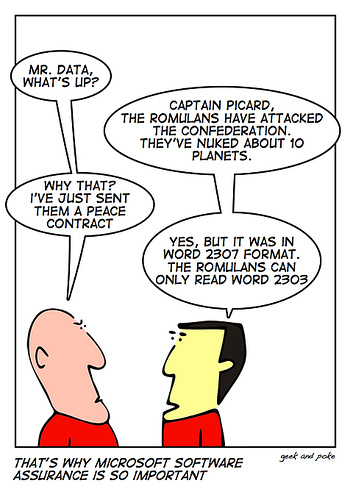
The Romulans attack the Federation for they can’t read the Peace Treaty sent to them in Word 2307 format… they only have Word 2303. A hilarious cartoon by Geek and Poke. Joke? Perhaps … or not.

Yesterday I attended a (so-called) Enterprise 3.0 event hosted by the MIT Club of Northern California. So-called, as nobody really used the term, other than the moderator, Sramana Mitra. The panelists politely put the title on their slides, and then distanced themselves from the concept, Google’s Jonathan Rochelle being most outspoken: “we did not even get to Enterprise 2.0, why 3.0 now?” (Update: read JR’s follow-up post).

That said, it was an interesting event, clearly focused on Software as a Service (SaaS). 3 of the 4 presenters came with PowerPoint decks - kudos to Microsoft’s Cliff Reeves who only had 1 slide. In the spirit of eating one’s own dogfood JR’s “presentation” was a public Google Spreadsheet.

Next came Captain Picard Sramana: her slides suffered the same faith the Federation’s Peace Treaty did: they were created in a different version, and could not be opened on the presenters’s laptop. Host Nicolas Saint-Arnaud made a heroic effort trying to download a converter, but failed, so Sramana could not show her presentation. This happened in a room discussing SaaS where at least two (well, one and a half) online presentation tools were represented: Google’s future presentation app by Jonathan, and the existing Zoho Show by Sridhar. With a Web 2.0 tool, there s no dependency on having the correct software version on your machine, there are no updates, patches (in fact there are, managed behind-the-scenes by the service provider) - your slides (data) are instantly available anywhere, anytime.

I somewhat wonder if this was an intentional ploy on Sramana’s behalf: after all we can talk all we want about the benefits of working on the Web, nothing delivers a punchline as forcefully as a publicly failed download/patch… or the Romulan nukes, for that matter. (Will they still use nukes in the 24th Century?)

(Side-note to anyone delivering presentations: don’t ever try to download and apply an upgrade publicly, on a projection screen. Murphy’s Law will apply)

Update: See Sramana’s Nuggets from the event, including the slides. She says it was not a ploy… (but I may just have given her an idea ;-) )

Tags: , , , , , , , , , , , , , , ,

Enterprise 3.0: Where Is It Headed? - Interesting Panel with the Wrong Title

Bay Area, Collaboration, Enterprise Software, SaaS, Social Networking August 13th, 2007

I’m not a big fan of the whole 2.0 /3.0 theme, but I have to accept the fact that Web 2.0 and related concepts have become commonplace, everyday terms that today we’re taking for granted. Enterprise 2.0, on the other hand is far more debated. Definitions range from loosely saying “Web 2.0 tools in the Enterprise” through Harvard Prof Andrew McAfee’s “Use of emergent social software platforms within companies, or between companies and their partners or customers” to MR Rangaswami’s much broader synergy of a new set of technologies , development models and delivery methods that are used to develop business software and deliver it to users.” Then we have a set of attempts to simply “get to the point”, without long academic debate, like lightweight software, or Meet Charlie, a simple yet effective slideshow that personalizes the story.

One thing there is agreement about is that there is no agreement - in terms of a definition, that is… but that does not prevent us from attending conferences like Enterprise 2.0 or Office 2.0, and more importantly, businesses from embracing Enterprise 2.0 to varying degrees. It is happening, whether we have a “final” definition or not.

However, I really don’t think we’re ready for Enterprise 3.0 - not now, not ever. There are quite a few articles on the subject, but they all come from the same author, Sramana Mitra (except for two old ZDNet articles quoting Shai Agassi and JP Rangaswami). Sramana has certainly “cornered” the market - except there really is no “market” if she’s the only one using the term. Her definition: Enterprise 3.0 = SaaS + EE. What’s EE? Extended Enterprise:

The modern enterprise is no longer one, monolithic organization. Customers, Partners, Suppliers, Outsourcers, Distributors, Resellers, … all kinds of entities extend and expand the boundaries of the enterprise, and make “collaboration” and “sharing” important.

Let’s take some examples. The Salesforce needs to share leads with distributors and resellers. The Product Design team needs to share CAD files with parts suppliers. Customers and Vendors need to share workspace often. Consultants, Contractors, Outsourcers often need to seamlessly participate in the workflow of a project, share files, upload information. All this, across a secure, seamlessly authenticated system.

Sounds familiar? Of course, back in the 90’s this is what we called (Extended) Supply Chain. I’m not sure we need to create another label just yet. But if and when something is so significant that it deserves a new name, let’s get a bit more creative … I’m with fellow Enterprise Irregular Thomas Otter, who humorously ranted:

  • The car isn’t called horse 2.0.
  • The lightbulb isn’t called candle 2.0
  • Fax (Facsimile) isn’t called letter 2.0

If we are so innovative in the 21st century, the least we can do is to think of some new terms that inspire. Think ROBOT, Television, Velcro, Radio, even scuba (Self-Contained Underwater-Breathing Apparatus) … If this stuff is really that innovative then it deserves a proper word.

Back to Sramana and “Enterprise 3.0″: next week she will be moderating a panel discussion of the MIT Club of Northern California, with the ambitious title: Enterprise 3.0: Where Is It Headed?. Excerpt from the event description:

Collaboration, wikis, blogs and social networking are new tools igniting the enterprise market. Service based models are emerging as alternates to desktop software and enterprise servers. In March 2007, Cisco acquired WebEx for $3.2 billion, stepping in with a splash in the enterprise collaboration space. Meanwhile, Google has assembled a whole suite of word processing, presentation, and spreadsheet tools and just acquired Postini, an email management company. Microsoft has been adding collaboration and knowledge management capabilities to its Windows Platform and just announced plans to offer Web-based versions of its applications. Then, there are exciting startups that are offering alternatives.

This panel will explore the impact of Web 2.0 on the prosumer i.e. the individual user in the enterprise and the evolution and integration of office tools, communication and collaboration technologies.

Sounds vintage Enterprise 2.0, if you ask me.smile_wink That said, I think it’s an exciting subject, and they will certainly have a first-rate panel:

  • Tom Cole, General Partner, Trinity Ventures
  • Cliff Reeves, GM, Emerging Business Unit Team, Microsoft
  • Jonathan Rochelle, Product Manager, Google Docs and Spreadsheets
  • Sridhar Vembu, Founder, CEO, Zoho / Adventnet last minute change: the event site now lists Tim Harvey, VP Planning, Webex, Cisco Systems instead of Sridhar Vembu.

Whatever we call it, I plan to be there. If you are reading this blog, chances are you’re also interested in these subjects, so if you happen to be in the Bay Area Wednesday evening, perhaps I’ll see you there. Here’s the registration page. (Warning: the form is way too long, asking for way too much information - vintage 1.0 stylesmile_omg)

Additional reading: Open Gardens, Portals and KM, Anne Zelenka, Luis Suarez, the FASTForward Blog, Read/WriteWeb, Chris Pirillo, Fake Steve Jobs smile_tongue , just to name a few…

Update (8/21): as much as I hate this 2.0-3.0 labeling, I like Don Dodge’s new formula: Web 2.0 = web app + 2 founders + 0 revenue

Tags: , , , , , , , , , , , , , , ,

Socialtext 2.0: Usability vs. Usefulness

Collaboration, Enterprise Software, Personal Productivity, SaaS, Software, Technology October 5th, 2006

Socialtext recently announced version 2.0 of it’s enterprise wiki. The two big news are a completely revamped user interface, aiming to make Socialtext a lot easier to use, and the publication of the REST APIs to support integration and mashup development. For more information watch this screencast by CEO Ross Mayfield, and see this review at TechCrunch.

The revamped UI is a huge deal, and it’s been long overdue. For some background check out Jeff Nolan on the “UI sucks” issue. One may agree or disagree, but as long as there are reviews like this:

I have tried on at least four separate occasions to use and like Socialtext but I can’t…I just can’t use this application.” - well, you definitely know you have a problem.

Interestingly enough Socialtext, the company realizes how important ease of use is, and they are contributing resources to bringing WYSIWYG Wikiwyg editing to Wikipedia. But let’s focus on Socialtext, the product for now.

The new UI is aesthetically pleasing, has nice colors (somewhat reminds me of JotSpot’s blue), but most importantly it’s clean, simple, in short it passes the “blink test“.

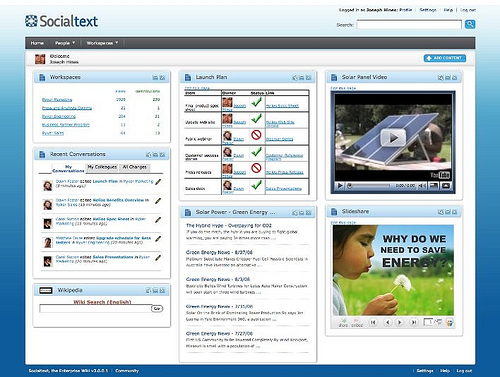
thumbs_up The Home Page is of key importance in the new release: a Dashboard gives users a quick glance of a shared whiteboard, personal notepad, customizable watchlist, a listing of what’s new (i.e. recently changed pages) as well as the users active workspaces (i.e. wikis). The Home page has become the central place where you can access all extended features, like a listing of all pages, files, tags, or change settings. You can start adding information using the New Page button, which, just like the Edit and Comment buttons on all subsequent pages clearly stands out, again, passing the “blink test”. I love the new colored side-boxes for tags, inbound links and attachments.

I can’t emphasize enough how important inbound links (backlinks in the previous releases) are - a wiki is all about associating pieces of information with each other, and the inbound link shows you where the information on the current page is used elsewhere. In wiki systems without this feature on would manually have to create them, a task most often forgotten (as it does not fit the natural flow of creating new pages), thus those systems don’t offer the full potential of a wiki. I can’t for the life of me understand why inbound links haven’t yet made it into the standard feature-set in JotSpot 2.0, when it’s been long (for more than a year) available as a downloadable plugin on the Jot Development wiki - but how many users search the development wiki? In contrast, Atlassian’s Confluence has long supported incoming links.

We know from Ross and others that in creating the new design the primary objective was to increase ease of use, and in doing so Socialtext conducted customer usability studies. The number one customer request was to reduce clutter, which was quite abundant in Socialtext 1.x. They certainly achieved this objective - perhaps too much. Playing around with the beta I run into trouble trying to create a page from an already existing page - I simply did not find the New Page button. “This is something too obvious to be a bug”, I thought, and Ross proved me right: It’s all part of “getting rid of the clutter” and doing what customers had requested.

Socialtext believes this helps eliminate a frequent problem: the existence of orphan pages in wikis. (Orphan pages are valid, existing pages that no inbound hyperlinks point to; thus it’s difficult to find them, other than by searching or listing all pages).

I am not sure binding users to the Home page is a good idea (it’s not just the “new page”button, all other extended features/tools are anchored here). To me the natural flow is typically top-down: one would create a subpage from the parent where the summary level thought flows, thus creating a parent-child relationship. In a business wiki, where after a while you’ll end up having a large number of pages, the further away you are from the right place (the parent), the more likely you will forget to create a link to the new page, thus may end up with a proliferation of orphan pages.

Interestingly enough, the most elegant solution to the orphan problem comes from two products at the opposite end of the spectrum: Wetpaint, the friendliest consumer/community focused wiki (actually a blend of wiki-forum-blog features) and Atlassian’s Confluence, the market-leading enterprise wiki. Other than the standard user-created links within the flow of text, these products also offer an automatic index of subpages along with each page. JotSpot’s 2.0 release offers a less foolproof but reasonable solution: when you create a page by using the “new page” button, technically it becomes an orphan, however when you hit “save”, you’ll find yourself at the parent level where a quick alert pops up proposing to create a link to the child page you just set up.

There’s a fool-proof way of creating new pages that can’t become orphans: create a link before the page, and forget the “new page” button. While typing, wherever you want to branch out to a new page, insert a link to the page about to be created, typically by highlighting text and using the “link” icon, or in JotSpot you have the option of simply typing a WikiWord (also referred to as CamelCase), it becomes a link automatically. This “trick” creates a shell, essentially a placeholder for your new page: you can add content later, but since it’s already linked to, it can’t become orphan. All the wikis I’ve talked about allow this method, but Wetpaint and Confluence don’t really need it, since they provide navigation based on the auto-index of child pages. (Update [2/17/07]: I’ve just discivered a perfect existing term for what I am trying to epxlain here: LinkAsYouThink.)

Back to Socialtext, perhaps there is more to the new design than the desire to create a very simple, clutter-free user experience: the underlying philosophical difference between hierarchical structures, parent-child data relationship vs. everything being flat (created at the home page ) and only associated through links embedded in page text. But hierarchy, structure are not necessarily evil; only pre-existing ones are.

smile_wink We tend to think in structures, need organizing principles - there is a reason why books have a table of contents. Wikis, as unstructured as they are in “virgin state” are a good tool to create structure - our own one. The assumption of a parent-child relationship mimics our usual workflow, and it does not impose a rigid structure, since through through cross-linking we can still have alternate structures, no matter where we create a page.

Perhaps that’s the fundamental difference between Socialtext and the other wikis I’ve mentioned - which would explain why it doesn’t have breadcrumbs (navigational line at the top): this standard feature of all the other three products (Confluence, Wetpaint, Jot) does not really fit in Socialtext’s flat world.

My other issue about with Socialtext 2.0: I really would have expected to see document versioning by now: when you upload an attachment (typically doc, ppt or xls file), Jot and Confluence shows the current version, indicating the most recent version number and the user who changed the document last. Click for details, and you get all previous versions and details. Confluence even allows you to label every instance of the attachment with a comment. Socialtext simply lists all documents with the same title (or not), not recognizing them as version of the same file.

smile_sad

Finally, a minor gripe: it would be nice to see threaded commenting, like Wetpaint and Confluence does, allowing users to enter comments to a page itself or to a previous comment. Socialtext, just like Jot, only has a flat list of comments.

Summing up, the new Socialtext 2.0 Beta is really good-looking, but in my view limits functionality for (perceived) ease of use. That said, it’s a beta, and Ross conformed repeatedly that they are seriously evaluating test user comments and it’s possible that the final 2.0 release will have a better solution for the edit/navigation/orphan problem.

fingerscrossed

Last, but not least, let’s revisit document versioning. It’s very-very important. In my “prior life” where as corporate VP I introduced a wiki-based intranet to the company, we used it for document management first, before exploring more of the native wiki functions. But here’s the catch: document versioning in wikis solves a very old problem, but solves it on the bases on yesterday’s (OK, today’s ) technology. Even with proper versioning one has to download documents, locally update them, then upload them back up to the wiki. The process is a lot easier using Office 2.0 applications, be it an editor, spreadsheet or presentation. There is no uploading/downloading, all updates happen online, if need be by multiple users at the same time, and instead of attaching them, one would simply link to, say a Zoho Sheet or Presentation from the wiki.

My ‘dream setup’ for corporate collaboration: a wiki with an integrated Office 2.0 Suite. The next step will be the wiki integration with ‘traditional’ , transactional enterprise systems - that’s a little further away (although … reading this, who knows?

smile_wink ) I hope to discuss many of these concepts with my readers next week in San Francisco, at the Office 2.0 Conference.

Update (9/5): For more insight read Socialtext 2 Design.

Update (11/1): Usability review on InfoSpaces.

Tags: , , , , , , , , , , , , , , , , , , , , , , ,