post

Microsoft – Adobe: Much Ado About Nothing

There is a lot of fuss about Adobe blocking Microsoft’s plans to incorporate “save to PDF” functionality in Office 2007.

Much Ado About Nothing. Legally Adobe owns the PDF format, but it has long been openly available.

A little known fact: the first company breaking Adobe’s monopoly may have been Intuit, introducing TurboTax print-to-pdf years ago. I’m sure they had a deal for that with Adobe, but I doubt they considered the fact that the PDF driver remains on one’s computer years after Turbotax has been uninstalled, and is quite accessible to any other programs. But that’s history now.

Today any Mac OSX user can save to PDF, OpenOffice creates PDF formats, Zoho Writer (which I recently featured), Writely both do it. And if you’re still stuck in Microsoft-prison, there are a number of free PDF-creators, including my favorite Paperless Printer which can convert almost any application data to PDF, HTML, DOC, Excel, JPEG or BMP including those created with drawing, page-layout, or image-editing programs.

Adobe, it’s gone, let go of it! Be happy to have become the standard, which allows you to charge for extra functionality. End of story.

Tags: , , , , , , , , , ,

post

San Francisco Commuter Nightmare to Begin

If you live in the San Francisco Bay area, and commute to/from the City on the Bay Bridge, I only have one word of advice: use BART.  (hm, that’s two words).  The nightmare begins on the weekend, when the entire lower deck of the bridge will be shut down. That means if you drive to the City, you cannot drive back East. 

But life will not be a whole lot easier even after the reopening: I’ve just heard Channel4 speculate that commuters should “budget in” an extra 45 minutes to their morning commute, due to confusion from the West-bound realignment.  An extra 45 minutes?  As if it wasn’t bad enough already.

Again, the magic word: BART.

Tags: , , , , ,

post

How To Be a Good Panel Audience – or Not

There are there roles in a conference/ panel discussion:

How? You can learn it here, at the Techdirt GreenhouseZbutton No, you don’t really have to be a Bay Area resident. Last time we had participants from Chicago, the UK … come on, it’s fun, and a life-changing experience: you won’t ever want to passively sit in a conference where the panel talks and you listen …or sleep.

Tags: , , , , , , ,

post

Technorati is Dying Again (Still?). White Knight Needed.

(Updated)
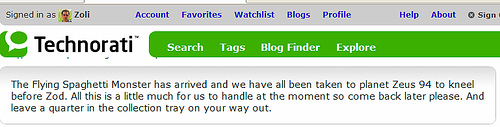
I’ve complained so much about Technorati‘s non-performance, it’s getting boring.  But I can’t help it, this idiotic message is just plain frustrating:

I guess the message itself is a sad indicator: they know they can’t fix the performance problems,  so they innovate where they can: with the error message.   Talk about innovation, there is a strange parallel to my previous Vonage post here: I recognized Vonage as the innovator who created the market, now that the job is done and the Big Boys have arrived, it’s time for them to go.

Isn’t the same true for Technorati?  They definitely have been (still are) innovators of the Blogosphere, but simply could never scale up the handle the ever-growing traffic.  I wish the Yahoo /  Microsoft / whoever rumors a few months ago were true: they badly need a White Knight with enough mu$cle to build out the robust infrastructure the ever-growing Blogosphere needs.

Update (6/4):  Now my blog is not indexed by Technorati at all.  Makes me wonder if I am in the “penalty box” or is it just “Technorati as usual” …

Update (6/4):  I guess I am not in the penalty box, just part of a bigger problem, and, unlike Stefan, I haven’t written 3 emails (just 1), and haven’t been ignored for 17 days.

Tags: , , , , , , , , ,

post

Vonage not giving Customers a Break – Why Should it?

(Updated)
I can’t believe this madness… everyone crying foul, provocative titles like Vonage not giving customers a break create a feeling that somehow Vonage screwed (pardon my French) their customers and somehow should compensate them. That’s Nonsense!

Now, let me just say I called the Vonage IPO a dud several times, first based on fundamentals, then the last straw being the customer-solicitation, that was as bearish an indicator as it gets.

But that has nothing to do with the fact that customers who bought the shares are responsible for their own decision, and can’t expect to be bailed out after the fact. I certainly agree with Jason, Caveat Emptor still applies. The stock market is not for everyone. Jason goes on saying everyone had access to the company’s S-1 filing – well, not everyone can interpret those documents, but in this case there really was no need: all one had to do was do a simple search on Vonage IPO and there was a barrage of highly sceptical articles in plain everyday language. It really must have been difficult not to see any of these warnings. But none if that matters; customer-investors made their own decision and are responsible for it. If they went to Vegas and lost thousands a night, they would not claim their money back, either.

So let’s get some facts straight:

  • Vonage is a technology innovator, they pioneered the VOIP market.
  • They had a chance for an IPO 1.5-2 years ago. Yes, I know the overall market was not favorable, but back then they were the VOIP industry, they had to expect competitors to rain on their parade sooner or later
  • The VOIP market is now being commoditized, they will become a marginal player. Thank you, Vonage, for bringing us this technology, you’ve done your job, now you can go.
  • Stock trading is dangerous to one’s health, the IPO market especially. It’s the Big Boy’s game, little guys get scr***d.
  • Availability of pre-IPO allocation to retail investors is a fool-proof sign that the stock will tank.

On a personal note, I am not pretending to be particularly smart here, I paid heavy tuition when I was stupid enough to actively trade in 1997. In fact back then I seriously considered writing an anti-daytrading book – had blogging been available, it would have been so much easier…

Update (6/2): Jason brought up a really interesting point in his comment below:Let’s say the average customer lost $300-$400 on the IPO (i.e., they got 100 share allocation), and that’s got them angry enough to leave Vonage? Hmmmm…sure doesn’t sound like Vonage is providing a service that customers can’t get elsewhere, does it?

It sure doesn’t , Jason. Now, I’ll be the contrarian again . Just like Vonage’s poor business performance had nothing to do with the fact that investors need to pay up, I don’t think their loss should be linked to continued use of service. Of course it will be, since we tend to be emotional, but c’mon people, let’s learn to make rational, not emotional decisions.
You should judge the usefulness of Vonage service on it’s own merits, and that of the competitors, not on whether you lost money on the stock or not.

The real bad sign for Vonage is that even on it’s own merits I find less and less reason to maintain service. It was great while it lasted, but I barely use my phone now, Skype or VoipStunt is so much more convenient to use. That’s what Vonage should be worried about… not that they can do much about it.
Of course, for Jeffrey Citron Apr

post

Animal Farm, 2006

This is insane, ridiculous, racist, shameful, Orwellian … I am speechless. And I am shocked that it is broadcast on TV, in fact “being considered” by politicians in Washington:

Scott Silverman, Chairman of the Board of VeriChip Corporation, has proposed implanting the company’s RFID tracking tags in immigrant and guest workers. He made the statement on national television earlier this week.

Silverman was being interviewed on “Fox & Friends.” Responding to the Bush administration’s call to know “who is in our country and why they are here,” he proposed using VeriChip RFID implants to register workers at the border, and then verify their identities in the workplace. He added, “We have talked to many people in Washington about using it….”

Related posts:

Update (11/14/07): Read Sheep at Between the Lines.
Tags: , , , , , ,

post

You Know Wikis Have Arrived When ….

You Know Wikis Have Arrived When …. they become the feature post in your regular junk mail – this time from an Executive Recruiter firm:

What in the World is a “Wiki”?

If you don’t know what a Wiki is, you probably should.
The term “Wiki” refers to both a collaborative site on the web or your company’s intranet/extranet and the software that runs the Wiki.

A wiki is a website designed for collaboration. Unlike a traditional website where pages can only be read, in a wiki everyone can edit, update and append pages with new information, all without knowing HTML, simply by using a MS Word type interface.

Wikis are the latest, greatest tool for group collaboration, project teams, document editing, etc. And, best of all, they are easy to use, affordable, and extremely flexible.

The easiest way to learn more is to click on the link at the end of this section of the newsletter and try it for yourself!

What can you do with a wiki?
Whether you’re at work or at home, you can access and use a wiki. The wiki allows free-form collaboration, but most wiki software providers and hosts also offer structured applications that allow you all kinds of very helpful functionality.

Here are some of the things that can be done (depending on whose software you use and what applications may be available:

  • Create an intranet
    Publish company information, such as news or employee guidelines
  • Project management
    Schedule project deadlines, assign tasks, and define product specifications
  • Document collaboration
    Multiple users author documents with aid of version history
  • Manage a group’s activities
    Utilize event calendars, discussion forums, blogs and other apps
  • Collaborate with virtual teams
    Communicate with remote contractors or clients
  • Track software bugs
    Log defects and build custom queries
  • Call center support
    Access case histories and increase customer support

A wiki can be hosted on your company servers or there are a number of hosted versions available. There are a number of suppliers, each touting advantages over their competitors, of course.

One important aspect of a wiki — it is highly cost- effective and versions/solutions range from those for the smallest teams on the most limited budgets scaling up to full enterprise versions.

If you are unfamiliar with this explosive growth phenomenon, you may want to take a look for yourself. [Company name] has found one supplier offering free trials. It’s pretty neat stuff and has become indispensable in our own operations. Click the link below for a free trial.

This is not a [Company name] product but we have used the free trial ourselves and had no problems, no hassles, and no sales calls. It just takes 30 seconds or so to sign up.


For spam, this is actually pretty good. The original letter pointed to the signup page of one particular provider, and of course the sender forgot to disclose the paid referral relationship … So instead of just one, here’s a list of a few wiki providers:

Confluence and Socialtext are both Enterprise Wiki’s , robust, well-supported, targeting corporate customers.
JotSpot is more geared towards smaller businesses and consumers and in fact it’s a mix of a wiki plus a few basic applications.
Central Desktop is a “wiki without the wiki”, more of a full-featured collaboration platform with calendar, task, project ..etc features.
WetPaint blurs the line between wiki, blog and discussion group, providing an amazingly easy to use interface, but it’s currently at beta stage.

The above list is by far not complete, it’s just a few of the top of my head – feel free to contribute in the comments section.


post

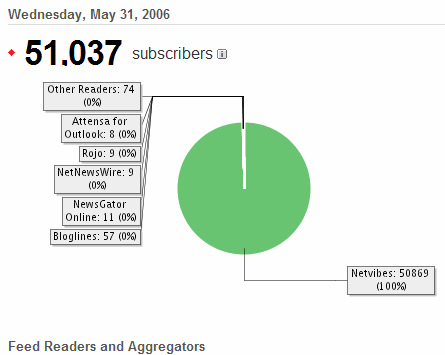
Growing Faster than TechCrunch – Thank You, Netvibes

Don’t worry, dear reader, TechCrunch is still doing OK – their Feedburner subscription base grew almost 100% overnight.  But it pales in comparison to my 2.5million % growth rate … yes, I went from 200 or so to 51k.   Jeff Clavier did quite well, too, at 56k, but hey Jeff, I am catching up!

OK, now that I had my coffee and am awake (?),  let’s look at what really happened. 

The culprit is clearly Netvibes – or to be precise, I don’t know if the error is on the Netvibes or Feedburner side, but clearly the Netvibes numbers are solely responsible for the inflated stats.  The “fluff factor” is not a multiplier, they simply appear to have added a base of 50K or so to all statistics.

Hm… perhaps it’s not a glitch, it’s a “feature”, since NetVibes just installed an upgrade Hey Netvibes (or Feedburner?), I hope I get a “finder’s fee” for pointing this out: when you fix this, could you please leave my base at… say at a tiny 10K bonus level… I promise I won’t tell.

Related posts:

Tags: , , , , ,

post

SaaS for Very Small Businesses – Show Me the Money

Recently, in  SME / SMB Have Become Obsolete Acronyms I discussed how now, that business software and services have become affordably available to small businesses, the SMB term has become inadequate to describe this market, especially from the software industry’s point of view.  Simply because the needs of a $100M company, which SAP and Oracle consider a “small” business are not even comparable to a 6-10 person company – traditionally referred to as SOHO, while recently a new term is popping up: VSB – very small business, the absolute “S” part of SMB.

Innovators in the software business are increasingly focusing on this segment. The result of this change is that “Enterprise Software” is no longer the luxury of large corporations. This might sound like a shocking statement, since “Enterprise Software” typically means the world of SAP and Oracle, and the traditional heavyweight, expensive, pay-huge-license-fees-upfront, then try-to-implement-forever model that does not work anymore.

But there is another definition that is largely being overlooked: 
Software that allows a company to conduct it’s everyday business, supporting most of the core, fairly standard business processes any company performs repeatedly. 

With this definition, Enterprise Software has a whole new, largely unpenetrated market to enter: that of small businesses.   Such business functionality has traditionally been beyond reach for a typical small business, for two major reasons:

  • Cost (license, hardware, implementation, maintenance ..etc)
  • Lack of IT resources (integrating applications, designing processes, dealing with multiple vendors ..etc)

SaaS  is the right answer for both, since it allows the SMB user to start using the functionality without an upfront investment, does not require implementation, upgrades, maintenance, worrying about backups and security ..etc.  

Of course several Open Source packages are available completely free, which is a perfect solution for the cost problem, but frankly most of these packages are by geeks for geeks; i.e. you really have to be quite IT-savy to implement, integrate, upgrade them, and as we stated most small businesses simply do not have that type of resource. 

Stefan Topfer, Winweb‘s Founder and CEO started an excellent mini-series on Saas Benefits  detailing a lot of technical, delivery, usage aspects – now I am going to look at the changed economics from the other side, the software vendors’ point of view.

If SMB’s could not in the past afford Enterprise Software, the same held true for the Software Industry: they could not afford SMB’s, since there was just no way to profitable reach millions of small businesses.   The cost of customer acquisition vs. the very low license fees made it an uneconomical model, whether via direct or channel sales. A common “dirty secret” of the industry is that about 80% of a an enterprise software company’s cost is Sales and Marketing.  There’s a lot of “fat” in that sales process that needs to be cut out.

Once again, technology comes to the rescue: the Internet, and largely Search Engine Marketing changes everything.  Joe Kraus, Founder of JotSpot and previously Excite sums it up:
“ Ten years ago to reach the market, we had to do expensive distribution deals. We advertised on television and radio and print. We spent a crap-load of money. There’s an old adage in television advertising “I know half my money is wasted. Trouble is, I don’t know what half”.  That was us.  It’s an obvious statement to say that search engine marketing changes everything. But the real revolution is the ability to affordably reach small markets. You can know what works and what doesn’t. And, search not only allows niche marketing, it’s global popularity allows mass marketing as well (if you can buy enough keywords). “

Another benefit of SEM (search engine marketing)  is that while traditional advertising can pick the right demographic groups, it cannot pick the right time, only a fraction of the target audience is in “change mode”, looking for  a solution.  That’s the beauty of Search Engine Marketing: obviously if you are searching, you have a problem and are looking for a solution, which is half a win from the vendor’s point of view.

Small Business Trends published a survey on “Selling to Small Businesses”, which supports the increasing importance of SEM: “A full 73% of vendors attract small business customers through search engine results”

Joe has another excellent article worth reading; especially the last two bullet-points are relevant to our discussion here.

What we’re seeing is that the SaaS model changes not only the technology and the delivery of software to customers, but the marketing and sales process, too, which is perhaps where most of the excess “fat” can be cut from.  Software companies can now directly and affordably reach millions of small customers. The entire marketing,  sales, delivery, implementation, support, upgrade process is seamless, highly standardized, conducted via the Net, teleconferencing, Webex-like sharing in new low-cost ways.

So how do software companies make money on small businesses?   Ziff Davis  has the answer:  “Products for the long tail and SMB market, where 72 million businesses spend $5k or less each year, are a much easier play”  Wow, I don’t know where those numbers come from, but if I were a SME-focused software vendor, I’d certainly like them … there’s a goldmine out there. 

AMI Partners confirm:  U.S. SMBs to Spend $2.2 Billion on Software in 2006

(This article, with minor changes is cross-posted at The SME Blog, where I am a guest blogger)

Tags: , , , , , , , , , , , , , , , , ,

post

SVASE VC Breakfast with Diamondhead Ventures – Almost Sold Out

The next  SVASE  VC Breakfast Club meeting is on Thursday, June 1st in Menlo Park – the VC Mecca, Sand Hill Road.  As usual, it’s an informal round-table where up to 10 entrepreneurs get to deliver a pitch, then answer questions and get critiqued by a VC Partner. We’ve had VC’s from Draper Fisher, Hummer Winblad, Kleiner Perkins, Mayfield, Mohr Davidow, Emergence Capital …etc.

Thursday’s featured VC is Raman Khanna, Founding Managing Director, Diamondhead Ventures. The Zvents post  has all the info and a map, and if you plan to attend,  hurry to register   – at the time I’m writing this there are 3 seats left of the 10 maximum.

These sessions are an incredible opportunity for Entrepreneurs, most of whom would probably have a hard time getting through the door to  VC Partners.   Since I’ve been through quite a few of these sessions, both as Entrepreneur and Moderator, let me share a few thoughts:

  • It’s a pressure-free environment, with no Powerpoint presentations, Business Plans…etc,  just casual conversation, but it does not mean you should come unprepared!
  • Bring an Executive Summary, some VC’s like it, others don’t.
  • Follow a structure, don’t just talk freely about what you would like to do, or even worse, spend all your time describing the problem, without addressing what your solution is.
  • Don’t forget “small things” like the Team, Product, Market..etc.
  • It would not hurt to mention how much you are looking for, and how you would use the funds…
  • Write down and practice your pitch, and prepare to deliver a compelling story in 3 minutes.  You will have about 5, but believe me, whatever your practice time was, when you are on the spot, you will likely take twice as long to deliver your story.  The second half of your time-slot is Q&A with the VC.
  • Last, but not least, please be on time!  I am not kidding… some of you know why I even have to  bring this up.

See you on Thursday! Zbutton

Update (5/30):  Here’s a participating Entrepreneur’s feedback about a previous event.

Tags: , , , , , , , ,