Salesforce.com: Is the Glass Half Full or Half Empty?
Marketing / PR, SMB / SME September 4th, 2009

Is Salesforce.com’s glass for SMBs half full (of lemonade) or half empty? I borrowed the lemonade metaphor from Venturebeat’s post announcing Salesforce.com’s new Contact Manager offering for (very) small businesses.
On second thought we should use orange juice as a metaphor – as in disappearing orange juice, by Tropicana which offers less juice in a redesigned pitcher for the same price, and even tries to sell it as a benefit to consumers
Salesforce.com “pulled a Tropicana” with the announcement of their $9 Contact Management edition, and the funny thing is, nobody seems to have noticed it. No, the media duly buys what Salesforce.com PR sells, welcoming the new edition as “giving something back to the little guy” , “breaking through a price barrier”, “making it affordable for SMBs to get in the Cloud”.
Nobody bothered to do some fact-checking, which would have unveiled that in the new Edition is in fact offering less for the same price, a’la Tropicana. Salesforce.com has pulled off a price increase and it went largely unnoticed.
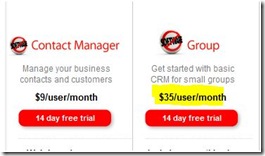
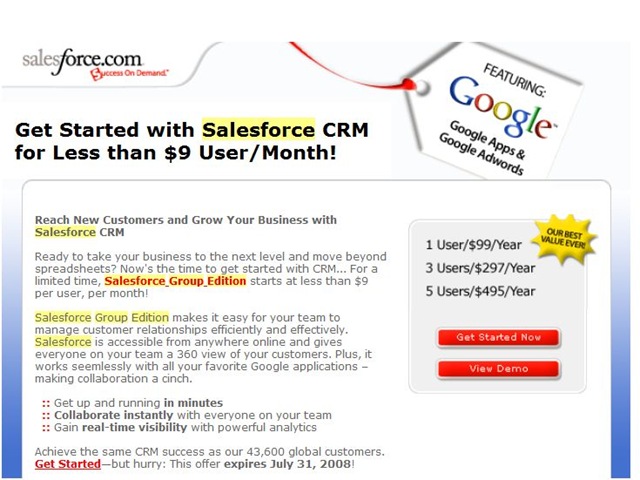
Prior to this announcement the lowest-priced edition of Salesforce CRM, the Group Edition was priced at $9 per user per month, and it is now increased to $35. The few media outlets that noticed this refer to it as temporary promotion for August, that has now expired. Let’s see just how temporary it was: the “promo” started not in August but in June, and not in 2009, but 2008.
This promotion was supposed to expire in July of last year, but it did not – and I correctly predicted it would transition into a permanent price-cut, without much fanfare. Indeed the $9 pricing lasted over a year. And just for the record, prior to dropping the price to $9, CRM Group Edition had cost $20 – so the $35 new price is definitely not just ending a promotion, it’s a price hike of several notches.
But forget history, let’s look at value: having a Contact Manager functionality is certainly useful, although I suspect Google Apps (which is integrated with this Salesforce.com offering) will also offer enhanced Contacts functions. Still, nice – for 2 users only, as that’s the maximum number allowed for this edition. Talk about 2-person companies, let’s remember that Salesforce.com used to offer a free single-user Personal Edition CRM. I’ve just checked my dormant account, it’s still working – but the offering is no longer available for new users.
So let’s see: from free CRM for one user, later $9 CRM up to five users, we’ve gone to $9 Contact Manager for two users. Quite an improvement.
Now if you have 3 users, the lowest entry point to Salesforce.com is now Group Edition at $35 per person = $105 vs. the previous price of $27. And if you have 6 users, you no longer qualify for Group Edition, your entry point now is Professional Edition at $65 per user.
Oh, well. Math lesson over, it’s a nice sunny morning, time for my glass of OJ ( not half full, not half empty – just full.
)
(Disclosure: I’m Editor of CloudAve, a group blog sponsored by Zoho. This article is cross-posted there.)
Tags: contact management, crm, crm price hike, pr, salesforce.com, software pricing, transparency, xref
Startups, Remember: Transparency, Transparency, Transparency
Marketing / PR, Startups January 17th, 2009
- How can people even think of launching a service without revealing the price upfront?
- How can they expect users to go through the hassle of signing up, installing software, only to find the price info after all this?
- Why do people still fall for this?
I’m discussing the above and more using Zumodrive’s launch as case study over @ CloudAve – read the details here.

Tags: box.net, dropbox, live mesh, online storage, pricing, Startups, storage, sync, synchronization, syncplicity, transparency, zumodrive
Zoho Status Displays Availability for All Services – You Can Use it, Too.
SaaS November 11th, 2008
No service is a 100% available, and of course your SaaS provider’s outage always comes in the ‘worst time’, just when you have a deadline to meet… what really gets painful is when you have no information whatsoever on what just happened and how long the outage may be. Major providers like Salesforce.com and Amazon learned the lesson the hard way, and they both released their status dashboards after extended outages and the customer uproar that followed:
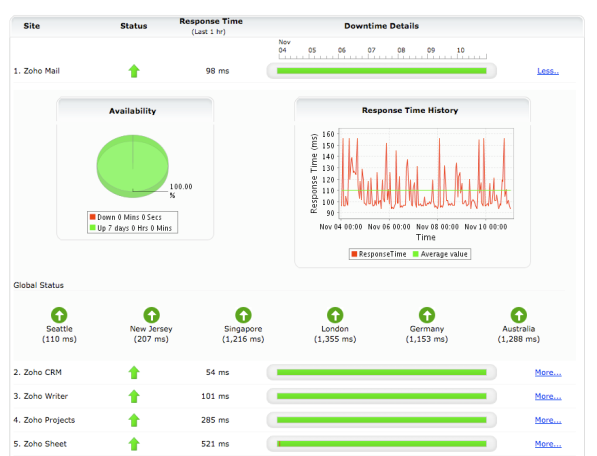
Free services rarely display such level of transparency, but that’s exactly what Zoho is announcing today: they created Zoho Status , a monitoring service which displays the health of all Zoho Applications – currently 24. Here’s a partial screen-print:

If it looks familiar, perhaps you followed my earlier advice on using Zoho’s Site24×7 service on your own site or even blog. I’ve been using it for two years now, and received alerts of outages that neither I nor my service provider were aware of.
Zoho took their own tools and turned it into a public availability display, monitoring their services from six different locations: Seattle, New Jersey, Singapore, London, Germany and Australia. For now the display is rather “boring”, being all green. Obviously we’re all better off if it stays that way and we have no reason to check the status site.
What makes sense, however, is to use Site24×7 on your own site, or on any service you are dependent on (you don’t have to install anything, it’s all external monitoring). As usual, it starts with a free level, adding extra paid services – the new addition today is the Enterprise version, allowing SLA definition, compliance tracking and reporting.
Related articles:
- Questions To Ask Before Trusting a Cloud Vendor
- Zoho Redefines Transparency With Zoho Status
- Zoho and the Cloud Stability Question
- Transparency is catching: Zoho shows status
- Zoho Status – Powered by Site24×7
(This article is cross-posted from for CloudAve, the Zoho-sponsored Cloud-Computing / SaaS / Business Blog I am editing. Subscribe to our feed here.)

Tags: Availability, downtime, monitoring, outage, SaaS, site24x7, sla, status dashboard, transparency, uptime, zoho, zoho status
You Can’t Compare Technorati to Amazon
Customer Service, SaaS, Technology February 15th, 2008
It’s rare that I get into a public debate with a fellow Enterprise Irregular, but today is the day:
Michael Krigsman at ZDNet’s Project Failures cites the stellar response by Technorati as exemplary customer communication at a time of system failure that Amazon should learn from.
True, Amazon did not shine (that’s an understatement) when S3 went down earlier today. I’m sure Amazon will work on not only improving infrastructure, but communication – like Salesforce.com did after their major outage, establishing an Health Monitor, reminds us Lassy Dignan at ZDNet.
True, Technorati was exceptionally forthcoming in that particular incident – but the emphasis is on exceptionally, which is why I would not set them as role model for quite a while. Infrastructure problems have been the constant state of affairs for Technorati for years, the Technorati Monster is still at large, and most of these problems have been swiped under the carpet. In fact when they recently removed old posts from their online index without any notification, they explicitly stated they hoped most users wouldn’t notice.
I salute Technorati on their new approach to transparency, if it holds – but they are very, very far from being a role model.
Tags: amazon, customer communication, S3, service outage, technorati, transparency, web infrastructure
Technorati Deletes Index, Hopes Customers Won’t Notice
Blogging, Customer Service November 5th, 2007
Just two weeks ago Technorati was praised left and right for “returning to their roots”: reinstating charts and the authority filter in search. The most telling title: Technorati Fights Off Irrelevance With Return of Charts.
Today they are back. To irrelevance. ![]()
When I first noticed I could not find posts older than 6 months, I had doubts if I tested enough, and even if I did, was the issue system-wide, and “by design” or just a glitch. Then I got confirmation from Technorati’s Ian Kallen:
We’re in the midst of some economization, performance fixes and retooling that have required taking some data offline. The data is not lost but our priorities are to prefer keeping recent data online. Most people don’t notice
We’ll probably be bringing that data back online but I don’t have an ETA yet.
First of all, thank you, Ian, for responding so fast. Second, it’s a sad post comment: you just condemned Technorati to irrelevance. Your new CEO says:
The core of everything we do is in blog search – without question, we must do that very, very well
Hm… and the first step to providing quality search is to take the index offline… 6 months is not “remote past”, significant events were reported / analyzed by blogs, often better than mainstream media, and now they are nowhere to be found! Here’s the result of a search I performed for background to my next story: Technorati (0 results) and Google (83 results). I can’t use Technorati if it does not remember “yesterday”… and you don’t even have an ETA on restoring the index.
But the worst part isn’t the poor performance It’s the attitude: silently take it offline, hoping “most people don’t notice“. Yuck. In the age of transparency. I’m afraid Dennis Howlett is right:
@Ian: “We’re in the midst of some economization, performance fixes and retooling” – in other words – we’re totally messed up and are trying to figure out what to do next. That would be closer to the truth don’t you think?
Update: Any hopes of users not noticing are up in smoke: it’s on TechCrunch, TechMeme and a bunch of blogs including hyku | blog, TeleRead, Susan Mernit’s Blog, Deep Jive Interests, Data Mining, WinExtra, Kevin Burton’s NEW FeedBlog, and The Last Podcast.
Tags: blog search, Customer Service, Google, google blog search, technorati, transparency
Zoho is mostly known for their Web-based productivity and business software, but sometimes they venture into … hmm…
) 
Zoli Erdos