… is to upgrade to IE9. No kidding:

It’s not even April 1st anymore…
(Cross-posted @ CloudAve » Zoli Erdos)
Connecting the dots ...

… is to upgrade to IE9. No kidding:
It’s not even April 1st anymore…
(Cross-posted @ CloudAve » Zoli Erdos)
 Here’s proof that Governments’ creativity in finding new revenue sources is unlimited, reports The Merc:
The California Legislature is considering a bill that would allow the state to begin researching the use of electronic license plates for vehicles. The move is intended as a moneymaker for a state facing a $19 billion deficit.
The device would mimic a standard license plate when the vehicle is in motion but would switch to digital ads or other messages when it is stopped for more than four seconds, whether in traffic or at a red light. The license plate number would remain visible at all times in some section of the screen.
Note: the bill is not passed yet, and it’s only about a feasibility study. And guess who would fund the research: the company that would make such licence plates, San Francisco-based Smart Plate.
Forgetting all technical details, visibility and driver distraction issues, a few questions that naturally come to mind: just whose car is it? ( yeah, I thought so…) Who gets to decide what ads to display or not, and more importantly, who receives the revenue?
 Of course once the license plate is electronic, new opportunities about – just look at this research by Accenture, the global Consulting firm:
The last point raises the possibility of another arms race, just like what we’ve seen with radar detectors, between those wishing to hack the system to fake/shield their license information and law enforcement…
And here’s the business that would certainly benefit: body shops. Bumper repair prices would sky-rocket, and so would the number of low-speed, bumper-to-bumper accidents. You know, when the driver behind you has the urge to click the ad you’re displaying. 🙂
Oh, well … while you wait for the 2-year research to conclude, you may wish to implement your own solution. (hint: iPad + velcro)
(Cross-posted @ CloudAve)
I guess I should start theme days. Yesterday it was passwords, today it’s a picture is worth a thousand words. Well, this time it’s actually 4 images, but they tell the full story.. no comment required.

New Blog Post: Check Out the NEW NetSuite Compete Site!: check out the new NetSuite compete site for competitive… http://twurl.nl/0h2gyj
OK, I am clicking through.. only to find this:

What’s this? Obstacle course? hm… click through again…

Geez, will this ever end? Click… click..

No way, Jose. I’m so outta here. #FAIL.
Update: On second thought, I think Microsoft must have a penchant for Obstacle Courses – here’s another one.
(Cross-posted @ CloudAve)
 Southern Comfort dumps old media, and pours (pun intended) their entire $8 million media budget on the Net. Let’s hope they’ll spend it smarter then they did on this ad four years ago.
What’s wrong with this banner? Nothing – unless you place it in context. It appeared just days after Hurricane Katrina almost wiped out New Orleans… which gives the words “where anything can happen” a special meaning. And if you think it was just an innocent mistake, read the details here.
Related posts:
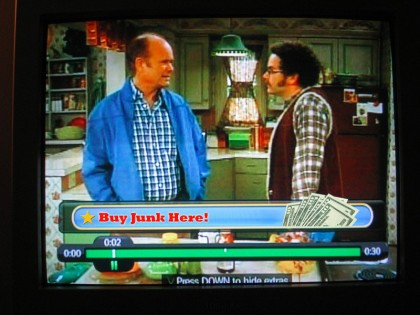
Zat’s Not Funny reports that Tivo is getting ready to push advertisements whenever you hit Pause on your remote.
Using the TiVo Pause Menu, advertisers can, for the first time, reach audiences with targeted product messages displayed within the pause screen of a Live or Timeshifted program. The feature provides an original solution for advertisers seeking to capture the fast-forwarding viewer. It’s another example of how TiVo offers unique and different solutions for advertisers looking to get viewers to watch advertisements.
Another example of offering solutions to whom? Certainly not their customers.
Screenshot from Yahoo Weather this morning:
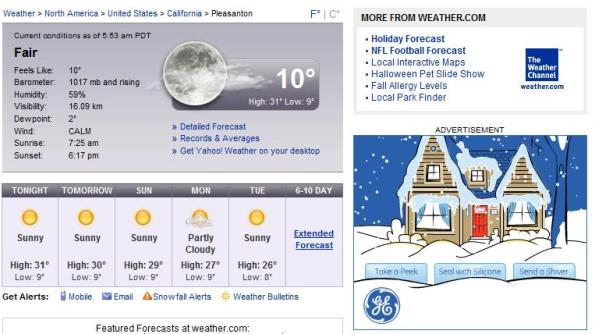
We’re expecting heat today, and Yahoo (weather.com) placed a snowy pic, offering all sorts of winterizing services along with my forecast. I guess it did not notice the weather display was in Celsius, and 31C is about 88F.
For more advertising blunders see:
As they say, a picture is worth a thousand words. Well, this one certainly belongs to the contextual ad blunder series.
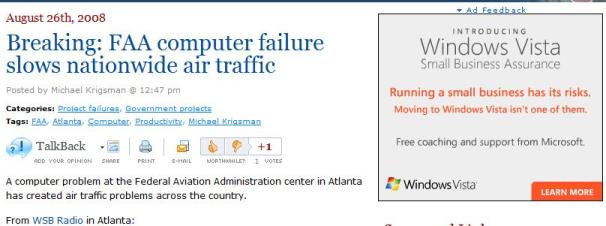
(Source: IT Project Failures)
Additional ad blunders:
Here’s a classic example for stupid “contextual” in-line ads:
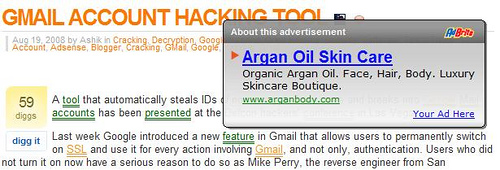
Clicking on the “feature” link in this article brings up skin care products. The “tool” link in the first line points to Honeymoon Planning Services. Here are some more cases of “contextual” advertising gone bad:
But all these mishaps aside, here’s another reason why you should avoid such in-line hypertext ads:
They seriously reduce readability. This article happens to be quite important, so the first thing I’d like to do is click on the link to the Google tool that allows me to protect my account (you should read the original article to understand what’s at stake). But I can’t – the link is hijacked. In fact I can’t even tell if there is any intentional, relevant link in this post. Blogs, wikis, you-name-it: online writing is all about linking and relevancy. But there’s only so many we can deal with: when your article becomes a link-jungle, it becomes impossible to find the meaningful ones, supporting your message.
See also: Ridiculous Advertising – or the Case of the Hijacked link
I often find out what’s happening in the world just be looking at the keyword activity in my blog referral log. Like today, when I received readers looking for news on the earthquake in Japan. This is actually sad, I feel bad for people looking for real info and getting “hijacked” – I am clearly not an earthquake expert, not even an authority on the subject. All I did was point out how Twitter had been the first to report on several quakes in China and Japan, long before the major news-wires, and miraculously (and unfortunately) my post became the #1 hit for the Japan earthquake search on Google for a while, even preceding Japan’s Meteorogical Agency, which should be the ultimate source for such information.
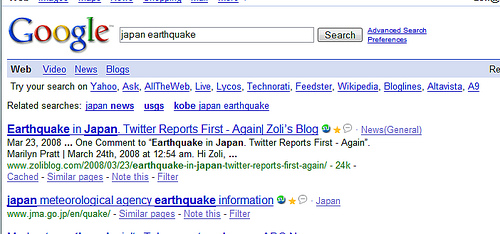
This isn’t anything new, I’ve seen some of my posts get into top Google positions before – but it’s more understandable when I write about a more obscure subject, or a startup nobody else covers… like Brainkeeper, where my post was #1 for months, preceding the company’s own site. Being #2 for the fairly generic search on saas very small business is a bit more surprising, and #1 for Microsoft Outlook Sluggish is certainly rather unexpected. Yahoo, for a change, lists my fairly old post as #1 for the very generic search term Startup Executives, and how on Earth did I get to dominate the igoogle for google apps search? 

Recently I’ve noticed it almost doesn’t matter what I write about, I can get a premium position for certain relevant keywords. As much as I am enjoying it (hey, who doesn’t like Google Juice), there’s something fundamentally wrong with this system. I think blogs are somewhat overrated, and perhaps individual posts should be weighted on their own merits, not the Google Juice of the main blog itself.
But there’s another conclusion we should draw here. Content is really king, to the extent that it can compete with advertising. Businesses should take notice: you can pay for AdWords, or get to the top by developing your own content – and organic hits are worth more than paid ads. 
There’s another side of the coin here: if you don’t develop your own content, someone else will – and you may not be happy with the results. I’m not sure UPS enjoys seeing my post immediately under their site for the google search UPS Tracking…
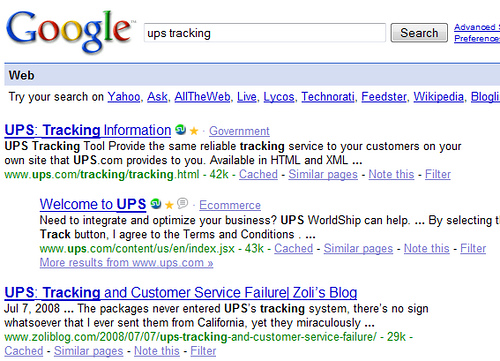
So once again: the old adage “Content is King” has got a new meaning. I’ve been contemplating this for a while, and am getting ready to announce a new initiative in the next few weeks.
That seems to be the Technorati recipe: TechCrunch reports they have a new Sales VP with a 7-person sales team, and a new marketing lead. This build-up was likely in preparation for the new business, Technorati Media, a newly launched blog advertising network.
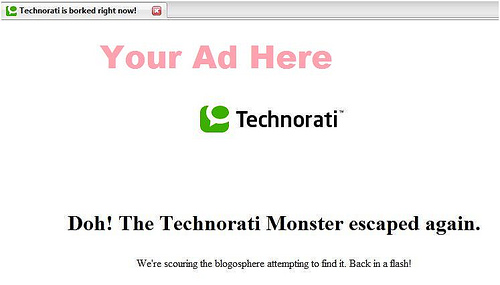
Technorati indeed needs a business model, so if this is it, fine. It’s just frustrating that they’ve spent the past two years in search of business models, while their service gradually fell apart. Anyway, in the spirit of the new-new business, I suggest they sell advertising on the Technorati page we see most frequently:
This was the rant – for details see: CNET News.com, Maple Leaf 2.0, Web Strategy, Trends in the Living Networks, A Media Circus, Andy Beal’s Marketing Pilgrim

Publisher / Editor of CloudAve and Enterprise Irregulars.
I do most of my business blogging there, with occasional asides here. More...
Recent Comments