Zoho CRM Enterprise Edition @ SMB Price

ERP / CRM, Enterprise Software, SMB / SME, SaaS April 16th, 2008

This morning Zoho announced the Enterprise Edition of their CRM product.  The key updates are:

  • Introduction of Role-based Security Administration
    • Profiles for managing CRM module-level permissions
    • Roles for modeling organizational hierarchy and setting up data sharing rules
    • Groups for sharing the data among various departments
    • Field-level security for controlling the access rights (View or Edit) of fields in CRM modules

  • Enhancements in product Customization & Data Administration
  • Multi-language Support (11 Languages)
  • SSL Support for Professional & Enterprise Version
  • Integration with Zoho Sheet
  • Improved Business Functionality
    • Automatically update Stock information once the Purchase Order is approved
    • Find and Merge the duplicate records in Vendors module
    • Convert Quote to Sales Order or Invoice in a single click
    • Convert Sales Order to Invoice in a single click
    • Add account information automatically while creating quotes/orders/invoices from the potentials
  • Wiki-based Context-sensitive Help


    The key in “going enterprise” is no doubt the new security/permissioning scheme. That said, Zoho CRM has already been functionally rich even before today’s upgrade.  I’ve repeatedly stated that supporting business processes like Sales Order Management, Procurement, Inventory Management, Invoicing  Zoho really has a mini-ERP system, under the disguise of the CRM label.smile_wink.  In fact let’s just stop here for a minute. 

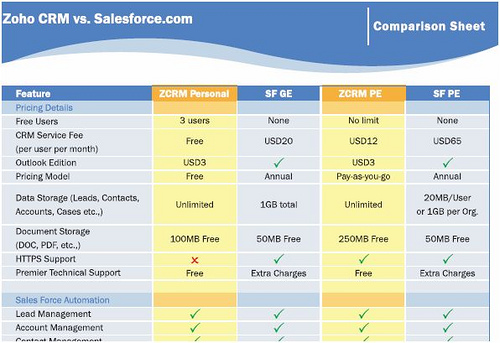
    Today’s announcement aside, I still consider Zoho’s primary focus to be the small business (SMB) market.  As for CRM, it really comes down to the classic breadth vs. depth of functionality question.   Zoho CRM’s breadth, along with the other productivity applications allows many SMB’s to use it as their single, only business application.  The market leader in SaaS CRM, Salesforce.com clearly supports fewer business processes, offering more depth in each - probably a better fit for larger enterprises which likely run several applications anyway.   This matrix provides an overview of Zoho CRM vs. Salesforce CRM Group and Professional Editions. (click on pic for detail)


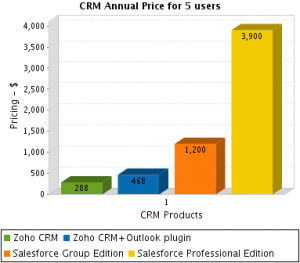
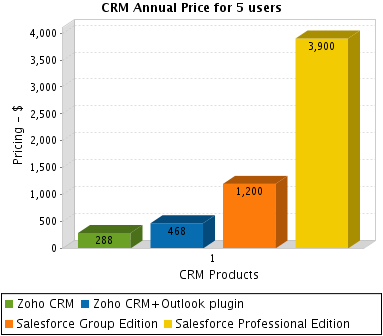
    Having done a functional comparison, a quick look at pricing demonstrates why Zoho CEO Sridhar Vembu called Salesforce.com still very expensive:


    CRM Pricing Comparison - http://sheet.zoho.com 


    No wonder Larry Dignan at ZDNet declares “Zoho aims to poach Salesforce.com customers.”  But Larry (and Marc), you ain’t seen nothing yet… just wait till Zoho comes out with a Salesforce.com importer smile_tongue.   

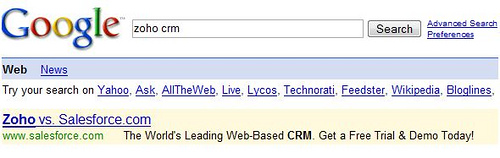
    Clearly, Salesforce.com does keep a close eye on Zoho, otherwise why would they spend money on the Google Adword “Zoho CRM“?


    But again, reality check: Salesforce.com does own the Enterprise space.  For now.

    Finally, a word about integration.  After all, Zoho is known for their almost endless range of products, they should work together…  Currently Zoho Sheet, the spreadsheet application is fully integrated with CRM - most data can be edited either inside CRM or in the spreadsheet format that many business users are more familiar with.

    Zoho plans to integrate Writer, their word processor, Mail (still in private beta) as well as some of the business applications, namely recently released Invoice and People. When all that’s done, Zoho will have a more complete offering than two industry giants, Salesforce.com and Google together.   I can’t wait…


    (Disclaimer: I am an Advisor to Zoho. Take anything I say with a grain of salt.  In fact with a pound of salt.  Don’t believe a single word of mine about Zoho products: go ahead and check them out yourself).


    Related posts:  Zoho Blogs, CenterNetworks, VentureBeat, CNET News.com, Mashable!, Between the Lines, Web Worker Daily, Irregular Enterprise, InformationWeek,


  • Tags: , , , , , , , , ,

    Enterprise Software: from ERP to BRP

    Collaboration, ERP / CRM, Enterprise Software, Startups March 5th, 2008

    I had already spent half a decade implementing SAP solutions in the 90’s when I finally got enlightened, learning the “proper term” for what I was doing: ERP, as in Enterprise Resource Planning. The term was coined by then Gartner Analyst, now Enterprise Irregular Erik Keller. Now another fellow Enterprise Irregular, Sig Rinde introduces a new interpretation of ERP: Easily Repeatable Process. Of course he contrasts that with his new acronym, BRP (not to be confused with BPR, another 90’s favorite), which means Barely Repeatable Process. BRP is what Thingamy, Sig’s lightweight, extremely adoptable system attempts to address. But it’s a very-very tough sell…

    ERP traditionally addresses the core, standard, and as such repeatable business processes. Whatever it can’t handle are the exceptions: processes to be handled by knowledge workers outside the realm of ERP, by traditional means: phone calls, spreadsheets, creative thinking and a lot of emailing back and forth. Exceptions may be a fraction of business volume, but they are what corporate employees spend most of their time resolving. If that’s the case, knowledge workers who come up with innovative solutions may consider it a good practice to document them just in case the “exception” ever occurs again… and if it does a few times, well then it’s no longer an exception, but a (Barely) Repeatable Process.

    Wikis in the Enterprise are a simple yet effective solution to manage such BRPs: they facilitate collaboration of all knowledge workers involved, allow some structure (structure is helpful when not pre-imposed but flexibly created) to organize data and finally, as a by-product they serve as documentation of the solution for future re-use.

    Neither process-driven heavyweight systems like ERP, nor innovative, lightweight collaboration tools like wikis are the one and only mantra for most businesses (see my previous rant on “you can’t run your supply chain on a wiki“), they have their own place and should complement each other. Standard business processes and exceptions are not black-and-white opposites either: it’s a continuum, and halfway is BRP. If ERP (in the traditional meaning) tries to address to many of theses BRPs, it gets overly complex (it already is!), hard to configure and use.

    This is the dilemma Sig’s system, Thingamy addresses. It’s neither free-form collaboration, nor ERP: it’s a business system framework, that allows you to model and define business processes: a tool to create your own custom-made ERP, if you like.

    And therein lies the rub. Most business users don’t want to create software. They want to use it. This was the problem that caused the demise of Teqlo: the unfunded, unproven belief, that users actually want to interactively create their tools. No, they want to deal with the urgent business problems (the BRP), using whatever tools are readily available.

    Thingamy’s dilemma is finding the customer: it certainly won’t be the business user. A modeling tool, simple it may be has a learning curve, dealing with it is a distraction to say the least. Thingamy’s likely “owner” would be corporate IT which would have to create processes on demand. But we all know what happens if you need to call IT to create a “program” for you.smile_omg Thingamy could possibly be a handy tool for consultants, system integrator firms - but they all have their own army of programmers, toolsets..etc, which makes it an awfully hard sell, IMHO.
    Thingamy is no doubt an elegant solution, I just don’t see the mass market need for it, because it does not solve a mass market problem. Or I should say, it does, but there’s a mismatch between whose problems it solves and who can use it. Sig himself defines collaboration as a workaround for the Barely Repeatable Processes in the Enterprise: my bet is that this “workaround” is here to stay for a long time.

    Update (3/18): CIO Magazine interviews Ross Mayfield, Founder and Chairman of Socialtext, an enterprise wiki company:

    Most employees don’t spend their time executing business process. That’s a myth. They spend most of their time handling exceptions to business process.

    … the greatest source of sustainable innovation is how you’re handling these exceptions to business process.

    … So I’ve always looked at it as we’re doing the other half of enterprise software: making this unstructured information transparent.

    Tags: , , , , , , , , , , , ,

    NetBooks: Integrated SaaS Suite for Very Small Businesses. Almost.

    ERP / CRM, SMB / SME, SaaS, Startups February 19th, 2008

    When I started this post 2 months ago, it had a more tongue-in-cheek working title: NetBooks - the Little Gem in Hiding - clearly a play on Dennis Howlett’s  post, NetBooks - a little gem.  That’s because despite Dennis’s positive review of this new SaaS solution for small businesses I found their website a major turn-off .   I did not find a feature-list, screen prints, demos: the closest they had was a contact form to request a scheduled demo.  Failure!  You can’t reach the “long tail” of the market via outbound sales; your site needs to be absolutely transparent, so potential customers can find all feature / price information at their fingertips, then just try-and-buy. 

    But what a difference a few weeks make!  Having checked back, now NetBooks offers decent product information, online videos, in fact you can now set up a free trial account with sample data in minutes.  (While it looks like just another contact form, the process is automated, I received my email confirmation within a minute.) Self-navigation definitely beats just watching vid’s. Kudos to NetBooks for fixing a major shortcoming so fast!  (Note to self: don’t leave half-written posts, they may have a short shelf-life…)

    Let’s look at the actual system now.  NetBooks aims to be an On-Demand integrated business management solution for small manufacturing businesses - in fact for other types of businesses, too, as long as they hold inventory and ship tangible products.  They cater for  what they call True Small Businesses (TSB), which I referred to as  VSB - very small businesses, the “S” in SMB / SME.  Typically companies with less then 25 employees, sometimes only 3-5, and, most importantly, without professional IT support, hence Software as a Service is a life-saver.

    NetBooks tries to cover a complete business cycle, from opportunity through sales, manufacturing, inventory / warehouse management, shipping, billing, accounting - some with more success then others.  Manufacturing, Inventory, Shipping and their integration to Accounting appear to be a stronghold.  If you’re in sales, you’d like to see a Sales Catalog, if you’re in the warehouse, you want an Inventory List, and if you are in manufacturing, you need a Production Elements list: they are all one and the same, allowing you to define a product structure (Bill of Materials, BOM) with different physical characteristics, reorder points, pricing levels, warehousing requirements, marketing notes…etc.   In other words, different functions can update their own slice of the same information and it’s shared with others (of course in a small business several of these functions may very well be carried out by the same person.)

    Not having any procurement / purchasing functions appears to be a glaring omission: after all, if you’re in manufacturing, you will likely need to buy some components / materials. 

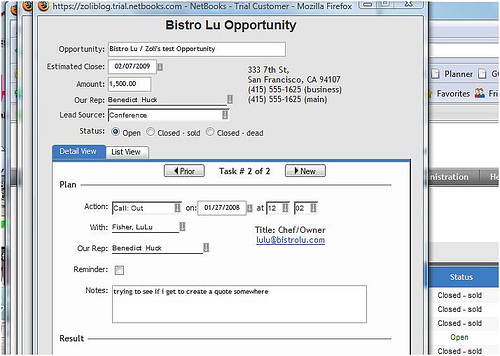
    Another function, nominally present, but rather weak is CRM.  I can set up a Revenue Opportunity list, track contacts, events, even financial terms per record, but what’s the point if I can’t turn these into a Quote, later a Sales Order?  In fact I have to start a sales order from scratch, and it does not update the opportunities: unless you close them out, they will show as prospects long after you shipped the order, invoiced the customer and received payment.

    Sales Order creation appears to be  a watershed event in NetBooks: that’s when the system comes alive, integration gets better from here, with information flowing through nicely.  Completing the order creates a shipping document, confirmation of the shipment creates a a billing request, invoice.  Even external services are integrated well, like UPS for Online Shipping and PayCycle for payroll .  There’s a complete “document trail”, you can start from the accounting side, too: from Accounts Payable (invoice) you can trace all actions back to the shipping doc, sales order…etc.

    I understand why Dennis with his accounting background considered this system a gem:

    As an accountant by training I often make the mistake of taking the number cruncher’s view. On this occasion I don’t have to. The way NetBooks is organized, you enter it according to the role you fulfill. That means you only ever need use the screens that are pertinent to you.

    Real-world people record their real-world transactions: manufacturing, physical movement of goods, and the system records the facts in Accounting.  NetBooks  is an accounting system at it’s heart, but one without the need to deal with accounting screens.  This should not come as a surprise, given Founder Ridgley Evers’s own background: he was co-founder at QuickBooks, the de facto standard for small businesses.

    Most of the sample data in the NetBooks trial system appear to have come from Evers’s real-life business: Davero Ingredienti, a purveyor of olive oil products, and I think this very well represents the type of small business NetBooks may be ideal for: relatively stable, has a good repeat customer base, receives a  lot of inbound orders and needs to execute on manufacturing and shipping to these customers.  It badly lacks stronger Sales features, and a more flow-oriented thinking to support aggressively growing businesses.

    The User Interface is nothing to call home about. You certainly won’t find the lively charts and dashboards seen at Salesforce.com, NetSuite, SugarCRM, Zoho CRM …etc.  But having a simplistic UI is one thing, making it outright boring is another, and hard to use is a capital crime.  In NetBooks you basically navigate through small text lists, then double -click on an item to drill down to more details, wait long (the system, at least the trial one feels very slow) for several overlapping screens to pop up. You have to close or move around some of these pop-ups to see what’s underneath.  And whoever came up with the idea of clicking on those tiny arrows should be banned from web design for life.  


    Seriously, this isn’t just the lack of rounded-corners-gradient-colors web 2.0 goodness: the poor UI, the microscopic arrows to click on render NetBooks a pain to use. 

    Although I’ve been quite critical in this review, I still like the NetBooks concept: give very small businesses an integrated system they previously could not afford. NetBooks starts at $200/month for 5 users, additional users seats are $20.  That’s a fraction of the current “gold standard” in the space, NetSuite - although the step up to NetSuite also brings a wealth of new functionality.  Finally, SAP’s Business ByDesign is worth mentioning: when it becomes widely available, it will be the most function-rich SMB SaaS solution - but their entry point is about where NetBooks’s upper limit is.

    Tags: , , , , , , , , , , , , , , , , , , , , , ,

    SmartTurn: Inventory & Warehouse Management SaaS-style

    ERP / CRM, Enterprise Software, SMB / SME, SaaS, Startups January 23rd, 2008

    Here’s further proof that the Software as a Service (SaaS) model will not be limited to CRM and Accounting: SmartTurn, providers of the first On-Demand Inventory and Warehouse Management System (WMS) announced today its $5M Series A financing led by New Enterprise Associates (NEA) and Emergence Capital Partners.

    I admit the announcement took me by surprise; I have not heard of the company before. A quick look at the Oakland address made me suspicious though, and yes, I was correct: this company is a spin-off of Navis, who are veterans of Warehouse Management systems, from the “old”, i.e. on-premise world. Old-world or not, the Navis team carries the SaaS DNA: a little-known fact is that their CEO, currently Chairman of SmartTurn John Dillon was CEO of Salesforce.com before Founder Marc Benioff took the reins back in 2001. The investors are not exactly new to SaaS either: Emergence Capital were early investors in Salesforce.com, and they specialize on SaaS and nothing else (I believe they are the first Valley VC firm to do so).

    Warehouse Management is an awfully complex area (I know first hand, having lead SAP logistic projects in the 90s), so if SmartTurn is successful, it will truly be a validation of all aspects of “Enterprise Software” being eligible for the On-Demand model.

    There are very few Enterprise SaaS players around, but SAP’s (SAP)new SaaS product, Business ByDesign for the SMB market and NetSuite (N) for small businesses are worth mentioning: they both offer complete, integrated systems, including Inventory and WMS. The opposite of the integrated systems is the best-of-breed approach, in which case one of the most difficult decisions in enterprise systems is where you draw your functional boundaries, and for companies implementing a multi-system scenario what functions are left in which systems, where to cut overlaps. Inventory Management is planning and accounting for your inventory levels; Warehouse Management is the extension of the concept down to physical locations (warehouses, buildings, down to bin levels). SmartTurn appears to support the Procurement and Order Fulfillment processes as well, which, from a logistics point of view are the inflows and outflows to/from your warehouse.

    This is an area worth keeping an eye on and I expect to revisit it once I know more about the company and their customers.

    On a lighter note… $5M to manage the inventory of major businesses vs. $50M to superpoke FaceBook users… am I the only one sensing imbalance here? smile_wink

    Update: No, apparently I am not the only one… Will Price, Managing Partner at Hummer Winblad Venture Partners:

    It way well be that Slide raising $55m from mutual fund companies at $500m+ pre-money will be the “what were we thinking” moment of the current cycle. I think, however, the investor who leads a $4 on $4m Series A in a company with a differentiated technology and a direct tie to hard ROI will feel calm in the storm.

    Tags: , , , , , , , , , , , , , , , , ,

    Enterprise Bloggers, Openness and a Thriving Ecosystem

    Blogging, ERP / CRM, Enterprise Software, Marketing / PR, Social Networking October 21st, 2007

    I started this post a week ago, than canned it, not wanting to be part of the “storm in a teacup“, created by Oracle’s announcement that they would open up their annual OpenWorld conference to bloggers for the first time. The software giant also actively reached out to 30 or so bloggers, including several of my fellow Enterprise Irregulars.

    It appears that most EI’s will not attend, partly since Oracle does not pay for expenses, partly because there is no word about access to Executives. More important than the expense issue was the reasoning:

    “We’re not picking up travel costs or expenses, sorry. This will keep you impartial. If you see me, I’ll give you a pat on the back, how’s that instead?

    Ahhh…the enterprise bloggers must be a bunch of prima donnas, used to getting their full expenses paid at SAP’s annual conference and other events.. SAP “bought them” and they are biased, right? Wrong.

    The reality is that unlike the press and analysts, the group bloggers are often lumped into, may of us are independents or are in small businesses, don’t have corporate expense accounts to lean on, and simply can’t afford to travel to conferences on our own. Even on a fully reimbursed trip, taking 3-4 days off business is a significant sacrifice. Of course that’s the bloggers’ side, why should Oracle care? Whose loss is it anyway?

    What does SAP get for the not-so-negligible travel budget they spend on enterprise bloggers? The one thing they don’t get is bias, “loyal”, positive reviews.
    Fellow irregular and ex-Gartner Vinnie Mirchandani can hardly get more critical, regularly beating up SAP on issues like pricing, maintenance, innovation (or lack of) - yet he is invited back to all SAP events. Fund Manager, former SAP investor and blogger Jason Wood is also a regular at SAP events, which certainly does not prevent him from expressing his doubts / concerns. Dennis Howlett is no exception, and the list could go on.
    SAP’s recent announcement of their new hosted SMB solution, Business ByDesign is another good example. While most of the media reprinted SAP’s press release, you won’t find it anywhere in the “enterprisey” blogs: what you will find instead is independent thinking, analysis (right or wrong) and dialogue. The bloggers’ verdict was generally positive, mostly about the feature set/ technology, but several of us expressed doubt regarding execution: SAP’s market segmentation, potential self-cannibalization, ability to create mobilize a new, agile ecosystem capable to profitably execute in the new high volume/low price model, and help SAP reach their market goals.

    Not exactly paid-off, loyal PR if you ask me… could it be that SAP knows something about the value of dialogue, in fact outright debate? They go the extra mile to provide bloggers with information, engage them actively. Round-table discussions with Hasso Plattner, Henning Kagermann, Leo Apotheker, Peter Zencke (did it all start with Niel’s chance encounter with SAP’s CEO?) and several other executives are highly appreciated, and believe me, it’s not one way PR-style briefing either. James ‘Redmonk” Governor says it best:

    “As I have said before, you can buy my thinking, but you can’t buy my opinion.”"

    At SAP’s Teched 07 Conference James publicly disagreed with Peter Zencke about market segmentation, and the world did not come to an end; in fact the SAP Board Member happily continued the debate at the bloggers chat afterwards. Two weeks after the “incident” James moderated several sessions at Teched Europe, on SAP’s invitation. Don’t we all know companies where such behavior is the sure way to lose access and get yourself uninvited forever?

    Bloggers are critical, opinionated, sometimes right, sometimes wrong, but never dull. But there’s a bigger picture here, other than external communication. I believe it’s not coincidental that the company that understands the power of dialogue has the most thriving online community I’ve seen in enterprise software.

    Two years ago, when the external “Bloggers Corner” program started the SAP Developer Network (SDN) counted close to 600K members - today it’s 900K. It’s younger sibling, the Business Process Expert (BPX) network counts 200 thousand members. Between the two, discounting overlaps, it’s fair to say 1 million members participate in SAP’s online communities. This includes blogs, forums, wikis, videos..etc. SDN+BPX is a thriving support system: over 5,500 issues are posted daily, and the average response time is 20 minutes.

    I think SAP has discovered something unique: they don’t have to give the code away yet they enjoy the benefits of “Open Source-like community“. The highest rated contributors don’t have to look for projects any more, they are in high demand. SAP Ecosystem Becomes a Booming Economy - declares research firm IDC.

    The Ecosystem has become an organic part of how SAP conducts business, and there is no turning back. SAP Executives are quite aware that competitors comb through the SDN / BPX entries daily, and they certainly lose some competitive edge - but there is no other way to “run” the ecosystem. The Genie is out of the bottle, and they don’t want to send him back.

    The role of the ecosystem will become even more important now that SAP is more aggressively pushing into the mid-market. This is a high-volume, low-margin market, sales, deployment, support all different from what SAP traditionally knows. Successful partnering will make or break it, and apparently SAP understands it.

    I’ve come a long way from the original issue of blogger participation at Oracle’s OpenWorld, and not without reason. This issue has sparked a debate, stirred up some emotions, and I don’t want people to think it’s all about greedy (or hungry) bloggers whining about not getting their expenses paid. Nor is it a SAP Good Guy, Oracle Bad Guy issue. Both companies have their own culture and will continue conducting business their own ways.

    I believe Oracle’s first approach to bloggers (late or mistaken as it is) is a welcome move, and it’s good to see they are open to learn and improve:

    “This is new territory for a lot of us, and personally, I’d like to hear a lot more opinions and suggestions before I support one path or another.”

    Some people in Oracle had to fight for this and they should not be given a (verysmile_wink) hard time. I certainly hope the initiative will not get shut down due to the initial negative feedback. I also hope Oracle management will realize how one step leads to another and that openness actually improves business in the long run. I used SAP as the positive example, because that’s the best showcase I know, and they are pioneering in this field - but if you know any other examples for actively embracing community, please share it in comments below.

    Oh, and if you happen to be in the San Francisco Bay Area, by all means, check out Lunch 2.0 @ Oracle tomorrow.

    Update (10/24):  …and not a happy update, for that matter. Just as I praised SAP for “getting” social media, here’s this disturbing post from Steve Mann, VP at SAP’s Global Marketing.  Apparently SAP HR wants him to remove the link to his personal blog from his corporate signature.   I guess I should correct my statement: SAP gets social media … just not everyone, all the time smile_sad

    Technorati Tags: , , , , , , , , , , , , , , , ,

    Yes, the Enterprise Software World Changed Today

    ERP / CRM, Enterprise Software, SaaS September 19th, 2007

    Yesterday I went out on a limb predicting that SAP’s new On-Demand mid-market offering, codenamed A1S will be a game-changer. ZDNet quoted my conclusion:

    My bet is on SAP: they may stumble a number of times, which will effect their quarterly numbers - but in the end, I believe they will succeed. They will become the dominant SaaS player in the mid-market, forcing smaller players like NetSuite down-market. In the next 2-3 years while SAP flexes their On-demand muscles, we’ll see just how pervasive SaaS proves in the large corporate market, and that will determine whether A1S remains a midmarket solution or becomes the foundation of SAP’s forey into that market - their natural home base.

    This was the day before the announcement. This morning my fellow Enterprise Irregulars jokingly asked: “Has the world of Enterprise Software really changed?’ We did not know the answer than, but now we do: Yes. SAP Business ByDesign is really a game changer. Key reasons:

    • Breadth of functionality
    • Fixed, Trasnparent pricing (which, I might add will put the squeeze on Salesforce.com ad NetSuite)
    • All this coming from SAP, the recognized leaders in automating business processes.

    I will soon have more details, but suffice to say the Enterprise Irregulars contingent here came to the same conclusions. Here are the initial reactions:

    ZDnet/Software, Rough Type, Redmonk, Computerworld, WSJ.com, ZDNet/IT Project Failures, The Ponderings of Woodrow, ZDNet/Software as a Service, Between the Lines,

    Photo: the Enterprise Irregulars with Henning Kagermann, SAP CEO. Credit: Prashanth Rai

    Technorati Tags: , , , , , , , , ,

    The World of Enterprise Software Will Change Tomorrow

    ERP / CRM, Enterprise Software, SMB / SME, SaaS September 18th, 2007

    I really would have liked to be at TechCrunch40, temporary HQ of all-things-Web. Instead, I’m in New York, where the world of Enterprise Software will change tomorrow. That’s when SAP will unveil A1S, the new generation SaaS solution for the SMB market. Incidentally, this may be the last time we hear A1S, as SAP is expected to reveal a new name.

    I suspect after Wednesday there will be a lot of talk about the new system’s features, but for now, very few people have actually seen it, and they are all under rock-solid NDA. So for now, just a few preliminary thoughts.

    SaaS and Enterprise Software

    I am a big fan of Software as a Service, have repeatedly written about it, but mostly in the context of the small business or consumers space. My own passion comes from the time when I switched from “sell side” in the SAP business to actually being a customer in a small business (Sales VP, NOT IT type!) and was shocked at the sorry state of infrastructure and systems (more lack of) available to most SMB’s. I became convinced that for small businesses that don’t have IT staff at all, On-Demand solutions are the only way to go.

    Does this mean SaaS is for small businesses only? Not at all. While it’s easy to declare that for small businesses without their own IT resources there is no better option than SaaS, there is no clear “winner” for large corporations. There shouldn’t be. SaaS is not a religion; adopting it should be a business decisions that these organizations have to make individually.

    SAP and SaaS

    On-demand “purists” (the religious types;)) have long criticized SAP for being laggards, taking a half-hearted hybrid approach to SaaS - but why would they do anything else? After all, SaaS is still only 10% of all enterprise software sold, although growing fast. Even if we believe “the future is SaaS” (which is of course unproven, but I happen to believe in it), there is a lot of mileage left in the “old” Enterprise model, and market leaders like SAP have certainly no reason to turn their backs to their huge and profitable customer base. Protection of the legacy market is largely the reason behind the segmentation, i.e. A1S being strictly a small- and midmarket solution - but I don’t believe this segmentation is cast in stone.

    Anyone who saw one of Hasso Plattner’s numerous “new idea” presentations will have to realize he is talking about a lot more than just a new SMB product. Plattner “gets it” and if he does, so will SAP. Clearly, for now the product is slated for the SMB market - new product, new markets - but it also allows SAP to get their feet wet in SaaS, before fully plunging in.

    This also explains what may appear as inconsistency at the low-end of the market (less than 50 employees) where SAP continues to offer Business One, their on-site solution. I fully agree with Dennis , for all the above reasons it’s exactly these businesses that would be better off with SaaS, so perhaps Busiess One should be replaced by A1S. But if SAP considers A1S as a test-bed, eyeing the Enterprise Market, they need a certain minimum organization size, and level of complexity. Complexity, after all, originates in the organization, not the software - but this brings us to the next point.

    So why is it such a Big Deal?

    Believers of the “SaaS Religion” should be happy when a behemoth like SAP throws in it’s weight - and the $400M it expects to spend on marketing A1S. But let’s dispel with a huge misunderstanding here. I literally go nuts when analists (even my fellow Enterprise Irregulars) mention SaaS players like Salesforce.com, Netsuite, Succesfactors, Constant Contact on the same page, as one category. For the purpose of a specific analysis, like Charles did, it makes sense, but please, please, let’s remember, the so-called SaaS market is an artificial aggregation that eventually will make very little sense.

    Companies do not buy software just for the sake of having it: they buy it to solve problems. They need inventory management, order and billing systems.. etc - not simply SaaS, just like in the past they could not care less if their software was delivered on tape, CD or DVD. Yes, I know I am simplifying to a great degree, but remember, It’s all about the functionality, not the delivery method.

    So labeling Salesforce.com the “market leader” is misleading - yes, they are the the largest pure-play SaaS player, but a relative point solution with a fraction of the functionality enterprises need - and the Appexcange / Force.com attempt to become a platform has not changed this picture.

    There is no market leader in On-Demand, complete integrated solutions, because so far no company has offered anything comparable to SAP’s functionality. Granted, I have not seen the system yet, but when SAP puts three tousand developers to work for 3 years, you know you are getting something significant. (In comparison Salesforce.com has less than 200 engineers.)

    It’s all about Execution

    The SaaS model allows for largely simplified business execution: marketing, awareness, “pull model”: instead off direct sales, the customer comes to the vendor, buying solutions on the Net. Consulting, Support all happens online. The reality of this pull-model is still debated, but I think waht’s often forgotten in the debate is that the “pull-efect” really works is the “S” part of SMB, (in fact, VSB), which are typically green-field businesses, often first-timers to transactional business software, without their own processes carved in stone, so they can test, configure and use software “out-of-the-box”. As we discussed, with size comes complexity, and since SAP targets the high-end of SMB, they will face such complexity, and that requires a “hybrid” model.

    So far their Go-to-market strategy appears to be largely based on telesales and leaving support to a network of partners. Where these partners come from: existing All-in-One or Business One partners, or new ones - and if the first, how they will not cannibalize their existing business is a huge question.

    A1S is a big bet for SAP,” said Gartner analyst Dan Sholler. “This has to succeed or they will have a whole host of business challenges ahead of them. No one has ever proven they can sell this type of business technology this way. SAP is betting the profitability of the company that it will be able to do it.

    My bet is on SAP: they may stumble a number of times, which will effect their quarterly numbers - but in the end, I believe they will succeed. They will become the dominant SaaS player in the mid-market, forcing smaller players like NetSuite down-market. In the next 2-3 years while SAP flexes their On-demand muscles, we’ll see just how pervasive SaaS proves in the large corporate market, and that will determine whether A1S remains a midmarket solution or becomes the foundation of SAP’s forey into that market - their natural home base.

    SAP understands New Media

    Last but not least, a word on how SAP “gets it”. Part of Hasso Plattner’s “new idea” sounds like a Web 2.0 pitch: he embraces social networking, wikis, videos. How much, if any of these have made it into the first incarnation of A1S remains to be seen.

    But SAP as a company themselves actively embrace new media. They have the best bloggers’ program, originally started by Jeff Nolan and now enjoying continued support by Michael Prosceno. I’m heading to the Big Show on Wednesday, but first tonight I’ll be in a group of 8 bloggers to meet SAP CEO Henning Kagerman. Two weeks later I will attend SAP TechEd, which, for the first time includes a full Community Day - an event certainly to be popular by bloggers. Oh, and who is the first keynote speaker? Mr. Web 2.0 Tim O’Reilly himself.

    Not exactly dinosaur-like behavor, if you ask me.;-)

    Off now, time to play tourist in Manhattan. And, in the meantime, I’ll be kept more then up-to-date on TechCrunch40 thanks to fellow bloggers on the scene.:-)

    Tags: , , , , , , , , , , ,

    On-demand CRM: Lunch is (Almost) Free

    ERP / CRM, SMB / SME, SaaS July 10th, 2007

    Will Microsoft eat Salesforce.com’s lunch with their freshly announced pricing for hosted CRM? There is a heated debate on the subject, with longtime enterprise software guru Josh Greenbaum declaring that Microsoft is about to eat Salesforce.com’s lunch:

    “2008 promises to be the real year of on-demand CRM: It’s Salesforce.com’s market to lose, and, unless something changes dramatically in their favor, lose it they will.”

    Josh has been bearish on Salesforce.com for a while, declaring it the next Siebel. It’s a bold call, but calling it ahead of the curve, based on fundamentals, going against the trend is what makes a real analyst.

    Salesforce.com does not seem to be worried about their lunch-ticket though:

    “What it looks like is that Microsoft is just marking down an inferior product to what customers are actually paying right now. “

    -says Bruce Francis, vice president of corporate strategy on Tod Bishop’s Blog. Ouch! He goes on:

    “Also, one thing that I haven’t seen is the url where I can sign up for a 30-day trial.”

    Well, I can point to such a URL, albeit not at Microsoft: http://zohocrm.com. (Disclaimer: I’m an advisor to Zoho)

    I’ve long stated that Zoho’s product is actually more than just CRM: with Sales Order Management, Procurement, Inventory Management, Invoicing functionality Zoho seems to have the makings of a CRM+ERP solution, under the disguise of the CRM label. The company also stated they are working on Accounting and HR, they have a database/application Creator, and the best-in-class Office Suite: can you see the Big Picture?

    Now, for the best part: pricing. Microsoft is heralded to undercut Salesforce.com with their $44/$59 per user pricing. That’s still a hefty price, if you ask me - Zoho CRM is free for the first 3 users, then $12 per user. I don’t know who is eating whose lunch, but if you are a business user, $12 bucks for CRM+++ is as close to a free lunch ticket as you can get.smile_regular

    How can Zoho do this? They are passionate about the real meaning of the On-Demand revolution: bringing good quality yet affordable software as a service to the masses. They are an efficient development “machine” and manage to cut out “fat”: Sales expenses, traditionally representing 70-80% of costs in the enterprise software business. We have an ongoing debate in the Enterprise Irregulars on whether this inexpensive “pull” model is hype or reality. The nay-sayers point to Salesforce.com, or the new IPO-hopeful NetSuite: sales costs are sky high, and for all the “no software” revolution Marc Benioff has brought about, he employs a rather traditional enterprise sales staff, a’la Oracle. The key differentiator IMHO is the target market:

    “Salesforce.com is focusing more of its efforts these days on capturing larger enterprise accounts”

    -says Phil Wainewright, and that means traditional, expensive sales. Viral Marketing, demand generation, try-online-then-sign-up works better with the Small Business market, which is what Zoho is focusing on. The Street only seems to value the large corporate market, so it’s understandable that venture funded, IPO-driven or already public companies strive to move up the chain; Zoho is privately owned, and can afford to grow their business as they wish - apparently they see the goldmine waiting to be explored on the SMB market.

    Related posts on TechMeme: eWEEK.com, Enterprise Anti-matter, Software as Services, Steve Clayton, Techdirt , CNET News.com, Microsoft News Tracker ,Zoho Blogs

    Tags: , , , , , , , , , , ,

    Software 2007 - First Impressions, Opening

    Bay Area, Business, ERP / CRM, Enterprise Software, SaaS, Social Networking, Software, Technology May 9th, 2007

    First impressions:

    Registration is smooth, there’s hardly any wait.  Hm.. am I too early… where is the crowd?

     This is growth: the badge is triple the size from last year: it’s actually a little bag, with a zippable compartment to store goodies.  Are we close to dressing up in a badge? :-)

    WiFi: Finally, free WiFi! (Oops, it does not work in the main Conference Hall, where the Opening Keynote is about to start. 

    MR Rangaswami, Opening Speech

    Started this event in 2003,in the middle of the tech depression, still had 1100 participants - today it’s 1900.   Now we’re thriving.  Theme for this conference is Innovation.  Name a few innovative companies: Apple, FedEx, Southwest..etc.  But where’s software? 

    Innovation in software was thought of as product innovation.  Get it out the door, see what customers say.  Industry changed, innovation is more than Product Release.

    McKinsey Innovation Tech Vendor Survey.

    PE funding is now larger than VC funding.   Surveyd 475 customers: 55% believe innovation is on the upswing.  CIO’s expect innovation from “little guys”.  (contrast to recent other survey)

    Share of software expanding withing IT budgets.

    Download two surveys jointly issued with McKinsey:

    Enterprise Software Customer Survey

    State of the Software Industry

    New Sand Hill Index (stock index, obviously public companies)


    Hasso Plattner, SAP

    Innovation, Speed, Success.  Uses blackboard-style slides, with chalked handwriting. Dressed in matching black:-)

    This is good, breaking it out in separate post…


    Software 2007: Plattner to Turn the SAP Mothership Again

    Bay Area, Business, ERP / CRM, Enterprise Software, SMB / SME, SaaS, Social Networking, Software, Technology May 9th, 2007

    Photo Credit: Dan Farber, ZDNet For half an hour or so I felt I was back at University at Software 2007 - in Professor Hasso Plattner’s class. That’s because his keynote was a compressed version of his recent SAPPHIRE 07 speech, which in turn was an “offsite class” for his Stanford students - literally so, he flew the entire class out to Atlanta. To make his point, he used the blackboard-metaphor, with chalked handwriting (and dressed in matching blacksmile_shades).

    I don’t normally enjoy keynotes, but found this one fascinating: it was about a lot more than most in the audience thinks - more on this later…

    The “lecture” was about his New Idea for enterprise software - more than an idea, it started as a side-project about 5 years ago, then about 3 years ago they realized they can’t do it with one codebase.. so it became a completely separate system from SAP’s current business suite. They kept the project secret as long as they could, but this year they started to talk about it: it’s code-named A1S, and currently 3000 people are working on it (For comparison, Salesforce.com has less than 200 engineers). It will be On-Demand, and not a point-solution, but a full-featured, integrated business solution, as one would expect from SAP.

    Some of my raw notes on the key concepts:

    • On-demand: Google, Salesforce.com showed it works. Time now for the whole enterprise to run in the cloud. Very small footprint at customer.
    • New markets: small business customers.
    • Key difference: user-centric design. Iteration, version 7 of user interface already, it will be 8 or 9 before it launches. Every single functions delivered either by browser or smart client. They look 100% identical. Office (MS) client, Mobile, too.
    • Separation of UI, App, Db - physical sep, multiple UI’s for same App. Front ends very specific to industries. Portal based. Company, departmental portal. User roles. Multiple workplaces. In smaller companies users have multiple workplaces. High degree of personalization.
    • Event driven approach. Model based system. Instead of exposing source code, expose the model. Not just documentation, active models. Change system behavior through models. Very different from SAP’s original table-based customization. Completely open to access by/ to other system. 2500+ service interfaces exposed.
    • The future of software design will be driven by community. SDN 750K members, 4000 posts per day. We’ll have hundreds of thousands of apps from the community. Blogs, Wikis, Youtube.
    • In-memory databases. Test: 5years accounting, 36 million line items. 20G in file 1.1G compressed in memory. Any question asked > 1.1sec. There is no relational database anymore. Database can be split over multiple computers. Finally information will be in the user’s fingertips. Google-speed for all Enterprise information. Analytics first, eventually everything in memory.

    For a more organized writeup, I recommend Dan Farber’s excellent summary, and for the full details watch the original SAPPHIRE 07 Keynote (after a bit of salesy intro).

    As it became obvious during the post-keynote private press/blogger discussion, most in the room thought Plattner was talking about the mysterious A1S, SAP’s yet-to-be-seen On-Demand SMB offering - although he made it clear he intentionally never used the A1S moniker. I think what we heard was a lot more - but to understand it, one has understand Hasso Plattner himself. No matter how his formal position changed, the last active SAP Founder has always been the Technology Visionary behind the company - the soul of SAP, it there is such a thing.smile_wink He is not a product-pusher, not a marketer: he sets direction for several years ahead.

    SAP has an existing (legacy) market to protect, and they clearly don’t want the On-Demand product to cannibalize that market. But Plattner knows On-Demand is coming, and I bet the SMB space will be the test-bed to the new system eventually “growing up” to all of SAP’s market segments. Hasso Plattner gets the On-Demand religion, and when he gets a new religion, SAP typically follows. Plattner oversaw two major paradigm changes: the move from mainframe to client/server, which was entirely his baby, and the move to SOA/Netweaver, where he embraced Shai Agassi’s initiatives. The ‘New Idea” will likely be the last time Plattner turns the Mothership around. Next he will need to find “another Shai” to make sure there is a strong tech DNA in SAP’s leadership, as the Sales/Marketing types take over at the helm.

    Tags: , , , , , , , , , , , ,