SaaS is an Ancient Model
Humor, SaaS August 28th, 2008
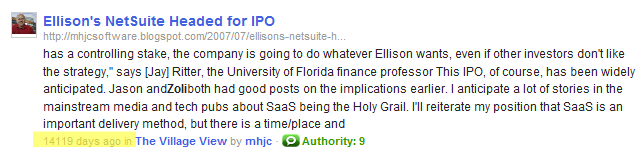
Lots of talk today about how the SaaS market will ‘collapse’ in two years. I don’t get it: if it survived 40 years, why would it collapse now? Yes, that’s right, SaaS has been a successful model for 4 decades now. Need proof? Check out Technorati linking to my post on the NetSuite IPO 11119 days ago. That’s 38 and a half years, give and take a few weeks. 
Oh, well, that was the fun part, for real analysis check out my fellow Enterprise Irregulars:
Jason Corsello, Anshu Sharma, Vinnie Mirchandani, Bob Warfield, Josh Greenbaum.
Tags: cloud computing, lawson, On-Demand, SaaS, Software, technorati, technoratty, ztesttag
I Wanted to Invest in Photobucket, Too
Humor, Startups August 27th, 2008
After all, those greedy Partners who stole this deal from their Limited Partners made a coupla millions each.
What do you mean they didn’t steal it? Oh, their firm, Insight Venture Partners only does late-stage deals and Photobucket did not qualify? Hm.. small detail, who cares? It’s still guaranteed profit, I want in on such deals.
What? Not guaranteed? Are you crazy? Oh, you mean this is what Venture Capital is all about.. you take a risk and invest in a company that could actually be a dud? Oh, boy, now where do I make my safe millions?
And what’s all this fuss about? 
Wall Street Journal, CNET News.com, Silicon Alley Insider, A VC, Valleywag, PE Hub Blog, Technology Live , Startup Chatter, paidcontent.org.
Tags: Humor, photobucket, Startups, vc Funding, venture Capital
FAA Failure – Golden Vista Ad
Humor, Marketing / PR August 26th, 2008
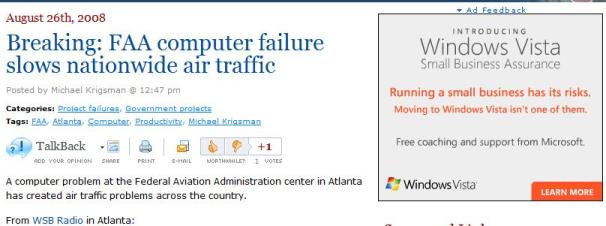
As they say, a picture is worth a thousand words. Well, this one certainly belongs to the contextual ad blunder series.
(Source: IT Project Failures)
Additional ad blunders:
- The Irony of Contextual Advertising
- Contextual Advertising Blunders
- The Scary Thing about Contextual (?) Advertising
Tags: adbrite, adsense, advertising, Adwords, contextual advertising
Office 2.0, a Most Irregular Conference – Get Your Discount Here
Bay Area, Business, Collaboration, Personal Productivity, SaaS, Startups August 25th, 2008

Nothing about the Office 2.0 Conference is even remotely ordinary.
Start with the organizer, Ismael Ghalimi, CEO of a VC-funded startup, Intalio. That’s normally a full-time job – not when it comes to Ismael: he is also a scuba-diving instructor, a pilot, launched Monolab|Workspace, (is that Incubator 2.0?), launched the Extreme Productivity Seminar series, oh, and have I mentioned the annual Office 2.0 Conference? ( I actually know his secret, he has two body doubles, I just haven’t been able to prove it yet
)
Pressed for time he is turning a necessity into a virtue: year by year the Conference is a showcase of creating a successful event out of nothing in only two months. I remember the first event in 2006, when a couple of us Enterprise Irregulars were helping him plan the sessions only weeks away from the start. A few days and a few blog posts later Ismael got flooded with request for sponsor and speaking slots. This year history repeats itself: just a month ago the conference site was a placeholder and one could only wonder if … then a new site was born overnight, based on Jive Software’s excellent ClearSpace platform, and now it’s alive with user participation, sponsors, registration..etc.
What’s a Web-focused Conference without wi-fi? It’s a joke that in 2008 conferences, including brands like Web 2.0, Gnomedex …etc. still fail to provide sufficient connection. Ismael’s solution includes laser beams to the top of the building, another one down to a terrace, then inside – making it happen with Swisscom was quite a project in itself. Office 2.0 set the standard once and for all, anything less at major conferences is a failure.
Then there’s the issue of The Gadget. I believe the iPod at the first conference was just more-then-generous swag. The iPhones handed out at the second conference had an integral part at the event: several applications released specifically for Office 2.0 allowed participants to interact with each other, navigate the schedule and find sessions. This time all paid participants will receive a the HP 2133 Mini-Note PC.

Yes, the conference swag is not pens, stickers or t-shirts: it’s a mini-computer, which cost about half the registration fee. It will clearly raise eyebrows, and many would prefer to skip the gadget and pay reduced fees. I think handing out such an expensive gadget will have an interesting effect on the conference demographic: we’ll likely see an increase of corporate employees, who can expense the entire conference and are less price-sensitive than startups and freelancers – the original Office 2.0 crowd.
But that may very well be what the conference needs. There’s a reason why this year’s theme is Enterprise Adoption. The Office 2.0 movement wouldn’t go very far with only the early pioneers, evangelists talking to themselves, dissmissing enterprise requirements. For the principles to become practice in business, we need a more balanced mix, and in a twisted way the gadget may just help achieve that.
Those who can’t afford the full registration are not entirely locked out: Socialtext CEO and top evangelist Ross Mayfield will facilitate Un-Conference 2.0 the day before the official conference, at a cost of $50.
Finally, startups have a chance to present the attending VCs, media, bloggers at LaunchPad – Ismael announced this event over the weekend, and already has 10 particpants – get in there while you can. Note to my (numerous) VC readers: I hope you will be there, too.
If you’re still hesitating, check out the Agenda, the list of Speakers, Media representatives, and if you haven’t done so, register now.
I’ve saved the best for last: don’t use the standard registration, save $100 by registering here.
Update: while I was typing here, fellow Enterprise Irregular Dennis Howlett explained why this is an Irregular (pun intended) Conference in more than one way. Update to the update: see Susan’s excellent summary.
(cross-posted on the Conference Blog)
Tags: cloud computing, Collaboration, o208, o2con, office 2.0, office 2.0 conference, office2.0, On-Demand, online, productivity, SaaS, web office
Benchmarking the Benchmarkers
SaaS, Startups August 22nd, 2008

I’ve repeatedly praised Web-based Invoicing service FreshBooks for being innovators, unveiling the hidden business model enabled by SaaS: benchmarking. But who’s benchmarking the benchmarkers?
Competitor Xero has just issued a call looking for benchmarking partners comparing metrics like:
- Customer acquisition rates
- Teaming model and allocation of spend
- Sales and marketing spend
- Sales quotas
- Google spend
- Pipeline conversion
CEO Rod Drury is looking for 5-10 partners, communicating either directly, or through a trusted third party. Either way, its quite a challenge, as unlike the aggregate anonymous data Freshbooks provides to their customers, this level of sharing requires quite a level of trust.
Interestingly I contemplated similar ideas just a few days ago when Zoho CEO Sridhar Vembu published his margin analysis of Google, SAP, Oracle, Microsoft and a few others. He drew a conclusion that since Google’s current revenue and profit per employee metrics were much higher than even the best players in the application space, Google has little incentive to move into this space forcefully. (He then followed up with a What’s in it for Zoho? post)
Specific conclusions aside, I thought it would really be interesting to expand this spreadsheet buy including Zoho and comparable companies as well as additional metrics. Needless to say I ran into a similar dilemma that Xero is facing now: these are private companies that don’t typically publish their financial results, to get them participate we would need a relatively larger sample and it would still require a leap of faith.
Rest assured I’ll be watching Xero’s experiment with great interest.
Related posts:
- Benchmarking: No Longer the Hidden Business Model in SaaS
- SaaS Will Never Be the Same – Again
- Freshbooks Launches Benchmarking Service: SaaS Will Never Be the Same
- The “Hidden” Business Model in SaaS: Benchmarking
- SaaS: The Cat is Out of the Bag
Tags: accounting, benchmarking, billing, freshbooks, Google, invoicing, SaaS, xero, zoho
AdBrite = AdDumb. Why You Should Avoid In-line Ads, Whether Contextual or Not.
Blogging August 20th, 2008
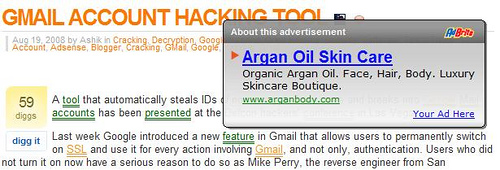
Here’s a classic example for stupid “contextual” in-line ads:

Clicking on the “feature” link in this article brings up skin care products. The “tool” link in the first line points to Honeymoon Planning Services. Here are some more cases of “contextual” advertising gone bad:
- The Irony of Contextual Advertising
- Contextual Advertising Blunders
- The Scary Thing about Contextual (?) Advertising
But all these mishaps aside, here’s another reason why you should avoid such in-line hypertext ads:
They seriously reduce readability. This article happens to be quite important, so the first thing I’d like to do is click on the link to the Google tool that allows me to protect my account (you should read the original article to understand what’s at stake). But I can’t – the link is hijacked. In fact I can’t even tell if there is any intentional, relevant link in this post. Blogs, wikis, you-name-it: online writing is all about linking and relevancy. But there’s only so many we can deal with: when your article becomes a link-jungle, it becomes impossible to find the meaningful ones, supporting your message.
See also: Ridiculous Advertising – or the Case of the Hijacked link
Tags: adbrite, advertising, gmail, Google, hacking, hypertext, in-line ads, security, ssl
The Shortest Windows 7 Wish-list
Software August 19th, 2008
Ed Bott compiled a detailed wish-list for Windows 7. Mine is shorter:
- Call it Vista Final (meaning it works)
- Provide it free of charge to all Vista victims
- Attach a letter of apology from Microsoft
Tags: microsoft, vista, vistasucks, Windows, windows 7, windows vista
Blinded by Vista Sales Numbers
Business, Technology August 18th, 2008
This is one of those rare occasions when I can pull up an old post, dust it off, and voila! – I’m done. Yes, I am lazy – but hey, I can’t help, this is one of those “I’ve told you” moments. Here’s what I wrote last year:
Time for a reality check. Product quality, customer satisfaction and market success have very little to do with each other when you have a monopoly.
The Vista problems are real, they are not fantasies created by bloggers. But how exactly are consumers supposed to revolt? They still need computers, and despite Apple’s respectable growth, they still represent a fraction of the consumer PC market. Try to buy a PC today, it’s hard to NOT end up with Vista (even I got one)
Customer demand for Vista? No, it’s customer demand for computers, in a market with no choice. I’m not “making this up”, Donna. It’s all in Microsoft’s 10-Q:
…Client revenue growth correlates with the growth of purchases of PCs from OEMs that pre-install versions of Windows operating systems because the OEM channel accounts for approximately 80% of total Client revenue. The differences between unit growth rates and revenue growth rates from year to year are affected by changes in the mix of OEM Windows operating systems licensed with premium edition operating systems as a percentage of total …
The increased “demand” for premium versions comes from another well-documented fact, i.e. Microsoft’s new segmentation, castrating Vista Home Basic and essentially making Home Premium the equivalent of XP Home – a hidden price increase, by any measure.
A true measure of “demand” for Vista would be corporate licenses and retail sales, and both are behind. But not for long: eventually, after the release of SP1 corporate IT will give in, too – who wants to be “left behind”, after all.
Today InfoWorld burst the Vista Sales Bubble (if you ask me, there never has been a bubble, but that’s another matter): 35 percent of mainly enterprise-class users “downgrade” their Vista systems to XP.

The numbers speak for themselves, let me just add this: next time you look at Vista Sales figures, remember: these customers did not have the choice to buy XP directly, they had to get Vista on their systems, then “downgrade” (upgrade, if you ask me) to XP. But by then their transaction is booked as a Vista purchase!
Vista sales figures are inflated, these transactions were not real purchases, just ransom paid to the monopolist for the privilege to use the OS that actually works- XP.
Tags: microsoft, microsoft monopoly, oem, vista, vistasucks, windows market share, windows vista, windows xp, xp


Zoli Erdos